

A promising concept has become an extraordinary boat – but does it actually live up to the hype?
Groupe Beneteau is a big deal in the world of boats – about as big as it gets in fact. In addition to the Beneteau and Jeanneau brands, it also owns Lagoon, Prestige and Monte Carlo Yachts, as well as Four Winns, Glastron, Scarab, Wellcraft and Delphia, so it has a tremendous amount of customer data at its fingertips.
The vast majority of that is derived from its proprietary Seanapps remote vessel monitoring system – and it has revealed some interesting truths about its customers’ real-world boating activities.
Apparently, 80% of both power and sail charter guests stay at anchor; 90% use their engines on passage; and while speed is not an issue of any great importance, stability and efficiency very much are. It’s that information that the designers have leveraged in the creation of a boat we first knew as the Beneteau Island Cruising Concept.
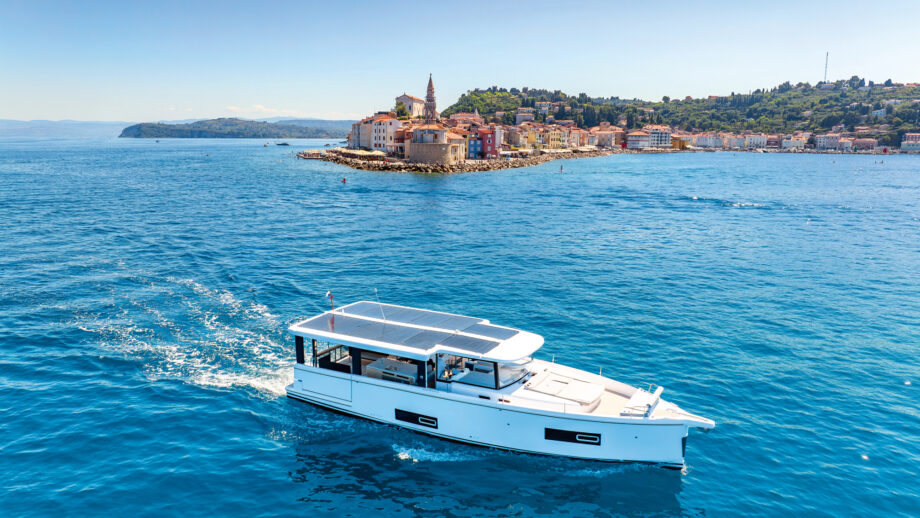
Now in production, it has changed its name to the Jeanneau Sea Loft 480, but as it reverses toward our test pontoon in Cannes, it’s interesting to see that it appears pretty much identical to the original concept; and it’s equally interesting to see that it still resembles a commercial tourist boat.
Given the skipper’s robust response to my observation it seems that Jeanneau strongly disagrees with that assessment but there’s no denying its unconventional hull shape. The bow takes the form of a tapered monohull with a V-shaped foredeck and a vertical stem similar to a modern sailing boat. However, this divides into a pair of catamaran hulls further aft with a tunnel between them and a beam approaching 15ft.
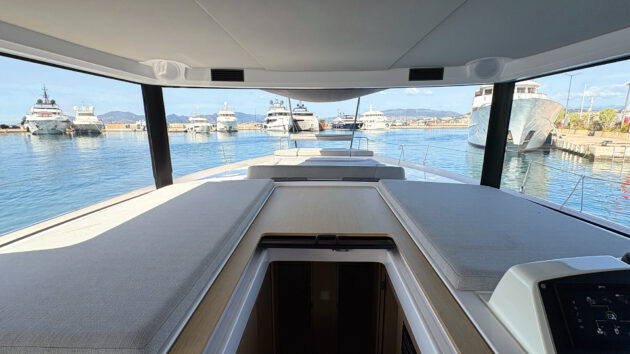
Raised sunbeds ahead of the helm distance the skipper from the screen and generate some useful space below
This unusual hull form is Jeanneau’s attempt to fuse the stability, deck space and running efficiency of a cat with the looks and bow volume of a monohull. But with its long, flat, full-beam roof structure, lined all over with solar panels and significantly raised for headroom, it has the air of a boat built for dayboating parties and sightseeing tours, and there’s really not much to be done about that.
Game-changing day spaces
While you might quibble with the style, the day spaces it creates are extraordinarily strong. The vast open single-level deck takes a sensibly modular approach, enabling you to spec it in pretty much whatever way suits your activities. On the test boat, the centrepiece is a really big island galley with space on all four sides to stroll around and use it as the social hub. To port of this is a freestanding dining table and eight chairs; and at the aft end of the main deck, with big drop-down terraces on either side, is a pair of long settees, which can be rigged to face either in toward each other or out over the water.
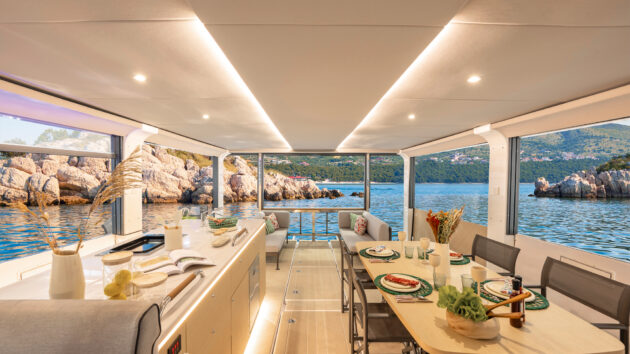
You can ward off the evening chill on the big party deck by simply dropping the automated side curtains
It’s made all the more practical by means of a simple push-button canvas system, which enables you to drop clear plastic window panels down from the roof structure or to use vented shade fabric partitions. They stay nice and taut inside the
window frames and it basically means you can shelter the entire cockpit from the elements without having to fight with zips and poppers and without losing your view.
At the back end of the cockpit deck, the short fixed swim platform is a bit of a non-event on the test boat but plans are underway to make it more accessible and more usable. And in the meantime, the bow space provides another really useful day zone.
Up three steps on either side of the central screen, it uses an island sunbed with a forward bench that looks toward some aft-facing seats in the forepeak. In spite of the taper, you can seat six people up here and there’s even room for a basic but adequate optional crew cabin beneath the bow seats in a space that is otherwise used as a dumping ground for bulky gear like fenders.
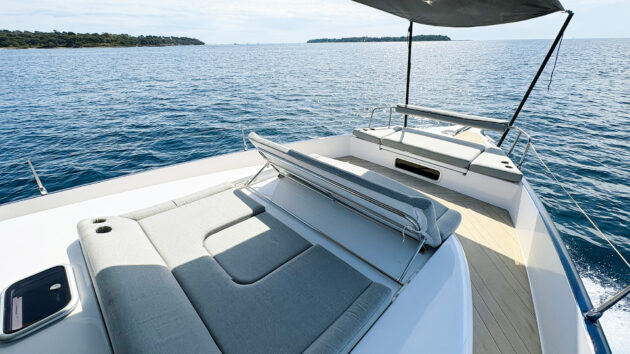
In spite of that monohull taper, there’s some useful breadth in the bow
It’s a cruiser too
Beyond the helm station, the vertical screen is positioned a really good way forward, creating the space for a pair of long fore-and-aft sunbeds, one on either side of the central stairwell. As on plenty of other boats, these are less about the merits of the sunbeds themselves and more about the volume they create down below.
What we have on the test boat then are four very similar ensuite cabins – two enjoying an equal share of the bow space and two more symmetrical cabins further aft, with four all-but identical wetroom-style bathrooms between them. There’s no room to walk around the beds, as the mattresses span the full width of each cabin, but there is decent floor space and headroom at the entry points, plus good hull windows and a fair bit of storage.
This even spread of cabins lends itself very naturally to charter, but you can also trade this test boat layout for the three-cabin arrangement, where the entire bow space is lavished on the owner’s cabin, and that of course will be by far the more popular choice for private owners. But whichever option you choose, you have to concede that, given what this boat delivers up top, the potential to sleep eight people, as well as accommodate up to 18 on deck, is profoundly impressive.
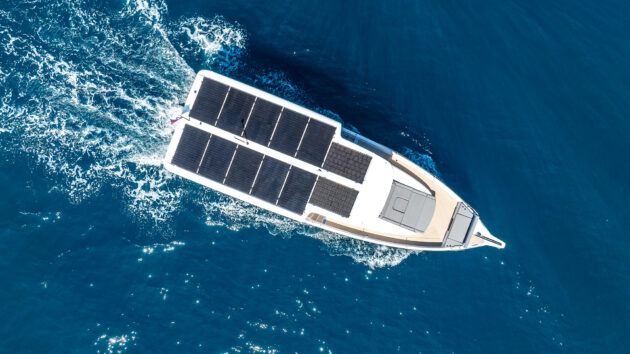
On a sunny day at 4-5 knots, that 4.8kWp solar array will keep you going as long as you like
Easy underway
While the standard boat comes with a pair of Yanmar 45hp diesels, the test boat uses the optional hybrid system. This comprises a pair of 10kW Fischer Panda electric pods hooked up to a 43kWh battery bank (six 7.2kW batteries). There’s also a 22kW generator beneath the centre of the deck next to the skipper, and a 4.8kWp solar array on the rooftop. This means there are three sources for charging the battery bank – solar power, shorepower and generator power. It’s a very intelligent and user-friendly system too…
If you leave it on automatic, the genset will kick in when the battery bank reaches 30% of capacity and ease off again when it reaches 70%. But if you prefer to operate the system manually, safeguards remain in place. At 19% of capacity, the inverter cuts out; at 15%, the power fed to the pods is limited to 65%; and at 9%, the genset automatically activates to preserve the health of your batteries.
As for the noise created by that generator, things could hardly be more refined. At rest, we record 56db(A) at the helm, 57 in the aft cabin and just 46 in the forward cabin, which of course, is potentially the owner’s space. To put that in perspective, that means a level of sound broadly equivalent to moderate rainfall and significantly quieter than normal conversation.
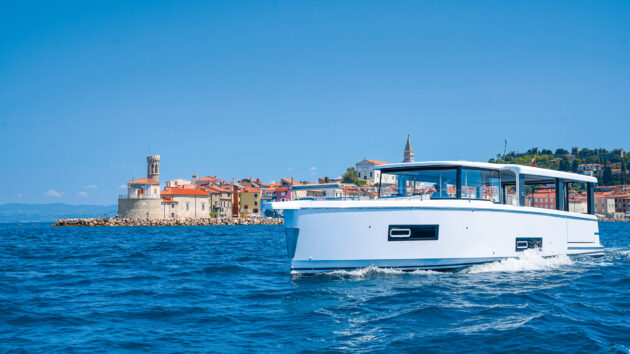
The upright sides, the big roof and the beamy aft end mean it’s not the world’s most beautiful boat
As for outright performance, well it’s by no means rapid.
We found ourselves topping out at 8 knots with much the same attitude, softness and comfort as we experience at 3 knots. Our test day provides nothing but 1ft seas and a F3 breeze so it’s tough to assess how dry the ride is likely to be. But while that considerable taper, those flare-free vertical hull sides and that fine entry do very good things for ride comfort, it’s reasonable to assume that the decks might get a bit wet on a lumpy day. You might also argue that the flat (cat-style) attitude in the turn is steady and dependable rather than diverting, but the range calculations make for much more interesting reading…
The electric motors consume just 500W at 3 knots meaning a theoretical range on battery power alone (allowing 9% in reserve) of 232 miles. That reduces to 131 miles at 4 knots and 73 miles at 5 knots; and it continues its decline to just 27 miles at 8 knots. But of course, once you’ve consumed all the power in the battery bank, you can then fall back on the extra range provided by the 22kW generator hooked up to the same 200-litre diesel tank that supplies the 45hp Yanmars in the non-hybrid variant.
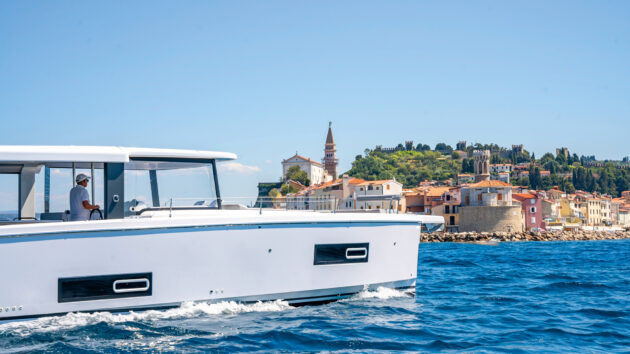
Its stability, low noise and easy tracking are ideal for exploring bays and inlets at low speed
Although official fuel flow figures for that won’t be released until the middle of June, Jeanneau has told us that a speed of 7.5 knots sees a fuel flow of 4 l/hour. Leaving the standard 20% in reserve, that gives you 160 litres or 40 hours of running time, which equates to an additional range of 300 miles.
The Yanmar 45s will apparently achieve much the same figures as the hybrid system but here, of course, the base battery bank range and the extended generator range are also supplemented with a roof-mounted solar array comprising a dozen 400W panels.
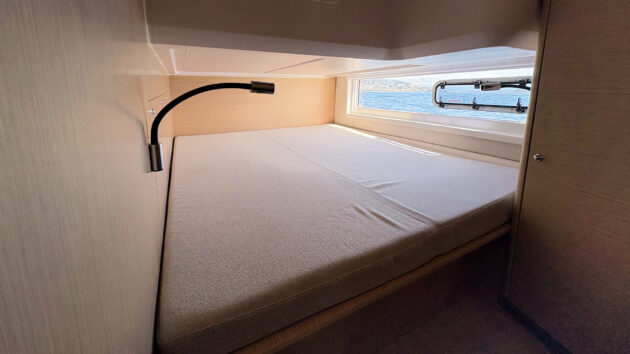
On the four-cabin model, the bow cabins and the mid cabins are remarkably similar
On our test day, which is bright, sunny and blustery, that 4.8kW system was operating at about 50% capacity, which means that, if you’re happy to cruise at less than 5 knots, you can do so pretty much as long as the sun continues to shine. It is, then, by all accounts a very impressive system in terms of its capacity to make quiet, stable, low-cost boating a simple thing to achieve.
Jeanneau Sea Loft 480 specifications
LOA: 48ft 9in (14.85m)
BEAM: 14ft 9in (4.50m)
DRAFT: 1ft 9in (0.53m)
DISPLACEMENT: 10,900kg (light)
FUEL CAPACITY: 200L
WATER CAPACITY: 580L
MOTORS: 2 x 10kW Fischer Panda pods / 22kW generator
Jeanneau Sea Loft 480 costs & options
Price: From €480,000 ex VAT. Test boat includes the following options…
Forward sunshade
Skipper’s cabin
6 x 7.2kWh battery bank
Twin 10kW Fischer Panda pods
22kw generator
Webasto reverse-cycle AC
Verdict
The Sea Loft 480 is a brilliantly courageous piece of work from the Beneteau Group. It would have been so easy to soften its commitment to the results of all that Seanapps data and go for something more conventional and easier to love. But it has stuck to its principles. It wanted to produce something that was stable, spacious and efficient, with a quiet, refined ride and the easiest possible user experience. And it has absolutely achieved that. But in spite of appearances, this is not just a limited use day boat. Spec it with four cabins and it works well for charter companies. Spec it with three and you could happily use it as a holiday home in a Mediterranean marina. And when you want to head out, it lends itself very well to relaxed cruises and lazy days (or nights) at anchor. Of course, with prices from €480,000 (€862,000 for the test boat package) it’s by no means a cheap option, particularly for a brand that is better known for class-leading value. But this is not a boat that actually belongs to any established class. It’s a pioneering step into an arena that directly addresses what real-world boaters do – and therefore what real-world boaters ought to want. Whether those boaters, particularly for private ownership, will be bold enough to recognise that and buy into it remains to be seen. But for sheer clarity of concept and courage of execution, Jeanneau deserves nothing but credit.