

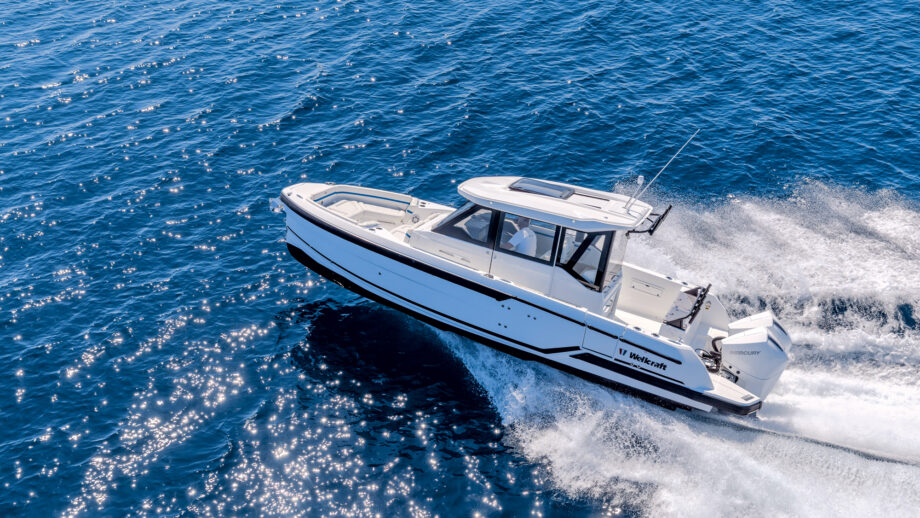
Can you really pack a worthwhile adventure boat into a 28ft package? Alex Smith set off to Cannes to find out…
Modern boaters – particularly those at the lower end in terms of size and value – seem to be putting more value on multi-purpose flexibility than ever before. That’s exactly why the Adventure sector has become such a dynamic and competitive part of the market and that’s exactly why Wellcraft chose to deviate from the offshore sports fishers that had defined its heritage with a fresh line of Explorer boats. ]
We’ve seen the Explorer 38 and Wellcraft Explorer 44 – both potent-looking four-season pilothouse boats with versatile decks, year-round shelter, overnighting cabins and huge wedges of outboard power. And now, in the form of the 28, we have the smallest model yet to attempt that trick.
Layout flexibility
In spite of its compact dimensions, flexibility once again sits at the heart of the Explorer concept. You can opt for the open (Speedster) variant of the Wellcraft 28, as well as the T-Top model. But even if you opt for this pilothouse-equipped platform, as most buyers of this boat surely will, you still get plenty of options for customisation.
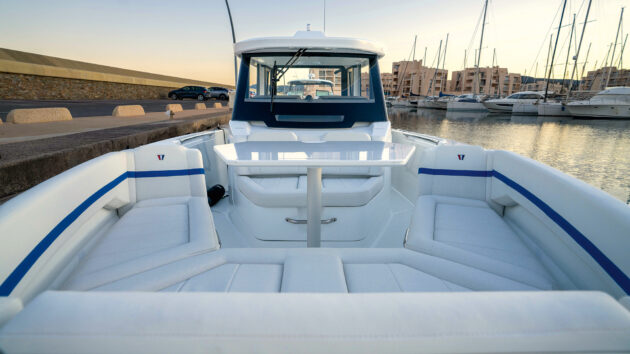
Curved bulwarks provide the support for a pair of forward-facing lounge seats
The cockpit, for instance, can be configured in one of three ways: the test boat’s Barracuda arrangement (with rod holders, fold-up seating, a large live well and a fish box); the Lounge (with an L-shaped dinette and wet bar); and the Sleeper (with a cushion-topped aft cabin, similar to those you might have seen from Axopar and Saxdor). You also get lots of engine options, with everything from a 225hp single rig right up to the twin Mercury 3.4L V6 200s of our test boat.
Given the size constraints at work here, it makes good sense that this boat keeps the pilothouse quite narrow to preserve easy movement along the single-level side decks. That’s supplemented with excellent security for family users thanks to the closed transom and impressively lofty bulwarks. And there’s plenty of quality and practicality to enjoy too.
There’s a port side gate with a dedicated bracket for the ladder. There are some distinctly premium stainless-steel guardrails set into the gunwale recesses. And there are boarding points with tread plates built into the bulwarks amidships. But in spite of this external space and user-friendliness, you still get some very decent furniture inside the pilothouse itself.
A permanent three-man aft bench sits behind a pair of rotating seat pods at the helm. While the helm itself is positioned to port, the dash unit extends right the way across the entire breadth of the superstructure, providing the co-pilot with the same scale of plotter as that enjoyed by the skipper. There’s a big optional sunroof overhead for extra light and air, plus excellent headroom throughout for great views all-round, even in the standing position.
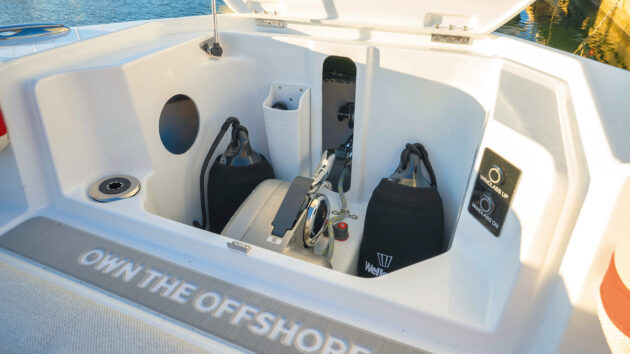
The anchor locker has space for a pair of fenders as well as the windlass
Huge sliding side doors on both sides mean you can get in and out without disturbing the people at the helm seats. And you can also spec the base for the helm seats with a sink, a single-ring gas stove and a slide-out fridge, so as compact wheelhouses go, it does a very impressive job. But for most people, it will be the big beam-forward bow that feels particularly ingenious.
While the aft cockpit is the chief social hub on this boat, the foredeck takes good advantage of the breadth with a really spacious four-sided dining station for five or even six people. It’s reassuringly deep-set for young families and it comes with a recess for a Yeti cool box in the forepeak so you don’t have to head aft for your drinks.
Better still, the forward-facing backrests on the side seats mean you can use it in a more casual, reclining fashion with your feet up; and there’s also decent room for a couple of small fenders in that plumb bow – one on either side of the windlass. But the cleverest part up here is actually hidden away beneath your feet…
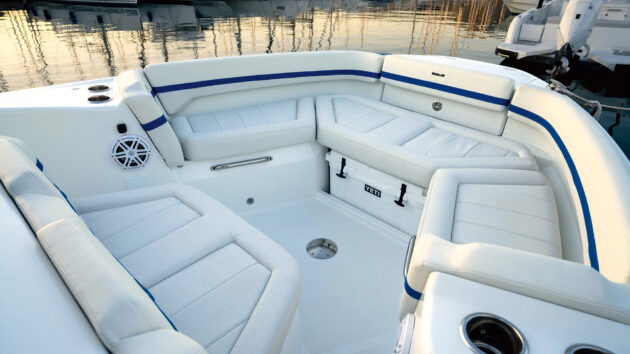
A Yeti coolbox slots neatly under the bow seat
Open up the hatch in the front of the helm console and you find a loo beneath a hinged cushion with a hidden sink to port and a storage space to starboard. Fold down the access steps and drop down the concertina cushion and, in tandem with some extra cushioning that extends forward beneath the bow lounge, you get an entirely usable double bed in less than ten seconds, when nothing of the sort had seemed even remotely possible.
In fairness, if you happen to need a wee in the night, you have to disrupt the head-end of the bed to access the loo – and it’s quite possible your partner will grow weary of that pretty quickly. But given the space constraints at work here, this is a marvellously ingenious overnighting solution. And if you don’t need to use this space as an overnighting cabin, it will also do a top job as a summer changing zone and a storage locker for bulky cruising gear, as well as a heads compartment.
bit of a beasT
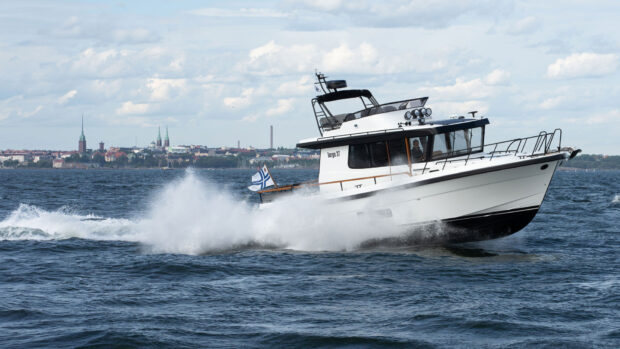
The 28’s twin-stepped hull is the work of Finnish design studio, Navia. What they’re going for is a faster plane, more urgent pick-up, extra efficiency and a drier ride and, as we open up the throttles, every one of those traits makes itself known.
Shift the revs up from 3,000 to 3,500 and the transition makes a huge difference. The pace soars from 15.2 knots to 25.5 with virtually no increase in fuel flow at all. That sees the efficiency increase from 3.5 to just 2.2L per mile – and, as you might expect of a stepped hull, that improves again to just 2.1L per mile at a faster cruise of 32 knots.
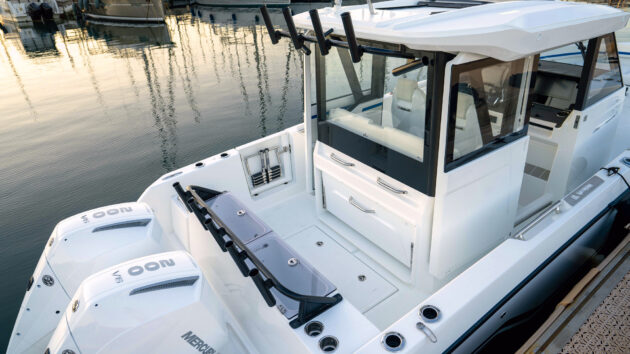
If fishing isn’t your thing, you can replace the live wells of the Barracuda pack with a bench or even an aft cabin
In fact, it’s not until you reach the 38-knot mark that the rate exceeds 2.5L, so the breadth of the cruising band is very generous. And if you want to extend the range, you can do that too, courtesy of a readymade option that increases fuel capacity from 340L to 530L for around 200 miles of autonomy.
Solidity also feels remarkably strong, and so it should. The 28 is constructed using what Wellcraft calls “infujection”, where the hull and stringers are moulded as a single part for a lighter, stronger, stiffer hull, so the quality of the build, as well as the fittings, feels really premium.
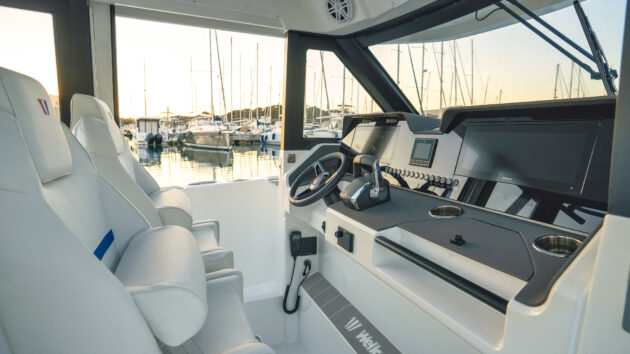
The dash extends right the way across to starboard so the co-pilot stays involved
There are no creaks or rattles at all as we make our way across a seascape stoked into two and three-footers by unrelenting F4 winds. In fact, the only noise we get from this boat, apart from the engines, is an unusual gurgle at rest, as the air funnels its way into those deep-cut hull steps before bubbling its way back out.
As for the vigour of performance that the styling of this boat leads us to expect, there’s certainly plenty of that – enough in fact to hit 50 knots for very brief moments when the waters allow. But with all this power, a choppy sea, a relatively short hull length, three people aft and relatively empty fuel and water tanks, it also feels like a pretty flighty boat.
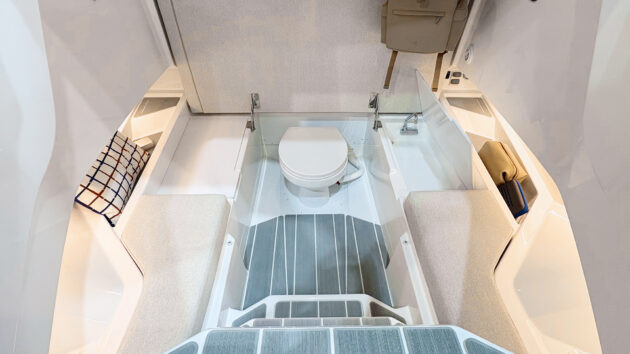
Forward heads
There’s immediate poke under your right hand, very rapid response to trim demands and a sense of relative lightness as we scoot across the swells off Cannes. But if the nature of the conditions and the potency of the boat demand a bit of respect in order to keep the boat low and sidestep the firmer impacts, the dryness of the ride here is impressive, thanks to a bow flare that is way more effective than it looks.
It’s a fun drive too, but given that it reduces the price, the maintenance and the running costs, while also extending the range, optimising the weight distribution and increasing the space at the swim platforms, you would think that, for a lot of regular family users, a single-engine rig might actually be the more tempting option. And the only other issue for consideration is the vent system. It funnels fresh air through gaps beneath the screen and out through four outlets in the dash.
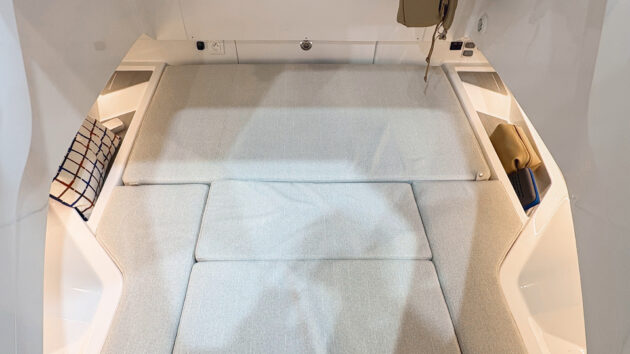
It takes seconds to turn the forward heads compartment into a proper double bed for occasional overnighting
That’s great on a balmy Mediterranean summer’s day but we can find no way to close them, so if you choose to use the 28 Explorer in the dead of winter, as buyers of this boat very well might, you may have to contend with icy 40-knot winds instead.
Wellcraft 28 Explorer specifications:
LOA: 28ft 0in (8.56m)
BEAM: 9ft 6in (2.90m)
DRAFT: 2ft 1in (0.63m)
DISPLACEMENT: 2,857kg (light)
FUEL CAPACITY: 340L
WATER CAPACITY: 50L
ENGINES: Single 225hp to twin 250hp outboards
Wellcraft 28 Explorer costs and options
Price: from €113,600 ex VAT. Test boat includes the following options…
Twin 200hp outboards: €20,300
Manual roof hatch: €1,730
Removable ski pylon: €710
Fore and aft sun awnings: €6,450
Bow table and infill: €810
Bow cabin pack: €4,020
Bow thruster: €2,640
Trim tabs: €1,730
Barracuda pack: €5,080
Verdict
This Wellcraft adventure platform is very much what a compact boat from the Explorer line ought to be. Like the 38 and 44ft models, it’s a great looking boat with plenty of performance, a range of application-driven options and an eye on multi-purpose usability in every aspect of the design. If you’re not a fisherman, it’s better specced with the cockpit lounge; and if you want to use it for overnighting, it’s better specced with the aft cabin so you can keep the bow available for other things. Even then, those in search of a clever inside-outside pilothouse or expandable decks may be left cold by this boat’s relative simplicity. But with its sheltered space, its optional four-berth capacity, its walkaround decks and its broad, accommodating bow lounge, this still feels about as hardworking and versatile as a traditional sporting pilothouse sportsboat could be.