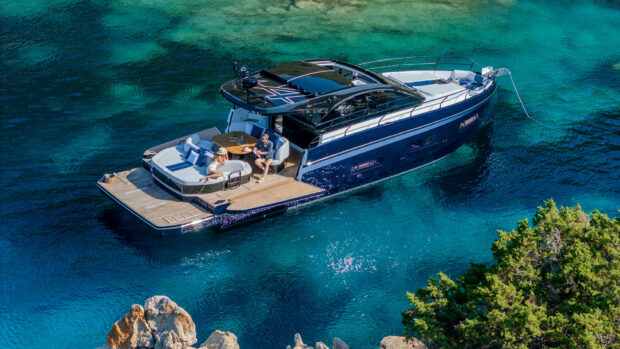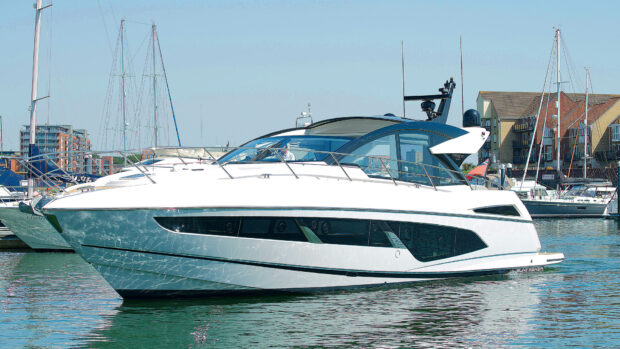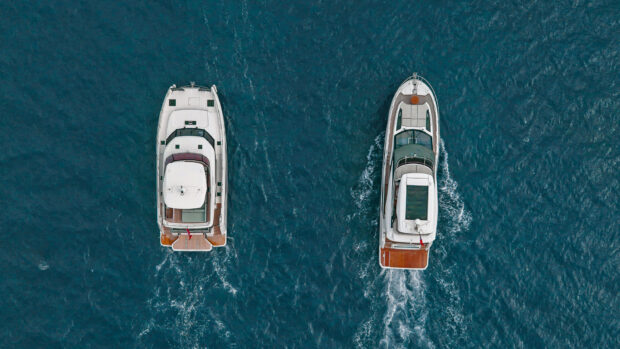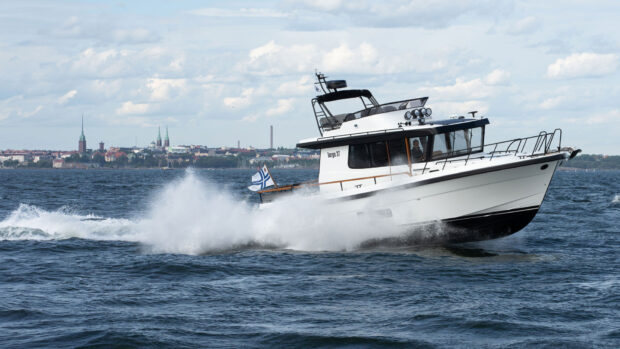


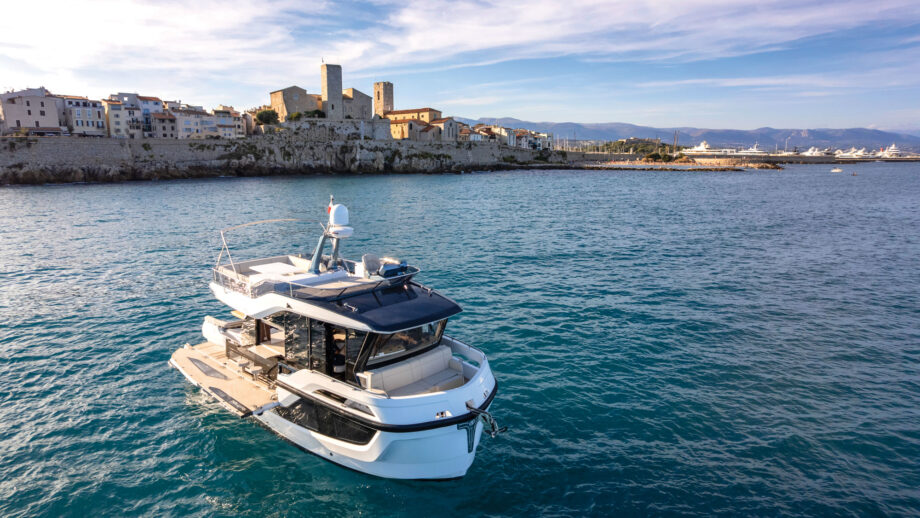
Its squat proportions and blunt bow may not be conventionally attractive but is the radical new Galeon Explorer 430 a beauty on the inside?
What a day that must have been at the Galeon design office. Let’s build a tugboat-style 43-footer that can expand its beam to almost 50% of its length. Let’s shift the pilothouse forward, beef up the aft deck, shorten the foredeck, carry the beam to the bow, fatten up the point of entry and perch a full-width flybridge way up on top. Let’s make that flybridge big enough to grace a 50-footer and let’s compensate for that with single or twin inboard engines on straight shafts.
We’ll then reverse the screen, tint the windows, cover it with every convertible Galeon toy we can think of and start a new line of boats called the Explorer. Anyone up for that?
At most yards, the answer would have been no. At Galeon, the first Explorer model is now very much in production with all its unvarnished design bravado blissfully intact.
Before we reach the internal stuff though, the first thing we need to address are the looks because, as it sits at the Galeon test marina near Gdansk in northern Poland, it still beggars belief that this thing exists.
Fit a beefy gyro and it’s tough to overestimate how much fun you could have with a boat like this at anchor
The rounded bow and the abrupt elevation of the superstructure feel deeply at odds with convention. And yet in a dock full of luxury yachts, it’s the only boat that has you sidling over for a closer look.
That’s when you notice that, quite apart from the innate charm of an unusually quirky thing (think the Citroen Dyane or original Renault 4), this is a boat that provides much more than just volume.
Space manipulation
The first trick is an asymmetrical wheelhouse that extends the full way to the bulwark on the port side but leaves a permanent walkway to starboard. That increases the space available in the saloon but twin side doors at the front of the superstructure mean you still get access to the bow via the shortened port side deck, as well as the permanent starboard one.
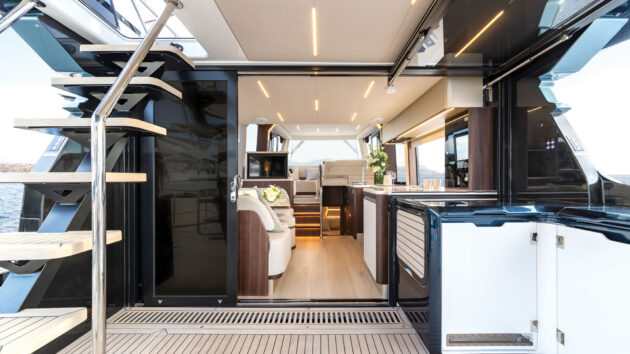
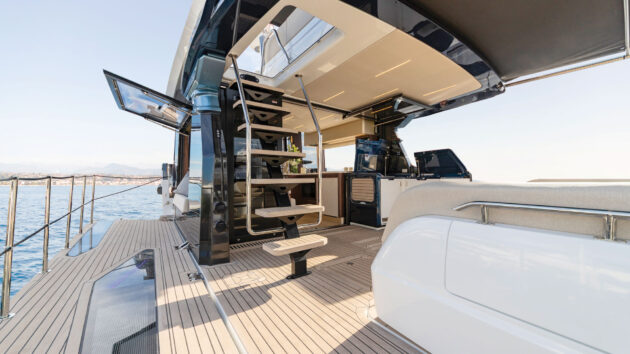
The flow is very strong, thanks to a hinge-up window, a sliding door, a single-level deck and a wetbar that adjoins the internal galley
You also get enormously long drop-down bulwarks on both sides that take up over half the boat’s length. Even without them, the 14ft 10in beam encompasses more than 32% of the LOA but when you drop them into place, you get nearly seven extra feet to play with.
The way the furniture has been designed makes great use of that too. The starboard galley uses a fold-out bar, allied to a secondary fold-up worktop on the outside of the superstructure so you can mount four stools in the deck without blocking the movement of passengers. And on the other side, the port dinette’s peripheral settee uses a reversing backrest and a lifting window to create an inside-outside lounge that faces directly out to sea.
As for the big aft cockpit, the forward superstructure certainly gives it plenty of space to play with and the drop-down bulwarks make it very simple to expand but it’s cleverly conceived in other ways too. It comes with a pair of side gates neatly engineered into the folding bulwarks for easy access to the dock, plus integrated glass panels for views of the water.
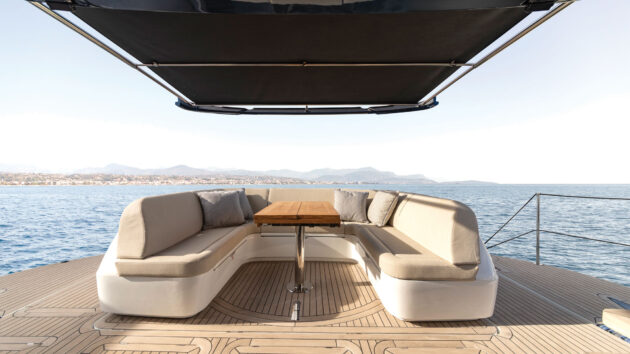
Opting for the rotating dinette makes the most of the 430 EXP’s extraordinary aft deck
The fact that the terraces are so wide means that, when they’re in the raised position, they provide outstanding security too. And the rotating dinette in the centre of the deck is also superb.
You can face it forward toward the wide-open aperture leading into the saloon or you can face it aft over the high-low swim platform. The table also drops low so you can convert it into a sunbed and, as long as you alternate the direction of rotation as you spin it back and forth, you can spec this excellent dinette with an electric drop-down table too.
There are handy transom gates built into the side of the seating unit, and the high-low swim platform is also thoughtfully designed. It comes with an integrated ladder to connect it to the port side deck when you drop the platform into the water – and if you don’t want your tender on display, there’s also a decent bit of space beneath the dinette so you can hinge the entire unit up and tuck it away.
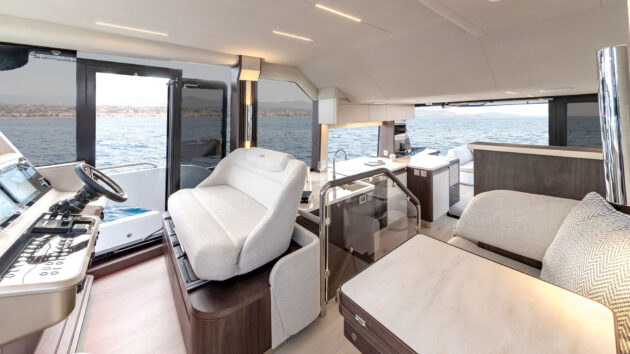
While the lower saloon opens up on both sides, the upper saloon’s twin side doors provide great access to the bow
The bow is less impressive of course, because it’s been used as the sacrificial zone for all the good stuff that goes on further aft. In fact, it’s so short that it would be all but pointless on any other boat but on the 430, the beam is taken so far forward that there’s plenty of room for four people to perch on the bench seat beneath the reverse screen.
There’s not enough space for any aft-facing seat pods or a table so you can’t turn it into a mini lounge without obstructing the walkway, but there is enough room to stow your poles and canvases so you can shelter this bonus seating zone from the sun.
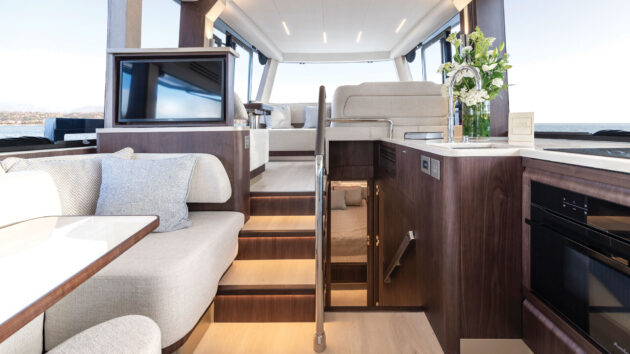
A raised forward saloon creates the space for the 430’s very practical choice of cabin layouts
A pair of cabin layouts
It’s clear then that these deck layouts revolve around the generation of space for the aft deck and the creation of breadth inside the superstructure. But they’re also designed to create sufficient volume in the bow for a pair of very practical cabin layouts and that space generation all begins with the main deck.
It sees the saloon divided in two, with a lower aft galley and lounge behind a forward lounge and helm, which is substantially elevated with no fewer than three deep steps dividing the two sections.
In order to retain headroom on the main deck (a job this boat does extremely well), the flybridge then adopts a similar approach, with a low-level aft lounge leading up another big step to a raised helm with a large sociable sunpad further forward.
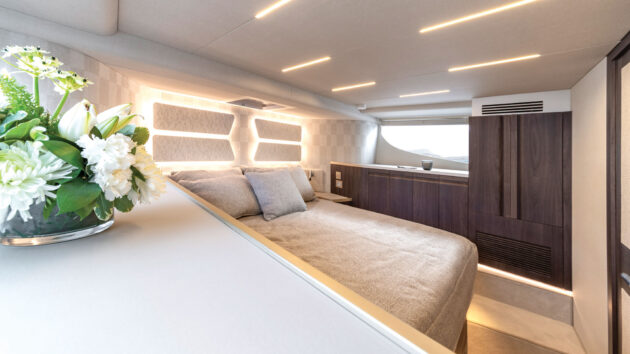
Both natural and artificial light are beautifully managed in the owner’s bow cabin
That does inevitably lift the profile of the 430 far more than you might expect of a boat at this length and, notwithstanding the integration of some cool-looking angles in the hull and topsides, that’s not something the 430 can hide. But when you step down below, the benefits of that are quite clear…
On the test boat, you get an owner’s cabin in the bright lofty bow space and a guest double further aft on the port side. The starboard side is dominated by a good size of heads compartment with separate shower and direct access from the bow cabin. There’s also a large storage and utility room accessed through a door at the back end of the guest double.
There’s just a washing machine in here but there’s lots of room for the storage of bulky cruising gear and it’s so well proportioned that you could easily use it as a huge walk-in wardrobe.
The alternative layout replaces this arrangement with a symmetrical design that divides the space between two identical ensuite cabins, each with a transverse double aft and a bathroom forward. That does mean you have to do away with the utility room but with good space in the engine bay, plus the option of a single-engine rig and big and small storage lockers elsewhere, it’s arguably not a feature you really need.
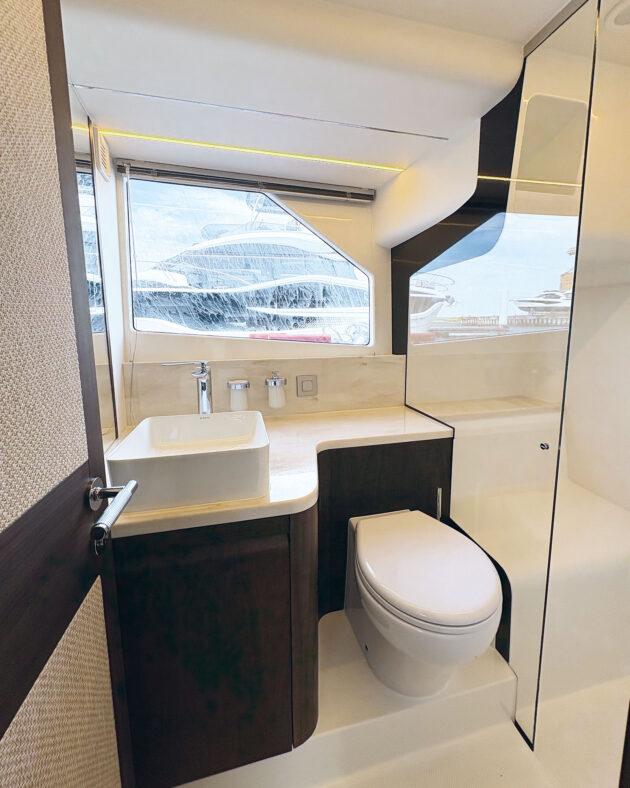
The test boat’s one and only heads compartment is suitably spacious
In short, the Explorer 430 arranges its three decks to really outstanding effect. You could certainly use it as a fun and unintimidating little cruiser for a small family but its real area of expertise lies in its capacity to make your day parties more sociable, more flexible and more fun. In fact, it’s such a brilliant boat for marina parties and anchoring up in a bay that it’s almost irrelevant how it drives.
But drive it we will – if for no other reason than to satisfy our curiosity in relation to how effectively Galeon has managed the 430’s extraordinary cocktail of volume, weight and windage…
A drive you won’t forget
Galeon has apparently engineered this hull to run pretty flat without recourse to the tabs but in practice, that’s not quite the case. Our test boat uses the top-rated twin D6-480s on what we’re told is the planing (rather than semi-displacement) hull – but what we see and feel only bears that out to a certain degree.
On the one hand, there’s substantial bow elevation as you accelerate from the bottom end to the midrange, followed by an improvement in fuel efficiency toward the upper end as the hull seems to free itself up a touch. But it does that without the classical hump that would tend to mark the transition from displacement to planing – and it does that with a point of entry that sits a very long way forward on the hull.
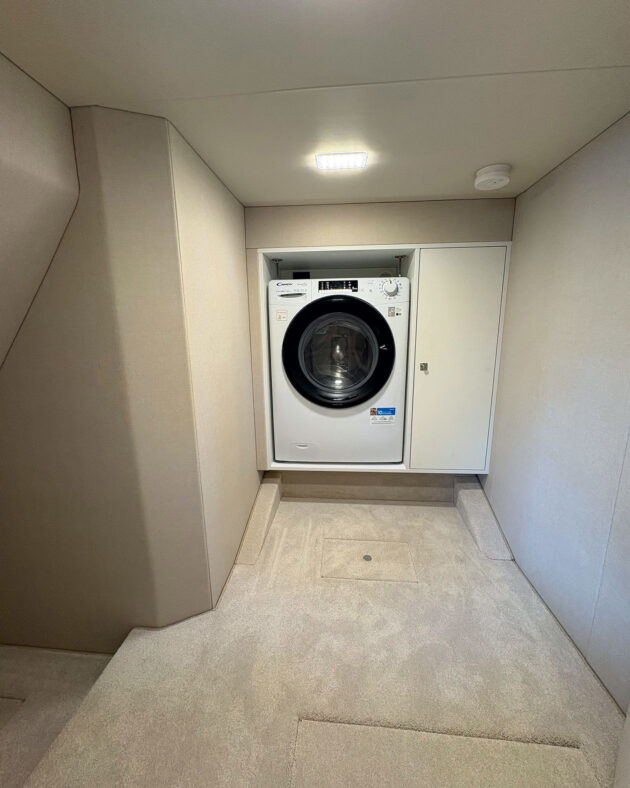
The test boat’s big utility room can be used equally well as a storage space or walk-in wardrobe
This unusual dynamic sees our fuel flow push up beyond 11 litres per mile at between 10.5 and 14 knots before easing back down to about 8.5 lpm as we near the 22-knot top end. That gives us a range of between 85 and 110 miles – and while that’s not the stuff of a true explorer boat, this platform is obviously more concerned with providing quiet, low-speed comfort in sensible conditions.
That cruising refinement shines through with really easygoing decibel figures of below 60 at everything under ten knots, rising to just 66 even at the top end. In fact, Galeon talks about this boat being in its element below ten knots and our experience bears that out in other ways too.
In addition to being quieter and more efficient, these lower speeds help flatter the ride from the blunt entry and deep, flat spray rails at the front end of this hull. And if you really want to embrace that go-slow philosophy, you can trade the twin D6-480s for a single engine instead.
As for the slightly thirsty-looking figures of our test boat, that’s no great surprise. At around 18-20 tonnes (light), this is a heavy boat for its length and, while it seems to push the water out of the way in the semi-displacement style, it lacks the swell-cleaving bow shape such boats often tend to use, so you really feel the work the engines are having to do as you increase the pace beyond nine knots.
We also have full fuel and water tanks, plus ten people on board, so we’re running very heavy; and this test boat comes without the gyro you would generally want to add so the sea manners, as well as the poke, reflects that.
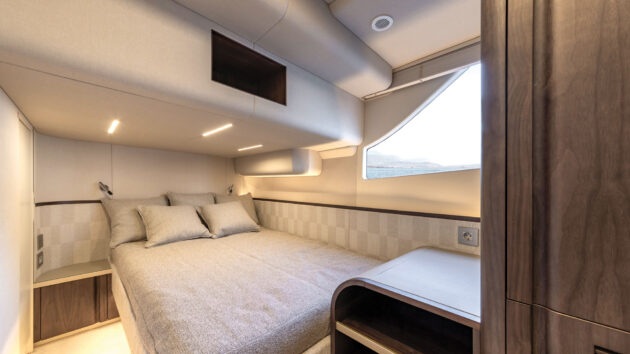
The bright guest double gets lots of headroom, a big window and plenty of storage options
It heels out of the turn in slightly uneasy fashion when running slowly but when you get up to speed, a bit of moderate inward heel feels much more reassuring.
In terms of the pitch, you do need to pin the tabs to help flatten off the ride but even then, visibility aft is not great because of the elevation of the forward saloon.
Visibility forward and on the beam, however, is an absolute delight. It feels odd but rather lovely to helm the boat just six feet from the forepeak with a huge view through that broad one-piece reverse screen. And it feels equally unusual when you helm this boat from the fly.
While the sociability of the forward sunbed is very appealing, such is the bluntness of the 430’s stubby front end that, even when you stand up at the helm, you have no chance of seeing the bow as it makes its way stoically through the water. What you get instead is a camera that transmits live footage of the forepeak to one of the two 12in MFDs at the upper dash.
We don’t have much (if any) chop to play with on our test day so the camera appears to have little to report – but when we execute some fast(ish) turns, the results are interesting.
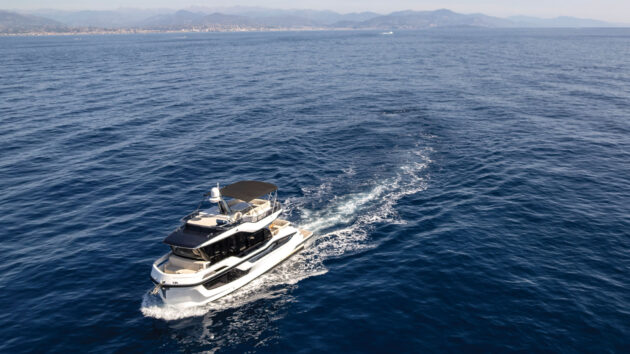
The voluminous shape, limited speed and modest range suggest this is an Explorer in name more than nature
With the tabs deployed and the bow pinned, we find the forward quarters ploughing through the water and causing spray to wash up the flare-free hull and over the bow on the inside of the turn.
Raise the tabs and, while the change in pitch slightly mitigates that trait, it’s fair to speculate that in livelier waters, this would be a pretty wet boat so it would be good to see some chunky scuppers added to the side decks – particularly on that truncated port side.
As expected then, the new Explorer 430 is not a performance boat by any means. Even with the top-end engines, pick-up is sluggish, handling is ponderous and we suspect that in a moderate swell, it would become quite firm and damp at anything beyond recommended cruising speeds. But to its credit, it goes and it turns with decent obedience.
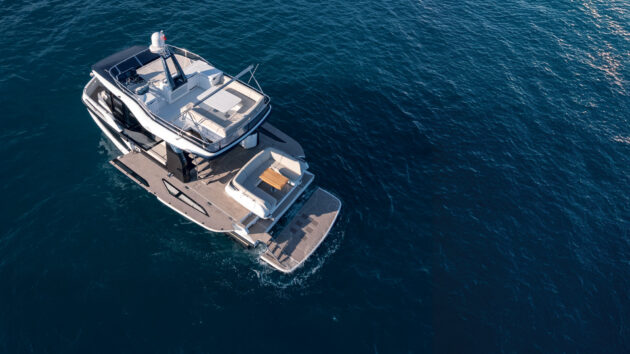
No boat of this length does more to make your day parties sociable, flexible and fun
With bow and stern thrusters plus twin engines and a joystick, it’s an easy boat to park too. And if you choose to take the Explorer 430 on a longer trip, then with moderate speeds on gentle seas, it’s likely to be a very quiet and comfortable enterprise, as well as an almost uniquely sociable one.
Galeon Explorer 430 specifications
Length overall: 45ft 9in (13.95M)
Beam: 14ft 10in (4.52M)
Fuel capacity: 1,200 litres
Water capacity: 450 litres
Draft: 2ft 11in (0.89M)
Displacement: 18 tonnes (light)
Price from: €1M ex VAT
Price as tested: €1.39M ex VAT
Galeon Explorer 430 costs and options
Price: from €1M ex VAT. Test boat includes the following options…
Twin Volvo Penta D6-480s
Sleipner proportional thrusters
Drop-down terraces with glass inserts
Rotating carousel cockpit dinette
High-low swim platform
Bow camera
Verdict
If this verdict is as clear cut and categorical as any we’ve written before, that’s directly down to the full-bloodedness of the 430’s radical new design. If you want a sexy boat, run for the hills. If you want a driver’s boat or a performance machine, avoid it at all costs. And if you want a long-range passage-maker, you could do much better. But if you want a large, sociable beach club, an expandable saloon and a massive flybridge on a boat so distinctive it might easily become an icon of the future, then shelve any reservations you might have about the challenges of the aesthetic, and give this extraordinary new cruiser the chance it deserves.