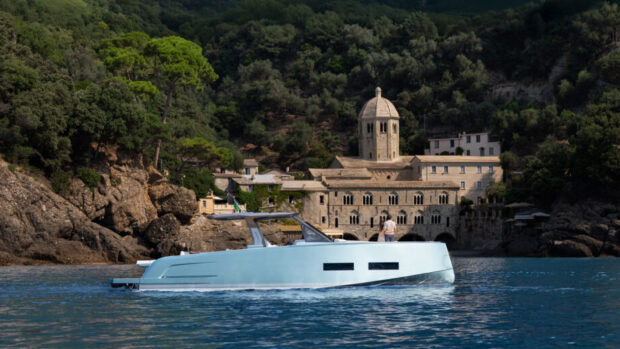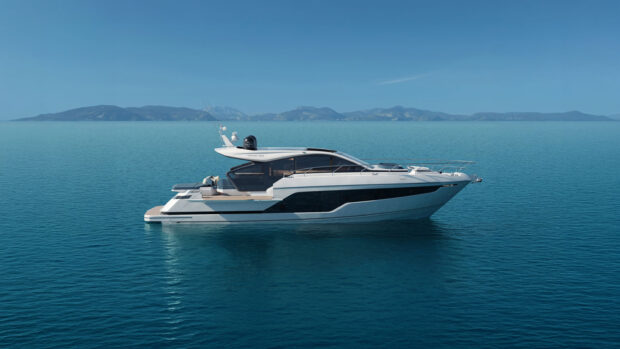


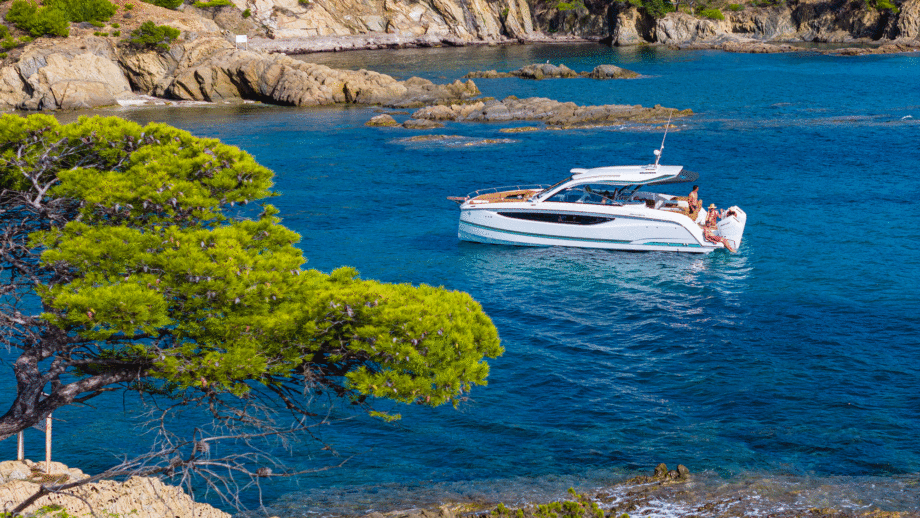
Alex Smith tested the Jeanneau TH38, a compact powercat with big ambition. Here's what he discovered.
You may remember the TH38 as the flagship of a new line of powercats under the FourWinns banner. It was unveiled at the Cannes Yachting Festival only a couple of years back but, having been taken on, revamped and rebranded under Jeanneau’s new powercat line, prior to the Beneteau Group’s sale of Four Winns, it looks better designed, better styled and a great deal more polished than the boat we first looked at on the show stand.
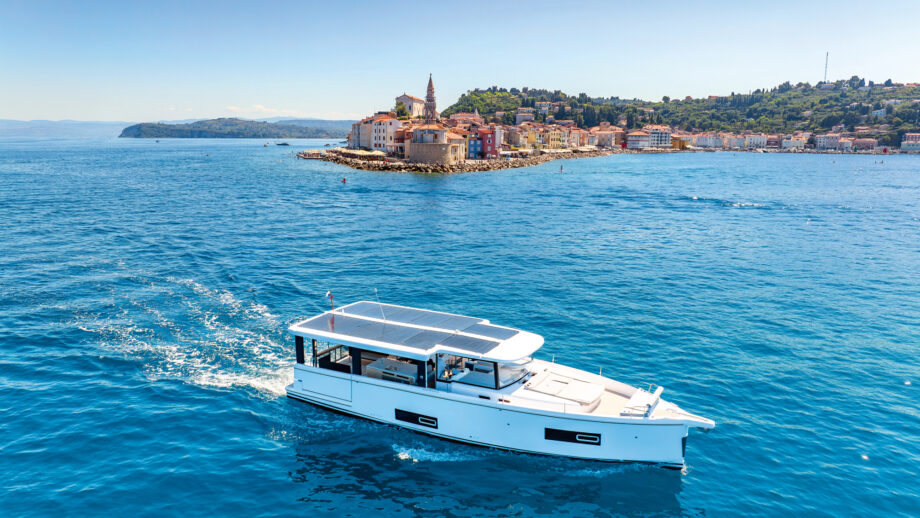
The applications of the two-strong TH (Twin Hulled) fleet have also been tidied up. While the relatively compact Jeanneau TH33 is designed as a dayboat with the potential to do a bit of weekending, the new TH38 you see here is a weekender that can turn its hand to a bit of cruising. It’s a bold claim for a relatively narrow-beamed, open-decked 38-footer with slender hulls and a raised bridge deck – so just how effective is it?
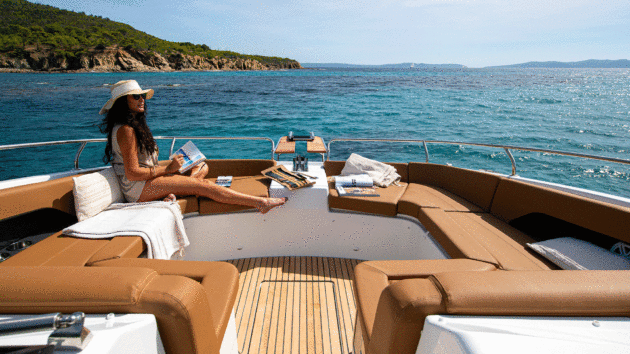
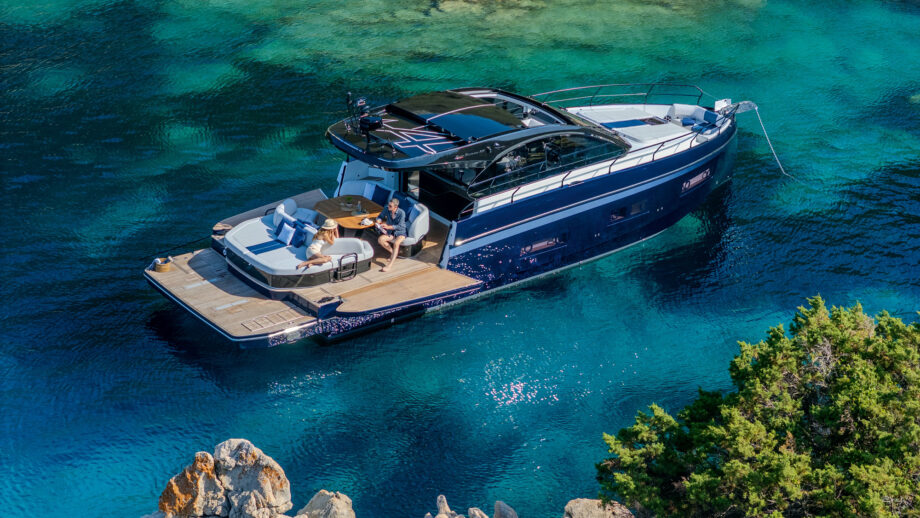
The configurable aft end is beautifully flexible
Open-deck flexibility
At 13ft 11in, the beam on this boat is only 36% of the overall length and that’s not huge by powercat standards – particularly as Jeanneau has used a pair of side decks, as well as a step-through screen. But there’s still space at the aft end for a pair of fixed platforms on either side of those outboards, plus a really generous passerelle-style central deck with a big drop-down ladder for easy access to the water, as well as the dock.
The furniture is also configured to make the best possible use of that. A C-shaped dinette rigged in the centre of the deck comprises two symmetrical parts, each on a set of transverse runners. This means you can slide these to either side and open up the entire central walkway all the way from the aft platform to the bow lounge.
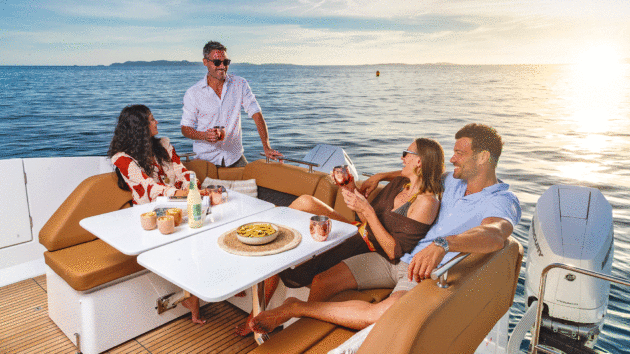
Another aft configuration.
The test boat doesn’t feature the optional telescopic legs, but if you do spec those, you get even more flexibility. You can turn the entire central section of the aft cockpit into a huge sunbed, or you can slide them sideways, opening up the central walkway and splitting the deck into whatever combination of sunbathing and seating you fancy.
And the fact that the aft safety-rails can be lifted and relocated keeps the cockpit secure for young families, whichever way you go. In the absence of inboard engines, there’s some decent storage inside the aft ends of the hulls for bulky baggage, lines and fenders too.
There’s also plenty of space for a generator, should you want to spec the electric stove or air conditioning – and while the port seating unit contains a locker for your liferaft, the starboard one adds plenty of extra storage. Further forward, we see some useful asymmetry begin to kick in just at the point where the side decks begin to emerge…
A small starboard bench seat is big enough for two people and the fact that it creates a corner section enables you to use it like a chaise longue, facing inboard and aft toward the occupants of the primary seating units. Over on the port side sits the main part of the wet bar. It has plenty of space for a fridge and an ice-maker to supplement the big fridge forward of the starboard bench.
And while there’s a good size of sink here too, plus a set of peripheral grab rails, the single gas ring looks a bit mean so a multi-ring electric version is likely to be the more popular option.
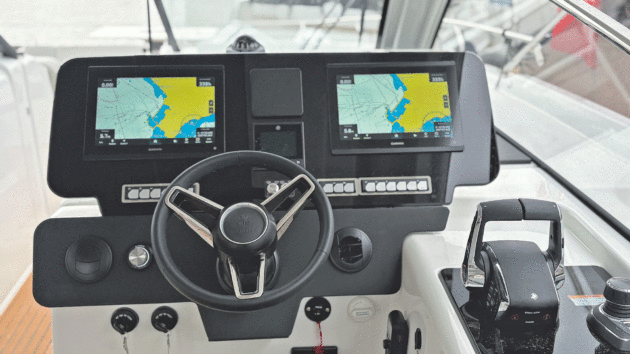
There’s plenty of space here to trade the 12in MFDs for 16-inchers
Broad bow lounge
Head further forward, via that broad single-level walkway, past the helm and the symmetrical access points to the two cabins, and you find yourself in the bow. This is always a highlight on a well sorted cat and it’s no different here. Some useful forward beam creates the space for what they tell us is a ten-man bow lounge – and while that feels like a bit of a stretch, it’s definitely big enough for eight.
It uses the same tables as the aft cockpit so you can relocate them forward if you like, once again, dropping them into the space on optional telescopic legs to create a huge all-over sunbed. The bow section is really deep too – and that’s particularly welcome because, thanks to the inherent stability and ride softness of twin hulls, it’s a place you might choose to come and sit, even when underway.
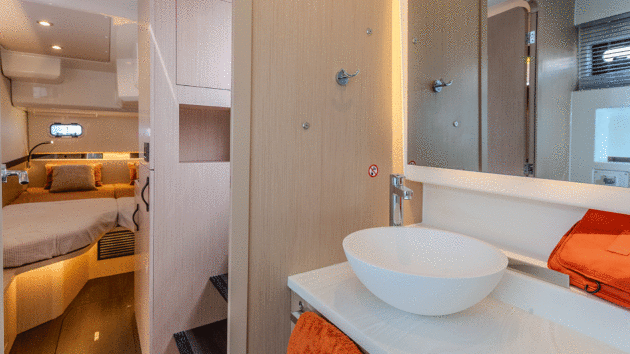
They are a shade beyond simple weekending cabins
To help with that, we also have a speaker built in here, plus a powerpoint and a couple of cup holders. And thanks to a hatch that gives you access to the inside of the ride-softening wave breaker (a V-shaped moulding between the hulls), storage is again a strength.
As for the seemingly odd decision to factor in a pair of external side decks on a boat with a step-through screen – a move which reduces the width in the forward part of cockpit – the reason is simple. These boats are expected to berth stern-to in Mediterranean marinas, where you have to fetch a lazy line and walk it to the bow before tying it off; and this makes that job much quicker and easier.
You can opt for 300s but the 350s are a worthwhile upgrade
Symmetrical cabins
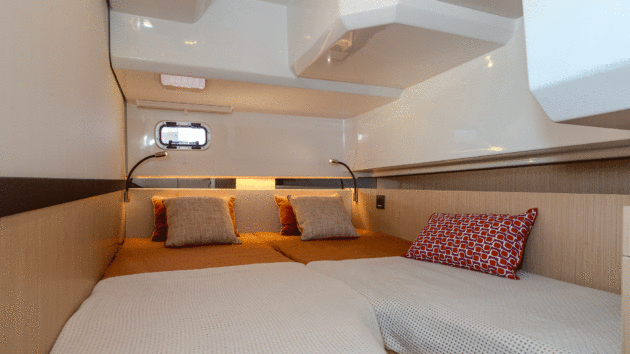
When you pop down the steps (either set of steps will do), you’re greeted with a bank of cabinetry in the centre, a double bed aft and a bathroom forward. It’s pretty lofty at the entry point and, although the deckhead does fluctuate quite radically beneath the main deck furniture, there is decent space to sit up in bed.
Compact portlights facing aft toward the cockpit add a bit of extra ventilation and light, and that’s particularly welcome because the hull windows themselves are a shade shallow. On the test boat, the space beneath each bed is swallowed up by an air-conditioning unit and some of the other cabinetry is similarly sacrificed to accommodate the trunking for that.
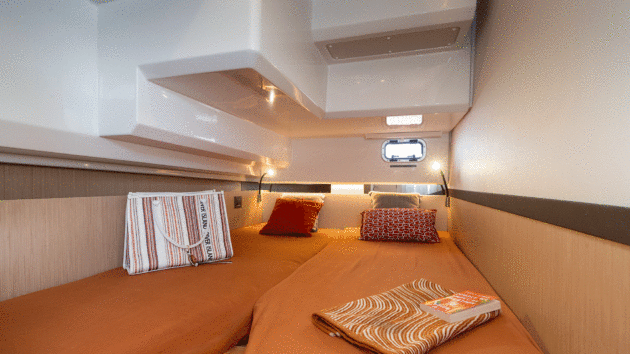
Compact portlights facing aft add extra ventilation
But, as intimated, storage on this boat is generally strong so it’s not a major issue, and the natural division between the two hulls means that privacy for a pair of couples is also first-class.
The bathrooms are impressive too. In addition to about 6ft 1in of headroom, you get a separate shower compartment, a proper toilet, a decent-size of vanity unit and a bit more natural light and ventilation from a hatch up onto the foredeck.
In short, these cabins are perfectly decent for extended weekends away. But if you really want to use this boat for cruising, you’ll need to make some targeted upgrades – namely, a better-specced wet bar, a generator in one of the aft lockers, a couple of extra water tanks and some all-over canvases to cordon off the cockpit from neighbouring boats and passers-by on the pontoon.
Article continues below…
Jeanneau Sea Loft 480 review: This brave design is stable, spacious, and efficient
Beneteau GT50 review: Onboard Beneteau’s outdoor-first flagship
On the water
When you helm a well-sorted powercat, you expect plenty of lateral and directional stability and you absolutely get that on the new TH38. You also get plenty of comfort at the helm, thanks to a pair of armrests and a big ledge to rest your throttle arm; and the outright poke on offer here is pretty satisfying too.
Even with six people on board and relatively full tanks, the test boat’s top-rated twin 350s get us up and running good and fast before a few notches of trim see us topping out at 33.4 knots. Protection is also excellent at the helm but if you need to cool off on a hot day, a lift-up section at the centre of the lofty screen enables you to divert fresh air down into the cockpit when you’re underway.
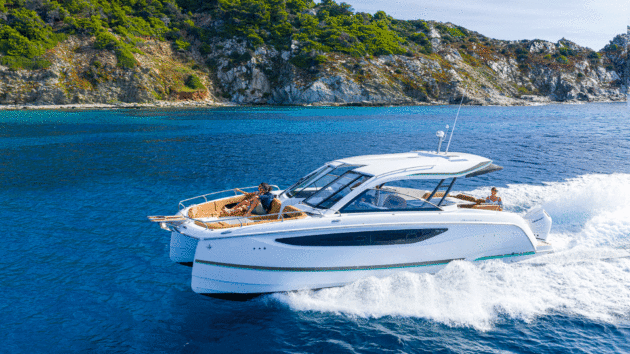
If you want more sun, you can replace the hardtop with a simple T-top instead
That said, the fact that the roof joins up with the screen does seem to trap a fair bit of engine noise, with sound readings pushing beyond the 85dB(A) mark as you ease toward the top end. You can of course mitigate that by opening the bow door and you can also replace the big roof structure with a simple T-top instead.
Either way, there’s no sunroof option in the hardtop because Jeanneau is keen to avoid adding too much weight high up, and while that will feel like a shame to some, it certainly helps preserve the integrity of the handling.
There’s a lot of fun to be had tightening a turn with lots of power on and feeling the increase in G-force; and it’s all the more enjoyable because this boat rides with such easy, compliant softness.
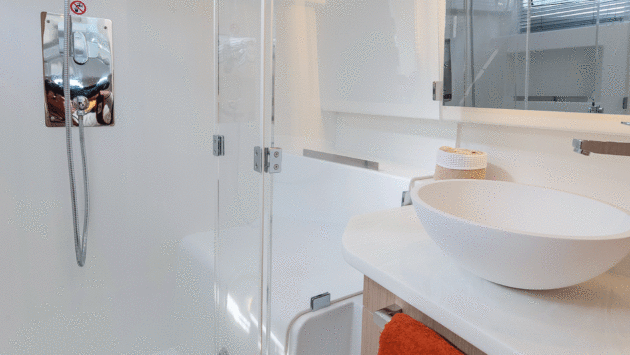
The bathrooms get separate showers
As regards efficiency, it’s not quite as light-footed as potential powercat buyers might hope. At sensible cruising speeds, we’re seeing fuel flow of between 4.5 and 6L per nautical mile.
Factoring in a 20% reserve from the twin 465L tanks, that gives you about 750 litres to play with for a range from 125 to 165 miles. That’s decent enough for monohull fans but the emergence of a hydrofoil option in the future should help differentiate this boat from the broader market to a much greater degree than that.
 If you enjoyed this….
 If you enjoyed this….
Motor Boat & Yachting is the world’s leading magazine for Motoryacht enthusiasts. Every month we have inspirational adventures and practical features to help you realise your sailing dreams, as well as tests and news of all the latest motorboats.
Plus you’ll get our quarterly Custom Yachting supplement where we share the last on offer in the superyacht world and at the luxury end of the market.
Build your knowledge with a subscription delivered to your door. See our latest offers and save at least 30% off the cover price.
Note: We may earn a commission when you buy through links on our site, at no extra cost to you. This doesn’t affect our editorial independence.
Price as reviewed:
£701,712.00 As tested inc. VAT
Verdict
This is the kind of boat you can enjoy right from day one. True, it’s a bit noisy underway and the outright performance is moderate. But it handles a treat and there’s all kinds of configurable furniture, both in the cockpit and the bow, so you can arrange the deck space to suit your application. It’s also supremely easy to make your way around this boat without feeling in the slightest bit exposed or vulnerable, and it’s a boat that, subject to a few optional extras, will put you up in comfort and privacy for more than just the odd night or two away. It’s not without competition in the burgeoning multihull market, but if an approachable, intelligently designed powercat from a mainstream brand is what you’re after, you could do a lot worse than this. CONTACT: www.jeanneau.com
Details
LOA: 38ft 9in (11.82m)
Beam: 14ft 8in (4.47m)
Draft: 2ft 0in (0.61m)
Displacement: 7,419kg (light)
Fuel capacity: 2 x 465L
Water capacity: 2 x 95L
Engine: Twin 300-350hp outboards