

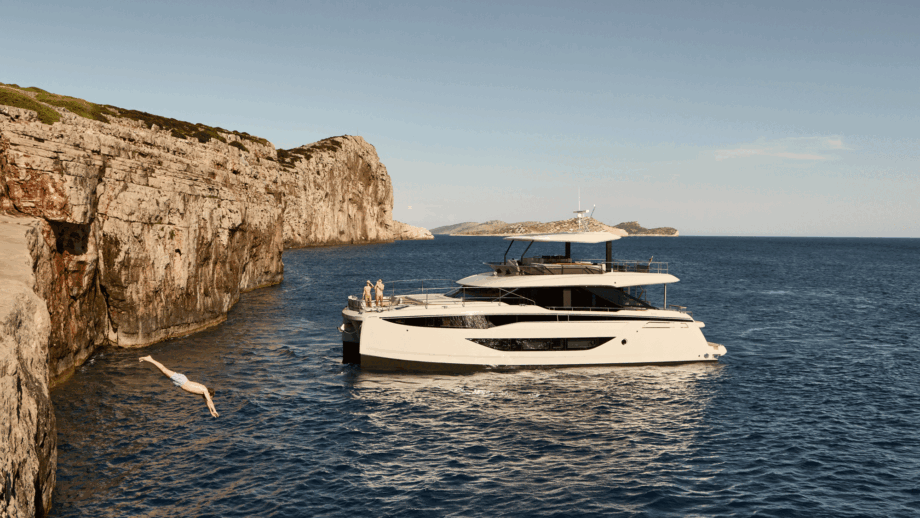
Comparing powercats to traditional monohull yachts shows why the Prestige M8 Evo offers unmatched living space at sea.
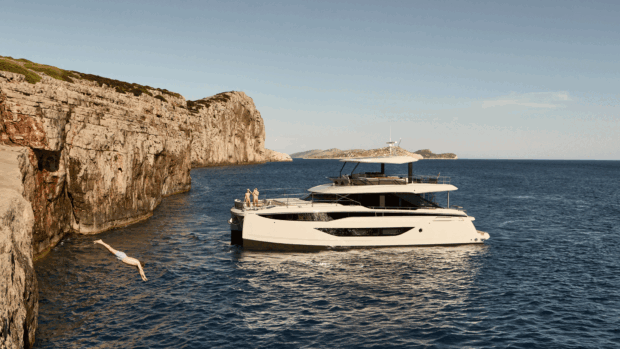
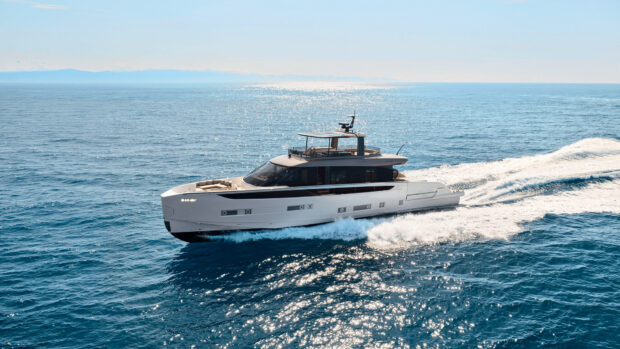
Who would’ve thought it? A powercat that looks good. And not any powercat but a big bruising powercat with a 29ft beam, a plunging bridge deck and space for 35 people. Yep. In spite of its inevitable bulk, the use of a subtly dipping sheerline, simplified mouldings and long tinted hull windows elevates the new M8 Evo from a boat the monohull fan could just about tolerate into a platform the stylistically minded could genuinely covet.
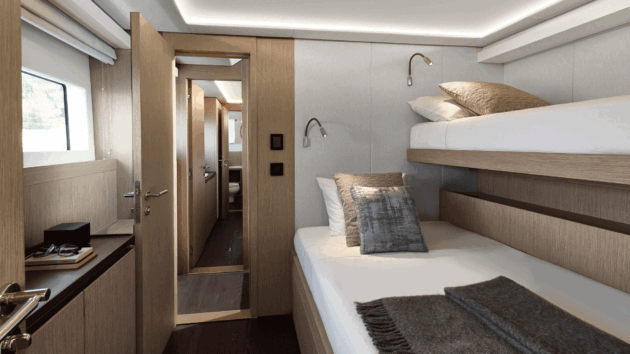
His-and-hers sinks divide the separate spa-style shower from the forward heads
That, of course, is a key part of the recipe with any flagship, but it’s particularly important on a second-generation model with ambitions to tempt buyers away from 80ft luxury motoryachts.
It’s a great start then – and while it’s good to learn that there are plenty of changes on the inside too, it’s equally good to learn that many of the stronger elements of the original M8 remain. Take the outdoor spaces. The big aft cockpit gets a glass balustrade with a step through section at its heart, so you can lift the central part of the aft platform and extend the cockpit deck out over the water.
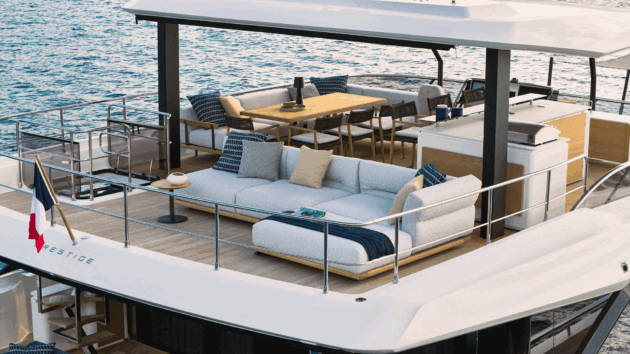
The Evo’s flybridge is all the better with a galley where the steps used to be
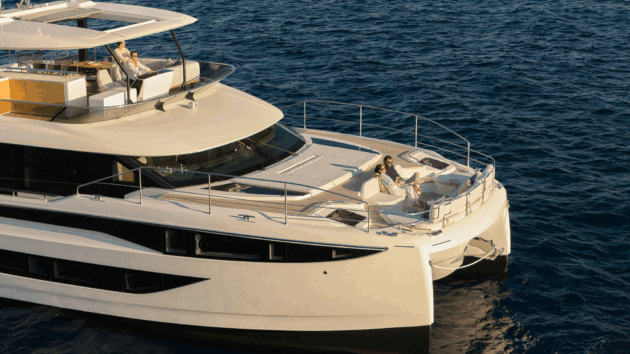
That is supplemented with a gloriously intimate-feeling sunken lounge at the leading edge of the bow, which is easily big enough for ten people. And while, as on the original M8, this is probably the best seat on the whole boat, you also get a broad, flat sunbed with lifting backrests ahead of the screen.
When you head up to the flybridge, that too inhabits precisely the same absurdly enormous footprint as the original M8 did – and that of course makes it pretty vast by the standards of a 65-footer. But it’s way better on this Evo model for a really simple reason. While the original M8 supplemented its aft staircase with a second internal staircase on the starboard side of the saloon, the Evo has eradicated it.
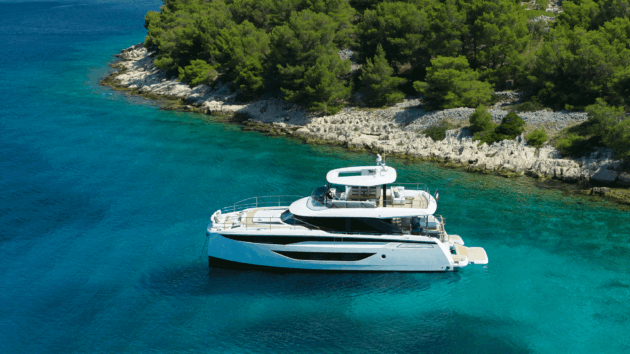
The sunken bow lounge is every bit as good as the original
At a stroke, that buys the new boat a big section of usable flybridge deck that the old boat lacked and it’s beautifully used for a full walkaround galley with integrated bar that operates as the hub of the upper deck.
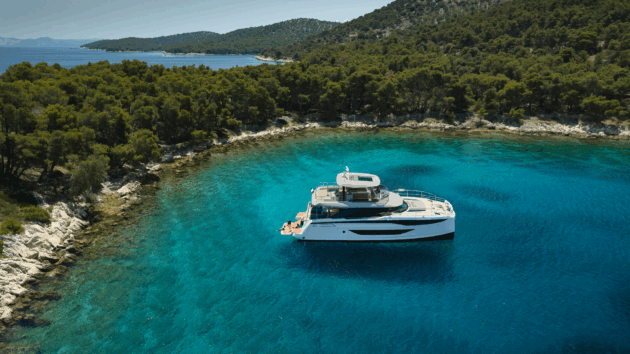
As with all M-line models (and arguably all large luxury powercats) the joy is more in the destination
than the journey
This galley (and it really is a galley rather than merely a wet bar) is paired with a central two-man helm, a big dining station to port and an open freestanding deck beyond the shade of the hardtop at the aft end. And another very happy trait that the new boat retains is the day heads…
It’s tucked away on the port side with sole access from the external side deck. While some might consider this ‘outhouse’ approach a bit of a flaw on a large luxury yacht, the fact that it divorces you entirely, both from the internal saloon and from all three external party zones, makes it a first-rate solution, both for privacy and discretion.
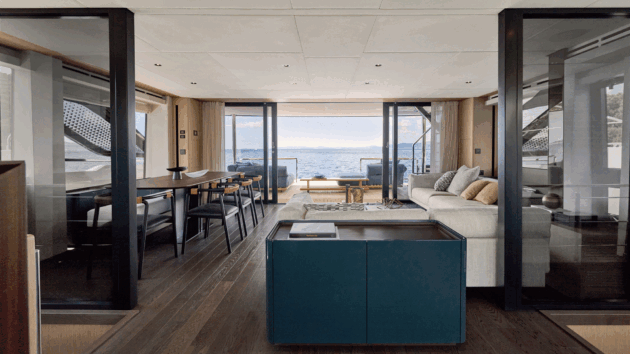
There may be an option in the future for a full glass bulkhead to divide the saloon spaces
Living space upgrades
The removal of the internal staircase also has a fundamental impact on the saloon. The extra space in here has been used for a more expansive aft dining station, which also now comes with the option of sliding side doors so you can open it right out to the big starboard side deck. There’s talk of extending the two truncated glass partitions that sit on either side of the saloon too.
As things stand, they provide an implied delineation between the aft lounge and the forward galley and helm station without insisting upon it with a full physical barrier.
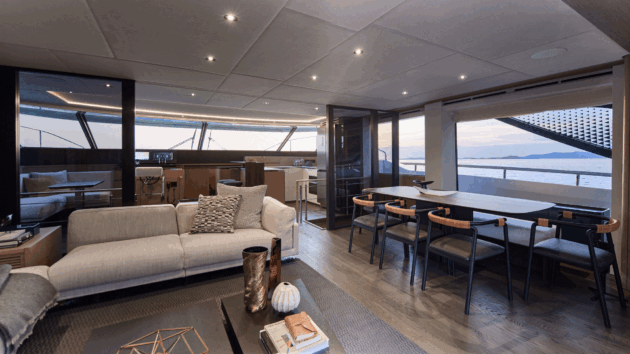
The extra space has been used for a more expansive dining station with the option of sliding side doors
But extending it to create a full but openable glass bulkhead could be a very effective way of making the large saloon space feel that bit more secluded and intimate without actually blocking any of the light that currently cascades unfettered from one end to the other. It could also be a good way to separate the leisure spaces from the work station during charter or when crew are on board.
The Evo’s saloon has been radically improved in one other key way too – namely by repositioning the helm from the starboard side, where it argued with the galley, to the port side. That immediately gives the main deck galley the space to expand and become the social hub it should always have been, as well as a far more practical station for large parties and charter applications.
The only real compromise at the bow is the size of the forepeak crew cabins
It also gets an integrated bar toward the centre of the deck, which is again very welcome. Critically though, it means that the lower helm is also much improved. It now comes with a variety of options so you can spec anything from a hidden steering position inside a compact cabinet to a full helm station with a skipper’s chair.
In all cases, there’s room for some extra lounge seating here so you don’t have to helm alone; and you get easy access through the port door to the side deck, which is ideal both for seamanship duties and for quick trips to the day heads.
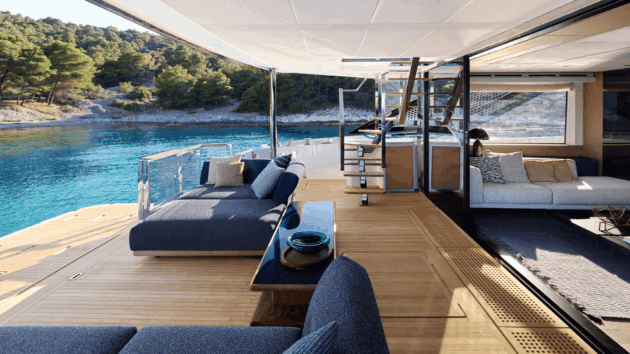
The open aft deck sits at the same level as the saloon
There’s practicality elsewhere too. The space beneath the fly steps, for instance, has been well used for an ice maker, a storage cabinet and an optional third helm. There’s plenty of room in the engine bays for your AC units, a pair of generators and the optional ‘Silent Boating’ lithium-ion battery bank.
There’s another big storage space beneath the cockpit deck; and the Evo’s stooping bridge deck means there’s also a spot beneath the centre of the forward saloon for a utility space big enough for a fridge, a washer dryer and some handy extra storage.
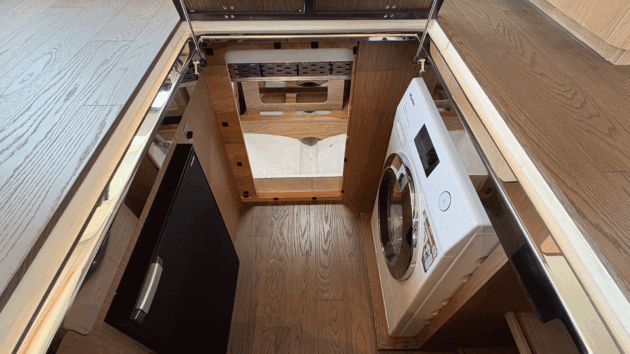
There’s a handy utility space beneath the saloon deck
King of cabins
While the smaller Prestige M6 comes with a four-cabin option that splits the big full-beam bow cabin in two, the M8 Evo is far less egalitarian than that, particularly in test boat form.
It provides four ensuite cabins for guests – two in each hull – plus a massive owner’s cabin that spans the entire beam at the bow. In fairness, the guest cabins are pretty good too. After all, this boat is designed and built as a powercat from the ground up so the hulls are much wider than you might expect of a sailing cat.
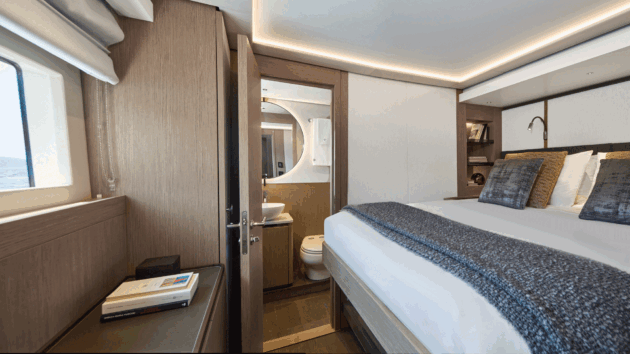
Three of the four guest cabins make use of the wide hulls for transverse beds that face out through large hull windows
The M8 Evo also takes a little of the space between the hulls for use in the cabins so there is sufficient breadth in three of the four for transverse double beds that face out through the big hull windows. The fourth cabin (forward in the starboard hull) adopts a staggered bunk arrangement and is presumably intended for kids but either way, their scale is impressive.
You can change things in a big way with the options list though. You can spec the entire port hull as a VIP cabin with a lounge and bathroom forward
and a cabin and walk-in wardrobe aft.
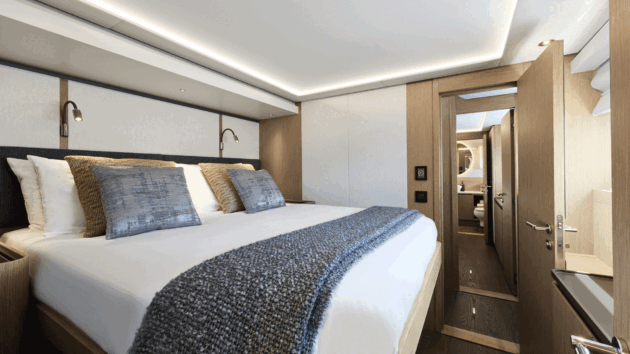
You can trade the two cabins of each hull for a long VIP cabin with lounge and bathroom forward, and bed and walk-in wardrobe aft
You can do exactly the same in the starboard hull too, or you can stick with an ensuite cabin forward and then relocate the galley down below in the aft part of that hull. That would free up extra space in the main deck saloon for seating or dining and it has potential merit in terms of crew discretion too. However, for our money, the galley is such a valuable main deck living asset that we’d be very reluctant to mess with it.
Even if you opt for a pair of big VIP cabins though, the undisputed star of the show is the owner’s bow cabin. Accessed via its own private staircase at the forward end of the saloon, it encompasses the full beam of the boat beneath the foredeck, enabling light to flood in from both sides, as well as from the letter slot windows, which look out onto the bow lounge.
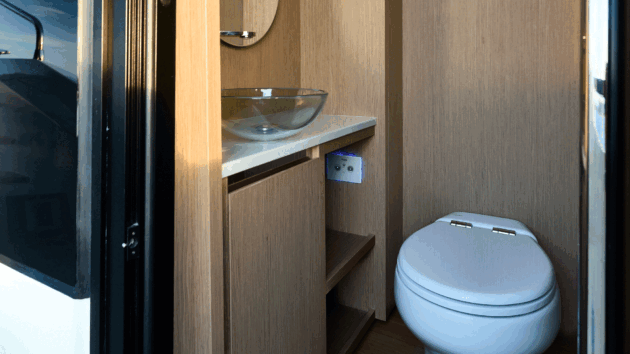
The external day heads keeps the lower deck ensuites private
The layout in here has all changed though. The bed now sits to starboard, freeing up a central zone for a settee and a desk. The port side, meanwhile, is taken up with the functional elements – a split bathroom with the heads forward and a huge spa-style shower cubicle with a tiled seat and a rain shower aft.
Between them sits a pair of sinks and an arrangement of built in storage units and, again, the light management is excellent, thanks to a selection of hinged and sliding glass doors that are either discreetly frosted or subtly tinted.
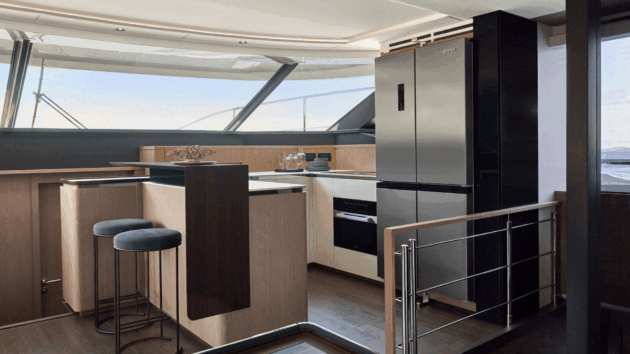
You can opt for the galley in the aft end of the starboard hull
Now clearly, with its twin hulls, its joystick, its widely spaced engines, its three helms and its virtually rectangular shape, the M8 Evo is by no means a difficult boat either to drive or to park. But it is a very large platform, so if you’re spending £7M on it, you’re going to want to employ people to wash and maintain it.
That’s why it comes as standard with a single ensuite crew cabin inside each of those deep, heavily tapered forepeaks. You can increase that with an extra single bed in each, which then crisscross the existing beds at right angles, taking the overall crew capacity to four – and that’s without question a very effective use of the space.
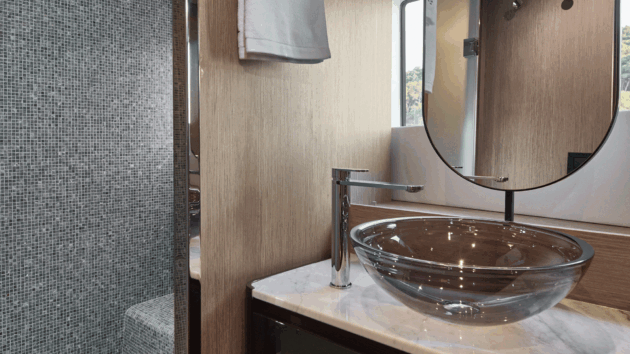
His-and-hers sinks divide the separate spa-style shower from the forward heads
But even with the single-rig cabins, these spaces are pretty cramped and dark so, much as you might relish the volume and flexibility of the living zones elsewhere on the new M80 Evo, this is not a boat that’s likely to paint much of a smile on your skipper’s face.
Article continues below…

Prestige M7 review: The powercat that offers 75ft of monohull space

Aquila 45 Sport first look: SUV styling for the powercat market
Easier than ever
The original M8 used a pair of Volvo Penta D8-600 7.7-litre diesels on V Drives. The Evo model replaces those with a pair of big-block (12.4L) MAN i6 730s – and while that only increases the top end by a knot or so (21.1 versus 20.3), it makes your cruising refinement significantly better.
In fact, this same block is also used for an 850hp variant, so in this guise, these MAN engines feel distinctly low-revving and unstressed, topping out at just 2,400rpm compared to nearly 3,000 for the Volvos – and registering just 56.5dB(A) at a ten-knot cruise compared to 60dB(A) for the old boat.
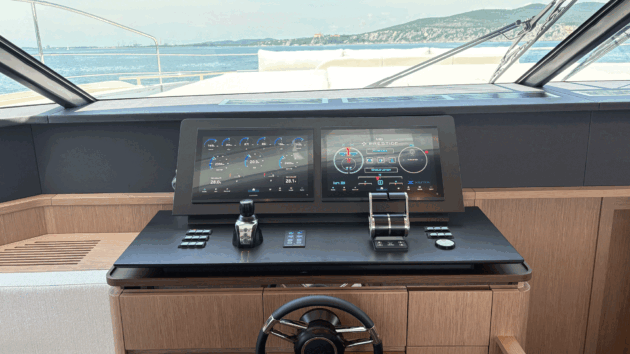
The lower helm comes with a really sociable port settee
That’s particularly useful because, as a big weighty cruising cat, this boat has no hump to ascend, nor any planing threshold to worry about. Six knots feels pretty much the same as 20, so we’d be very much inclined to take advantage of that and run it at between seven and ten knots.
At these speeds, you get the same soft, stable, comfortable ride as everywhere else in the performance band but with way gentler sound readings (ten decibels lower than the very top end), allied to almost implausibly lovely fuel-flow figures of between 2.5 and 5 litres per nautical mile for a usable range from 600 to 1,200 miles.
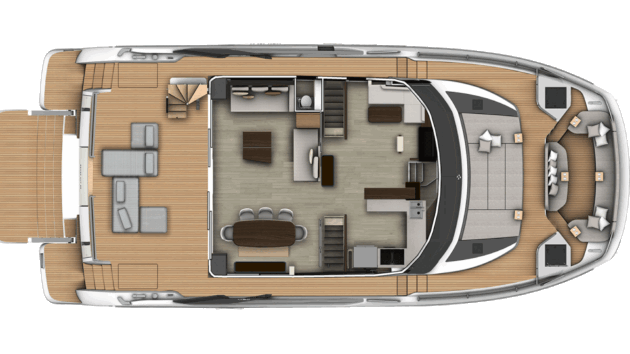
The shifting of the lower helm has created a lovely big galley
 If you enjoyed this….
 If you enjoyed this….
Motor Boat & Yachting is the world’s leading magazine for Motoryacht enthusiasts. Every month we have inspirational adventures and practical features to help you realise your sailing dreams, as well as tests and news of all the latest motorboats.
Plus you’ll get our quarterly Custom Yachting supplement where we share the last on offer in the superyacht world and at the luxury end of the market.
Build your knowledge with a subscription delivered to your door. See our latest offers and save at least 30% off the cover price.
Note: We may earn a commission when you buy through links on our site, at no extra cost to you. This doesn’t affect our editorial independence.
Price as reviewed:
£4,001,208.00 As tested ex. VAT
Verdict
It’s taken a lot of people a lot of time to get to grips with the idea that a large boat can be designed as real estate on the water, but when you see it done as effectively as this, the merits of that ethos are clear. The cruise is soft, quiet, stable and efficient. The deck spaces are huge and better used than ever thanks to the latest Evo updates. And if the prioritising of the galleys on the main and upper decks has finessed the flavour of those living spaces, the cabins provide an opportunity to cruise in numbers, privacy and comfort. Whether this 65ft powercat is genuinely comparable to an 80-85ft motoryacht remains open to debate. But when you package all of the Evo’s clear and obvious talents into one of the market’s best proportioned power cats, it becomes a remarkably convincing argument. CONTACT: www.prestige-yachts.com
Details
LOA: 65ft 0in (19.82m)
Beam: 29ft 0in (8.85m)
Draft: 5ft 5in (1.65m)
Displacement: 41,100kg (light)
Fuel capacity: 3,700L
Water capacity: 2,100L
Engines: Twin MAN i6 – 730s