
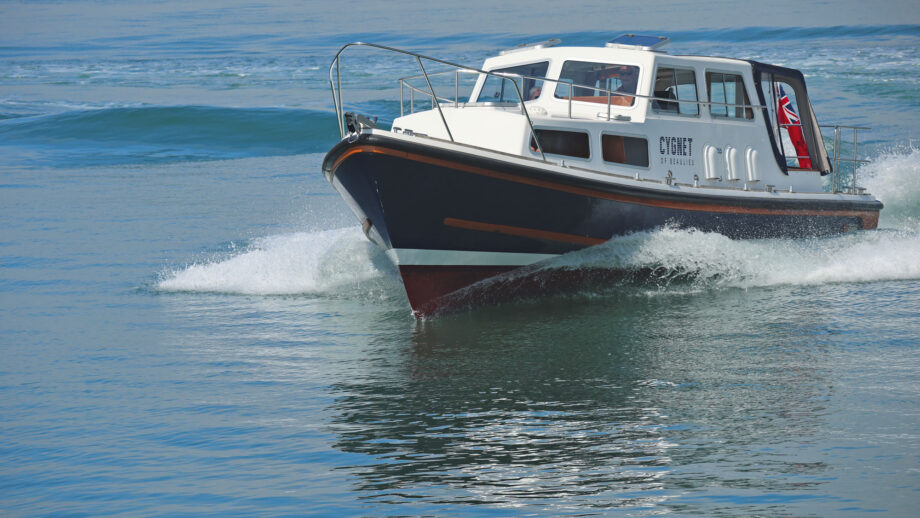
When Steve Brenner decided to restore Lord Montagu’s original Nelson 35, nothing but a full stem-to-stern refit would suffice
Steve Brenner seems to eat, sleep and breathe Nelson motor boats. Over the past 40 years he has owned seven of them, in which he has cruised extensively, particularly to the Netherlands and the Baltic; he has been the historian of the Nelson Boat Owners’ Club since its formation in 1984 and its honorary secretary for the last ten years.
In 2021 he and shipwright Andrew Oliver formed a new company – Nelson Motor Yachts – to build Nelson 18s in various different versions. But there was always one particular Nelson that he had his eye on: Cygnet of Beaulieu, the very first Nelson 35.
Designed by Arthur Mursell of TT Boat Designs, the Nelson 35 was Halmatic’s answer to Tyler Boat Co’s highly successful Nelson 34. While reproducing the 34’s low freeboard and semi-displacement hull form, the 35 had more beam to provide extra internal volume and to reduce the tendency to roll, for which the 34 had received some criticism. It did the trick; a total of 38 Nelson 35s were built over the following years.
There’s another reason, Steve wanted that particular 35. Cygnet was built for Lord Montagu of Beaulieu, who had previously owned a Nelson 34 of the same name (which was then renamed Lady of Beaulieu).
Cygnet of Beaulieu is the very first Nelson 35 ever built and was made for Lord Montagu in 1984. Photos: Nigel Sharp and Steve Brenner
Having been moulded by Halmatic, the new Cygnet was fitted out to Montagu’s specific requirements as a day boat with no sleeping accommodation by Buckler’s Hard Boatbuilders on the Beaulieu River. She was completed in 1984. Around the same time, Montagu became the first Commodore of the newly-formed Nelson Boat Owners’ Club.
Montagu used Cygnet as a day boat in the Solent, but from 1999 she also doubled up as a coastguard auxiliary boat. As such she had to be coded (this included having plywood window-shaped blanks to replace a window in the event of one being stoved in), and she had a crane to help rescue casualties from the water.
In 2014 Montagu’s declining health led to the sale of Cygnet. Her new owner was William Verner, who lived in Bushmills, Northern Ireland. Cygnet wasn’t in great condition by this time but Verner planned to restore her and then use her to take people on sightseeing trips to the Giant’s Causeway.
However, after injuries sustained in a car accident put paid to his plans, Cygnet was put on the market again.
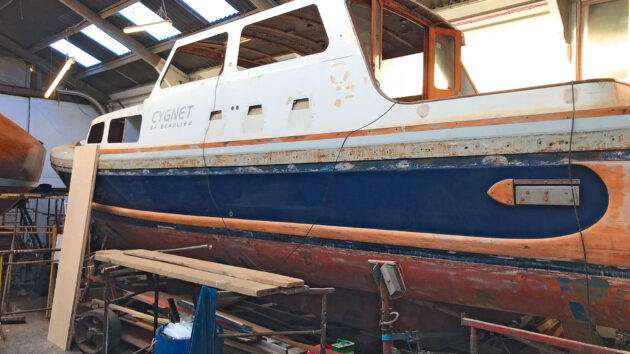
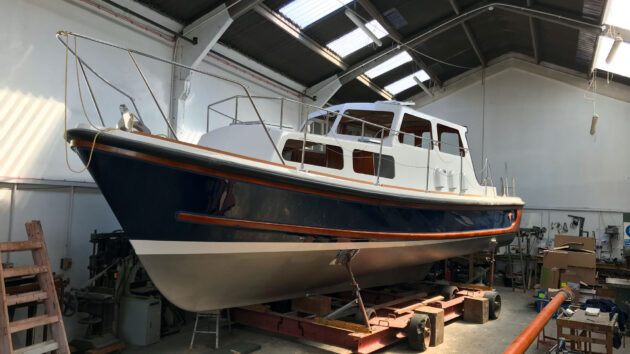
By the time Steve Brenner bought her she was in dire need of a full restoration and refit. Photos: Nigel Sharp and Steve Brenner
Plumbing and electrics
In February 2017, after news of this reached Steve, he travelled over to Ireland to look at the boat and meet Verner. “Cygnet had deteriorated much further by this time and was covered in snow and ice,” Steve told me. “But I had coveted her for more than 30 years and in my eyes she was the epitome of all things ‘Nelson’.”
So it wasn’t long before the two of them agreed a price and Steve made arrangements for Cygnet to be transported by low loader to Andrew Oliver’s shed in Emsworth, where a great deal of work was about to begin.
Almost everything had to be stripped out of the boat and many items had to be replaced but the “saving grace”, as Steve put it, were the engines. Cygnet was originally fitted with a pair of Ford Sabre 250hp diesels but when, in 1998, one of them blew up, they had both been replaced with Perkins Sabre 225s.
Those engines were still in the boat when Steve bought her and had only done about 500 hours, but he didn’t think they had been well installed so there was much that had to be done to them.
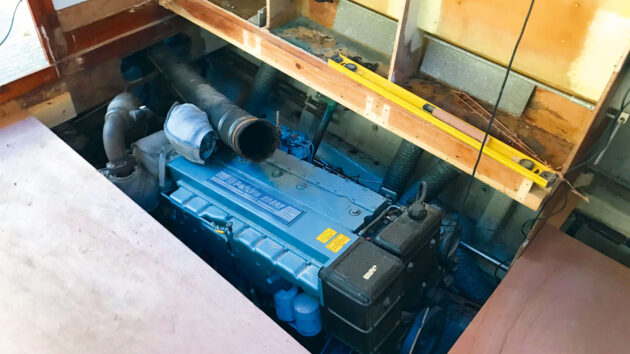
The Perkins Sabre diesels were given new gearboxes, shafts and four-blade propellers. Photos: Nigel Sharp and Steve Brenner
This included the addition of R&D flexible engine mounts; new PRM 750C contra-rotating 2:1 gearboxes to allow better manoeuvrability; new shafts in Aquamet (a high-tensile stainless steel); four-bladed propellers; new Morse KE-4 electronic throttles and gearchange mechanism; and digitised engine sensor outputs linked to Simrad screens and “good old-fashioned analogue engine dials”.
The integral GRP fuel tanks were in reasonable condition apart from their aluminium lids, which were replaced by new stainless steel ones. New Racor Duplex fuel filters were added with six-port changeover valves to provide multiple options with regard to the tanks from which fuel is drawn and returned.
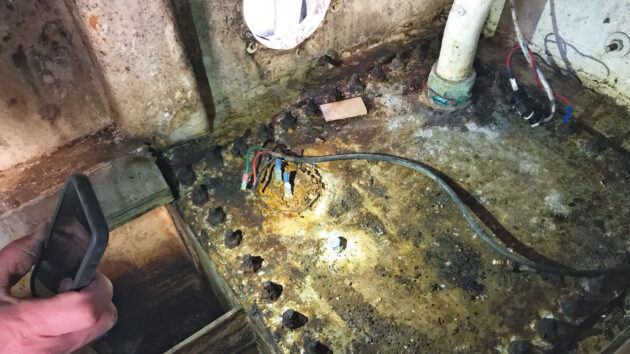
The aluminium lids on the four GRP fuel tanks were replaced with stainless steel ones. Photos: Nigel Sharp and Steve Brenner
Interior refit
The original galvanised steel water tank was still in serviceable condition and now a second water tank, solely for flushing the Jabsco toilet, has been added along with a black water tank, both in high-density polyethylene by Tek Tanks.
The mechanical steering system was replaced with a SeaStar Capilano hydraulic one with a variable capacity pump, which allows the number of turns, hard over to hard-over, to be instantly adjusted.
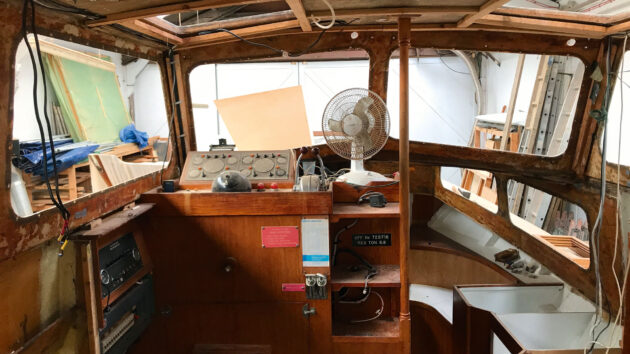
The whole interior was stripped out except for Lord Montagu’s drinks cabinet! Photos: Nigel Sharp and Steve Brenner
With regard to the electrical systems, Steve wasn’t keen on having a generator or lithium batteries, not least because of the expense. So Cygnet’s DC systems are now mostly 24-volt with seven AGM batteries.
While each engine has its own starting bank of two 12V batteries wired in series, charged by its own alternator, the port engine has an additional Lucas 120A alternator, which charges the 24V, 480Ah domestic bank.
From this bank, a Victron inverter/charger provides 240V AC power, and a converter provides 12V for a few of the minor systems. The majority of the engineering and electrical work was carried out by Trevor Clarke of TCG Marine while Andrew was working on the other renovations.
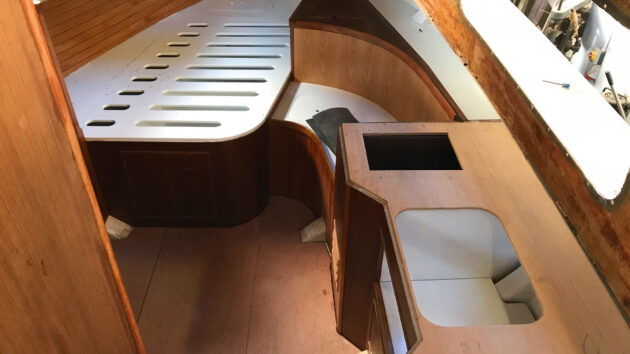
The galley, saloon and sleeping area are all part of the same open-plan cabin space. Photos: Nigel Sharp and Steve Brenner
The only parts of the internal joinery that were salvageable – partly because of water ingress but also because Steve’s requirements were different to those of Lord Montagu four decades earlier – were the heads’ bulkheads and Lord Montagu’s drinks cabinet.
While the forward cabin had been dominated by a large table and seating around it, a double berth was now installed. Aft of this to port is a wardrobe and drawer chest, while to starboard is a cosy settee.
A brand new galley, which replaces the very basic one that was there before, now features a Corian worktop, a top-loading Dometic fridge, a sink and a Smev gas hob and oven.
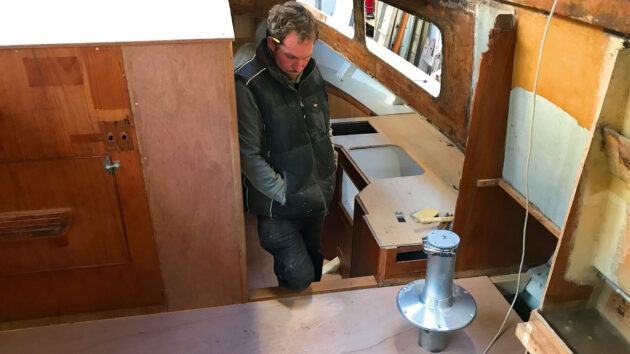
Joiners crafted bespoke cabinets and bulkheads. Photos: Nigel Sharp and Steve Brenner
A dominant feature of the saloon/wheelhouse is that the engine box tops on each side are raised by 12in above the central cabin sole. This is a consequence of the Nelson 35’s low freeboard – there simply isn’t room to fit the engines below the cabin sole while still allowing an acceptable level of headroom.
As it happens, the Perkins engines are slightly lower than the original Fords, and while no effort was made when they were originally installed to lower the engine boxes correspondingly, that has now been done, by about 3in. It has also now been possible to lower the central cabin sole area to allow the 6ft 4in Steve to stand up straight.
On top of these boxes to port is a bench seat and the JCB helm seat, which can swivel through 180º to face aft as well as forward; and to starboard is another swivelling seat, a fixed seat aft, and a small folding table between them.
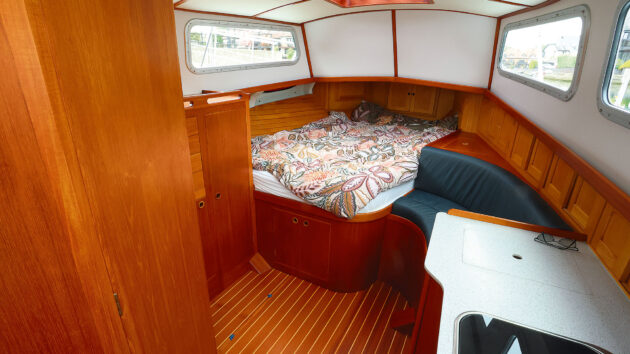
The finished interior is a fine example of the boatbuilder’s art, as well as very practical. Photos: Nigel Sharp and Steve Brenner
Throughout the boat there are numerous handholds as well as deep, profiled fiddles which can also act as handholds. “That was really important to me as I’m not getting any younger,” said Steve, although it seems to me entirely sensible for people of any age.
The internal joinery is predominantly crafted from teak with some items, such as the table, the forward cabin, sidelining and outboard lockers made out of oak.
The cabin sole and engine box tops are made from teak with holly splines, while the seating is upholstered in blue leather.
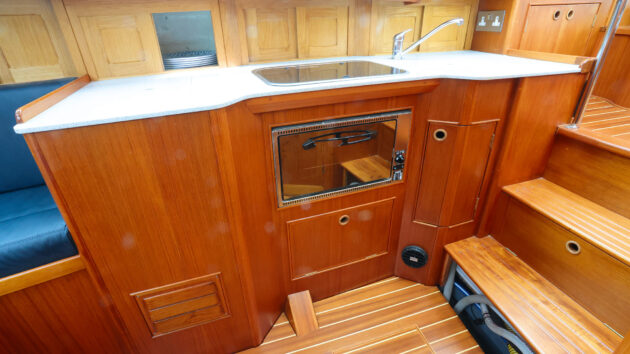
The new galley has all the mod cons, including a gas hob, oven and top-loading fridge. Photos: Nigel Sharp and Steve Brenner
Exterior tweaks
The main modification on the outside is the addition of a substantial D-section rubber fender around the perimeter of the boat. This was supplied by Bridge Rubber, which formed the three corners in an autoclave and fitted nylon strips with tapped holes within the D-section so it could be fastened to the hull from inside, allowing a clean finish on the outside.
Ten new windows from Technautic Marine Windows of Burnham-on-Crouch include four opening ones in the wheelhouse and small Lewmar hatches above the heads and galley.
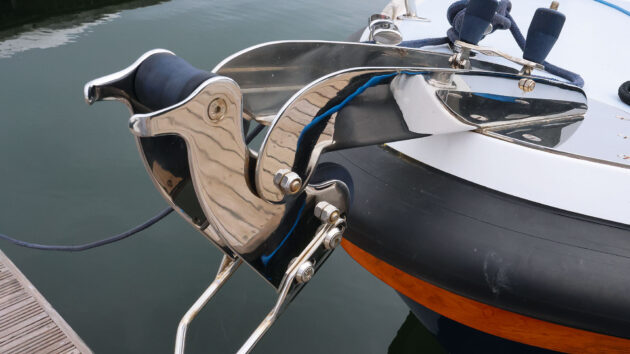
Rubber fendering is true to its workboat heritage. Photos: Nigel Sharp and Steve Brenner
The stainless-steel pulpit and the pilot boat- style handrails around the sides and front of the superstructure have been refurbished and retained; while stainless-steel railings with a timber capping around the cockpit coaming have effectively been replaced with a conventional pushpit. “I was frightened to death of losing somebody over the stern, perhaps without even knowing it,” explained Steve.
The original teak cockpit seats have been retained, albeit with some local repairs, and the cockpit sole has been re-laid with second-hand teak that was recycled from the worktops of a school science laboratory!
The cockpit cover has been made by Dutch company Perlo in triple acrylic Mohair which, while it is dark blue on the outside, has a light grey interior colour for a less oppressive feel. Furthermore, the side and aft sections can either be removed completely or replaced by transparent panels.
“The cockpit is absolutely fantastic,” said Steve. “It’s the nicest I have ever had in any of my boats.”
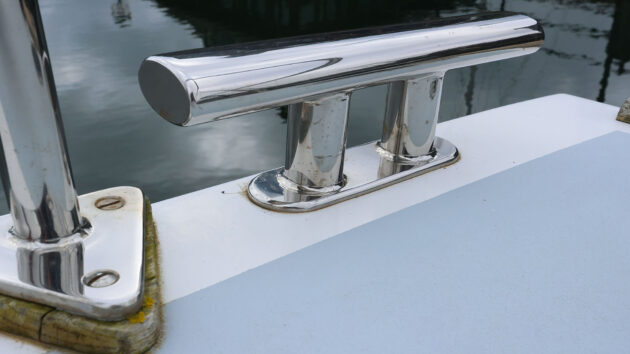
Heavy duty stainless steel fittings look smart. Photos: Nigel Sharp and Steve Brenner
One of Steve’s previous Nelsons was a 34 called Moonlight Shadow of Aldeburgh, to which he incorporated an innovative outside steering position that he has now replicated on Cygnet.
This is deployed by first stepping onto the seat in the starboard aft corner of the saloon, opening the hatch above it, and then looking out over the coachroof. A portable screen is then connected to allow control of the engines, steering system and electronic navigation.
Counting the cost
The whole project has cost Steve in the order of £345,000, including the purchase of the boat (or rather that is the cost to date, but he has plans to make further improvements in due course). “Fortunately for me, the costs were spread over a long period of time,” he said.
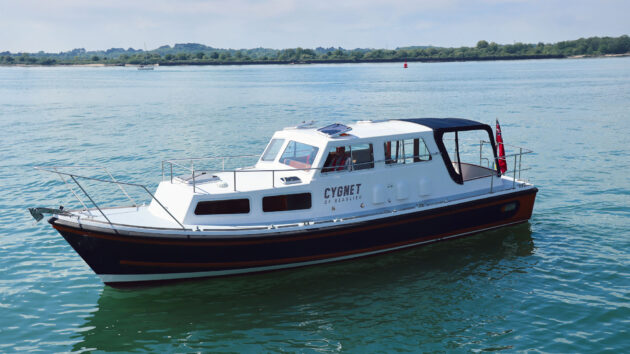
Still instantly recognisable as a Nelson but now looking better than ever. Photos: Nigel Sharp and Steve Brenner
It actually took about eight years in total, partly because of Covid but also because, in 2018, Steve had a dreadful accident, although it could have been much worse.
“I fell off a shore-based Nelson 40 Pilot boat,” he said. “I don’t really know what happened but apparently I was found by a local dog walker and ended up being taken by helicopter to Southampton Hospital where I spent five weeks, initially in intensive care.”
With Cygnet back in the water in 2025, Steve and his wife Grietje took her to the West Country – partly in company with five other boats from the Nelson Boat Owners’ Club – visiting Poole, Weymouth and Dartmouth.
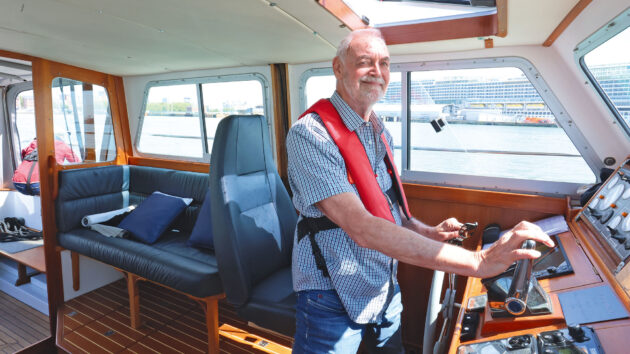
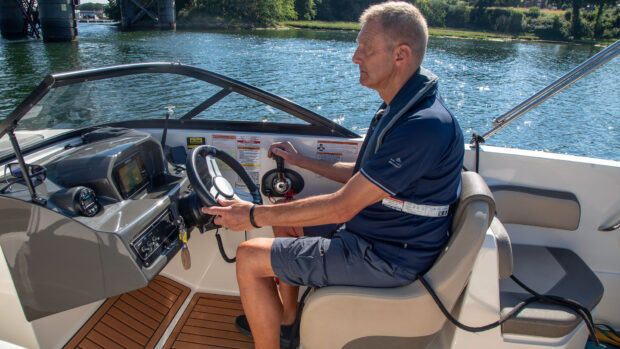
Steve Brenner at the helm of his lovingly restored Nelson 35. Photos: Nigel Sharp and Steve Brenner
Cygnet’s top speed is about 21 knots, but Steve finds that her optimum performance is with the engines running at 2000rpm at which the speed is 18 knots and the fuel consumption is 4.1 litres per nautical mile; while at the displacement speed of 8 knots, it drops to 1.7lpm.
The couple have two alternative UK moorings for Cygnet, one at Hythe Marina Village (where they also have a house) and one at Emsworth Yacht Harbour.
From there their future plans include voyages to the Netherlands (where they have a berth in the KDR&ZV harbour in Dordrecht) and the Frisian Islands, where Steve and Grietje have been many times before at the helm of their other Nelsons.
“I’m delighted with the boat,” Steve told me. “She is everything I would want in a Nelson. “Because the systems and everything being so new, hopefully there won’t be many problems with her. But you never know with boats!”
 If you enjoyed this….
 If you enjoyed this….
Motor Boat & Yachting is the world’s leading magazine for Motoryacht enthusiasts. Every month we have inspirational adventures and practical features to help you realise your sailing dreams, as well as tests and news of all the latest motorboats.
Plus you’ll get our quarterly Custom Yachting supplement where we share the last on offer in the superyacht world and at the luxury end of the market.
Build your knowledge with a subscription delivered to your door. See our latest offers and save at least 30% off the cover price.
Note: We may earn a commission when you buy through links on our site, at no extra cost to you. This doesn’t affect our editorial independence.