
The first production hybrid pod drive system from Volvo promises to be a game-changer. We take it for a spin
This isn’t the first time Volvo Penta has invited us to test a hybrid engine. Back in 2023 we sea -trialled a Jeanneau NC37 sportscruiser fitted with a prototype diesel electric drivetrain featuring a pair of D4 engines linked to 60kW electric motors. It worked a treat and yet three years on there is still no sign of either Jeanneau or Volvo offering it to customers.
The problem isn’t the technology, that’s well proven, it’s the extra weight and cost that makes little commercial sense on a mass market leisure boat that may only get used for 50 hours a year. Upscale the system to luxury 60-100ft motor yachts, however, and the cost- to benefit ratio looks a lot more attractive – hence the reason we are back at Volvo’s Krossholmen test facility to sea trial Volvo’s first production hybrid drivetrain.
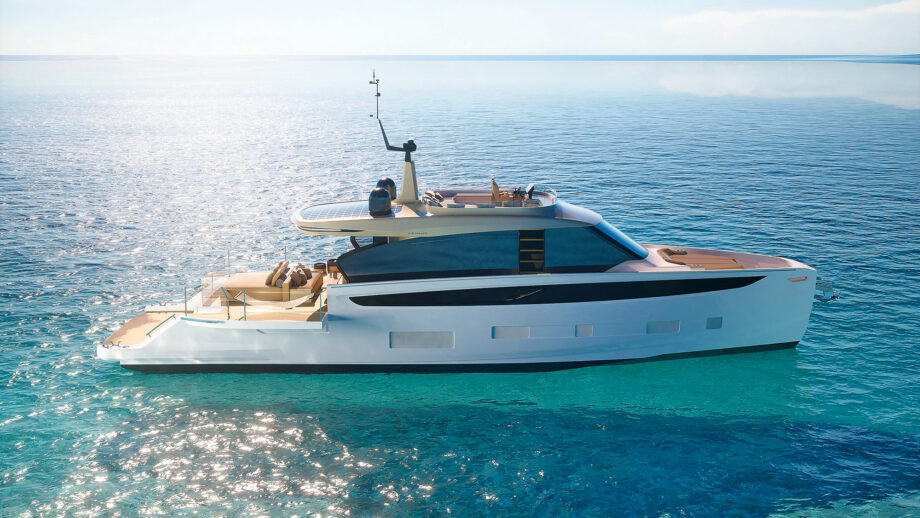
Not only is this new D13 IPS Hybrid a relatively easy to install helm-to-propeller solution, it also has several major yards already committed to using it, including Azimut for its Seadeck 7 and Sanlorenzo for its elegant retro motor yacht, SHE.
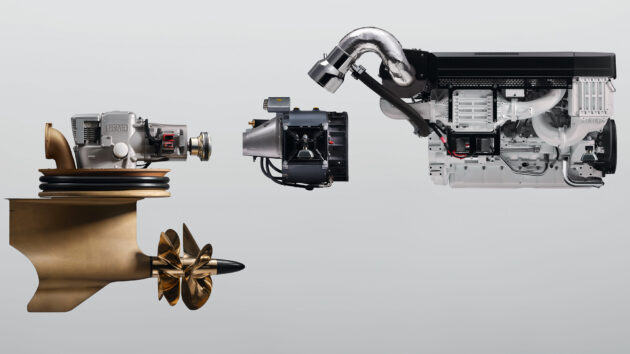
A powerful 160kW electric motor/generator slots in between the D13 diesel engine and the IPS pod
Hybrid Heart
Sadly, neither of these craft are here today but what we do have is Volvo’s own 68ft aluminium test vessel. Weighing 42 tonnes and featuring a planing hull, it’s a pretty close match for the Seadeck 7, in size if not in style! But first a little more on what the hybrid package comprises and why it should appeal to owners as well as yards.
At the heart of the system is Volvo’s 12.8-litre six-cylinder D13 engine, delivering between 700-1,000hp depending on the state of tune. This is linked to Volvo’s usual forward-facing IPS pod drive system but there’s now a 160kW (214hp) electric motor/generator slotted in between them. Supporting this is a Volvo battery pack of 147-221kWh linked to a bespoke liquid cooling system and a power distribution unit (PDU) containing a charger, inverter and 24V DC output for house loads in a single compact unit.
If this sounds a bit complicated, it should all look and feel pretty familiar to existing Volvo owners. You still get the same user-friendly throttles, joystick and docking functions as a regular IPS system, it’s only the glass cockpit plotter display that has changed to accommodate the four new driving modes.
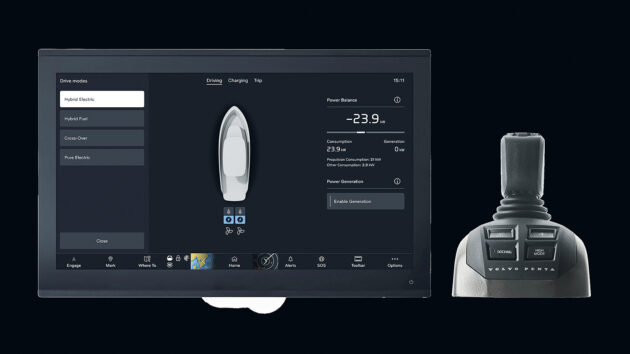
Different driving modes include Cross-Over where one engine drives both pods, halving engine hours
The first, and by far the most frequently used, is called Hybrid Electric. Just like in a hybrid car this is an automated system that takes all the important decisions for you. At low speeds it will favour electric propulsion to minimise noise and vibration. When more speed is required or the batteries need recharging, it will fire up one or more of the diesel engines and bring them into play using a clever electric clutch mechanism.
Driving Modes
Pure Electric and Hybrid Fuel modes are really variations on a theme, allowing the skipper to manually select exclusively electric or diesel power, for example when leaving or entering a marina or wanting to save battery power for later use. The final Cross-Over mode is more interesting, as it enables you to drive both IPS pods from a single diesel engine – one directly and the other via the electrical energy which the diesel motor generates being diverted to its electric motor.
Not only does this save around 30% of the usual fuel burn but it halves the engine hours, extending servicing intervals and reducing costs. Cleverly, it also swaps engines every hour to balance usage across them both. So how does this all work in practice?
This being a commercial test boat, it’s not the prettiest of installations. The maximum capacity 221kWh battery bank is plonked on the aft deck for ease of access and the engineroom is a blizzard of cables and wires for monitoring purposes. In production form the batteries are likely to be tucked in the bilges, often some distance ahead of the engines to maintain a level trim and low centre of gravity (the hybrid system adds around 3 tonnes to the weight of a standard IPS1350), leaving the engineroom relatively clean and accessible, albeit with a 650V electrical system requiring specialist training to work on.
With no need for a generator (the battery pack takes care of house loads) and far less heat, noise and vibrations at low speeds, the engineroom should also be a nicer place to work in.
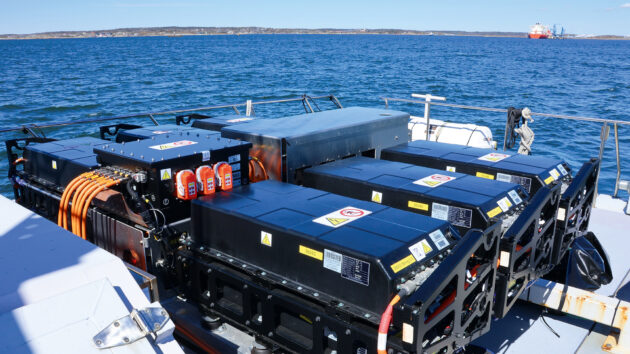
The test boat’s battery pack was installed on the deck for ease of access. It would normally be hidden
First Impressions
From the Captain’s perspective, it’s largely business as usual at the helm. In Pure Electric mode the two 160kW motors provide more than enough grunt to propel the boat close to its maximum displacement speed. This will of course vary from boat to boat but we managed 11 knots, giving a run time of around 40 minutes and a range of roughly 7 miles.
At a more modest 8 knots this increased to just over two hours and 16nm, enough for a near silent potter to a nearby bay. Combined with Volvo’s excellent joystick and Assisted Docking function, which automatically counteracts the effect of wind and tide, it makes for effortless and almost noise-free berthing – perfect for slipping in and out of marinas without waking your guests.
Switching to Cross-Over mode brought the starboard engine into life and a little more noise and vibration. Running this one engine at 1,100rpm delivered a solid 10 knots while burning just 4.4 litres per nautical mile and generating 120kW, 110kW of which was being used by the port electric motor, leaving 10kW to power the house loads and/or recharge the batteries.
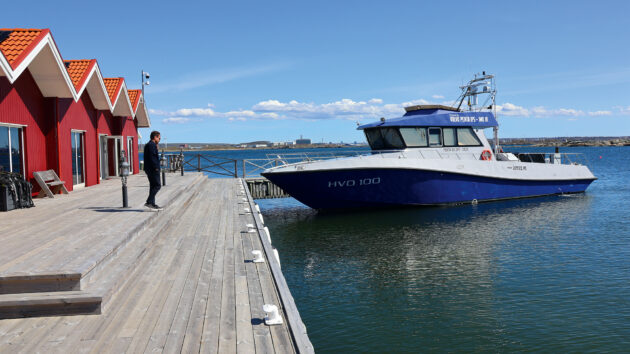
It’s not as pretty but Volvo’s 68ft aluminium test vessel is a similar size and weight to an Azimut Seadeck 7
Changing to Hybrid Electric mode and increasing the revs to 1,900rpm sparked both engines into life, pushing the speed up to 18 knots and increasing the fuel burn to 13.7 l/nm. However, at this speed it was also generating 135kW, enough to charge that massive battery bank from empty to full in a little over 90 minutes.
Flat out with both engines running at 2,470rpm and no loading on the generators, we reached 28 knots.
While the figures may make interesting reading for owners and engineers with an eye on running costs, the real benefit to users is the superior guest experience it brings with it.
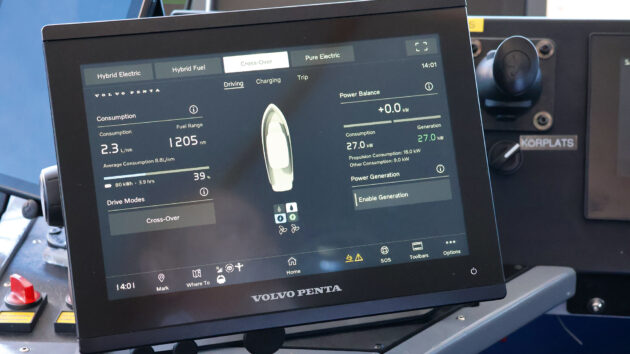
A bespoke hybrid screen shows the driving mode, fuel burn and range remaining as well as whether the diesel or electric motors are being used
Verdict
Tellingly, there is almost no mention of any environmental benefits in the press release, the focus being on the reduced noise and vibration levels. Don’t forget that even the smaller of the two battery packs should be able to power a 70ft yacht’s hotel load for over 11 hours without the noise or smell of a diesel generator.
It can also be fully recharged by running the main engines for just 40 minutes at anchor or for an hour or two while cruising at 15 knots. Combined with the speed, efficiency, refinement and docking benefits of Volvo’s existing IPS drives, as well as the ease of installation for yards, it is a very compelling package.
 If you enjoyed this….
 If you enjoyed this….
Motor Boat & Yachting is the world’s leading magazine for Motoryacht enthusiasts. Every month we have inspirational adventures and practical features to help you realise your sailing dreams, as well as tests and news of all the latest motorboats.
Plus you’ll get our quarterly Custom Yachting supplement where we share the last on offer in the superyacht world and at the luxury end of the market.
Build your knowledge with a subscription delivered to your door. See our latest offers and save at least 30% off the cover price.
Note: We may earn a commission when you buy through links on our site, at no extra cost to you. This doesn’t affect our editorial independence.