

A new generation of Seakeeper stabilisers promises more power and faster spool-up times in a smaller package with fewer servicing costs. Hugo Andreae takes a closer look
Since Seakeeper launched its first gyroscopic stabiliser in 2008, the name has become so synonymous with the product that it’s close to becoming genericised. People no longer ask if a boat has a gyroscopic stabiliser, they simply ask if it has a Seakeeper.
It’s both a measure of the company’s success and a potential risk – hoover, biro and jet-ski all started off as brand names before being subsumed into everyday language.
Seakeeper isn’t there yet but with 40,000 gyros sold and almost every major boat builder offering them as a factory-fit option, there’s no doubting the impact it’s had. Where does Seakeeper go next and how will it sustain that level of success?
The answer to the first is Seakeeper RIDE; a new and extremely effective vessel attitude control system. The answer to the second is at least partially contained in this new model, the Seakeeper 7.5.
It may not look radically different to the 13 other gyro stabilisers in the range, but thanks to an all-new mechanical design it heralds a step change in performance relative to size and price.
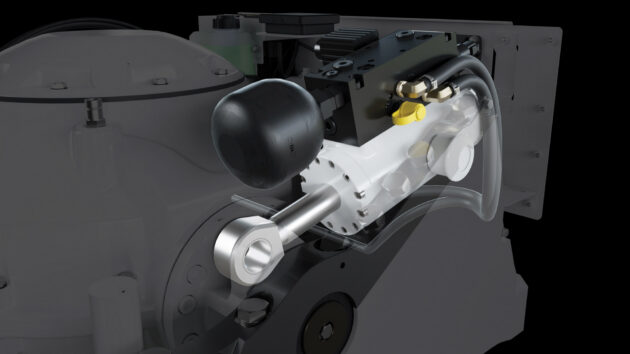
Brake matches the stablising force to the wave frequency
Faster spool up
Designed as a direct replacement for the Seakeeper 6, it offers 25% more stabilisation power in a 20% smaller package with a 50% faster spool up time and reduced servicing requirements. Crucially it also fits in the exact same footprint, so owners can quickly and easily upgrade from a 6 to a 7.5 without any major structural modifications.
Nor is this the only model to benefit from this technology. It is being joined by a new Seakeeper 5 and 10.5, both of which promise similar, albeit smaller, gains over their predecessors.
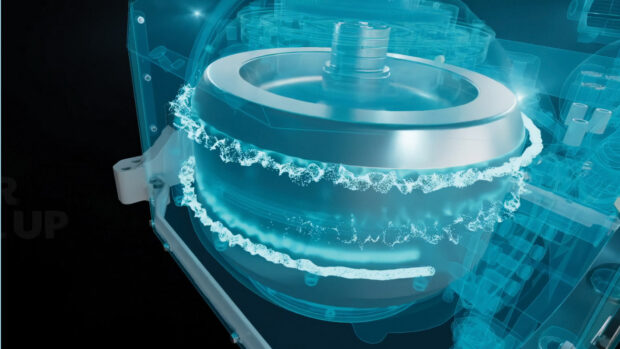
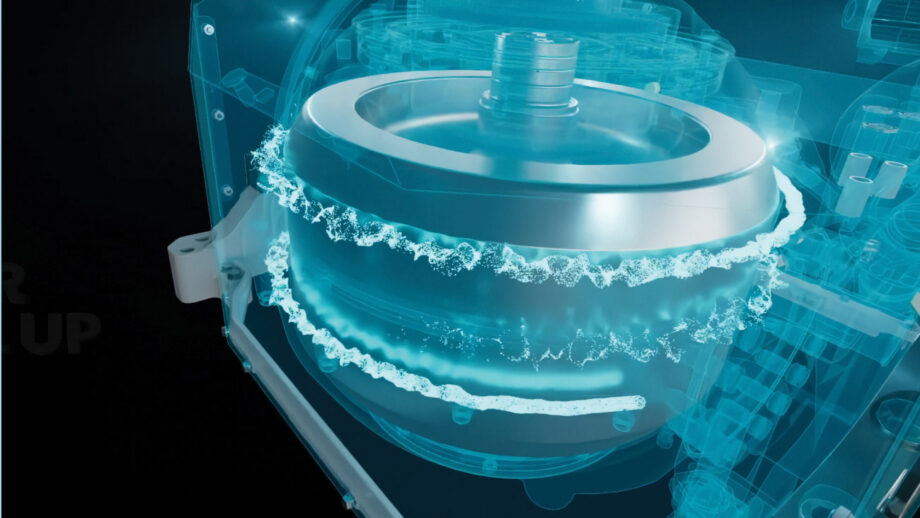
The improvements come from a variety of technical advances, not all of which Seakeeper were prepared to share with us, but we do know they include a new asymmetric design of flywheel that delivers more righting power while taking up less space than previous models.
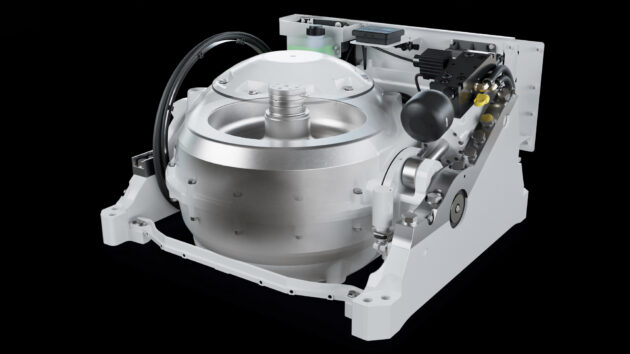
Asymmetric flywheel has the motor inside it
A more powerful custom-built electric motor, fitted inside the flywheel, also plays a big part in the shorter spool up time – a common bugbear of earlier models. The new 7.5 reaches its base stabilisation speed of 5,280rpm in just ten minutes and its full working speed of 9,700rpm in 21 minutes – less than half the 21 and 42 minutes required by the Seakeeper 6.
It also features a new single-cylinder brake instead of the previous twin-cylinder design. First introduced on the Seakeeper 1, this not only saves weight and space but also improves reliability by eliminating a number of high- pressure hoses and connections. This means it no longer requires routine servicing, just an annual inspection to check all is in order.
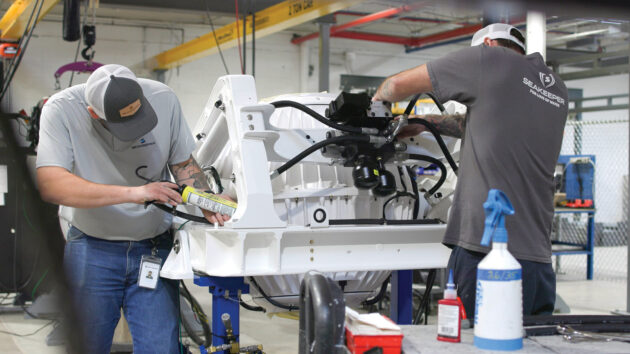
Trade-ins are rebuilt to as-new standard
Vacuum-packed
As with all Seakeeper gyros, the new models are numbered according to stabilisation power rather than size of boat. So the new Seakeeper 5 delivers an angular momentum of 5000 Newton-meter-seconds (a measurement of stabilising torque over time) while the 7.5 delivers 7500 N-m-s and the 10.5, 10,500 N-m-s. The size of boat they can handle depends on displacement as much as LOA but the guidelines are 40-48ft, 45-54ft and 50-62ft respectively.
The reason they are so compact is down to the vacuum sphere in which the flywheels are mounted. With no air resistance, the flywheels can spin at immense speed (up to 557mph) while using relatively little power.
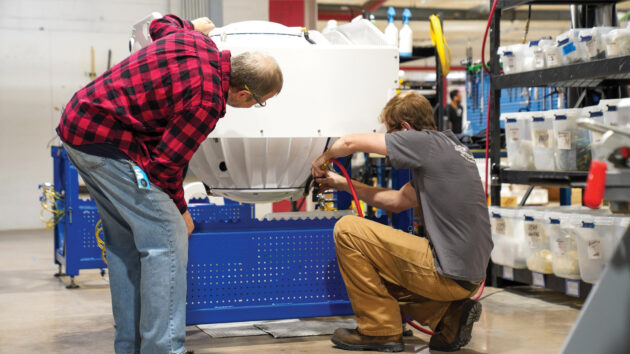
All models come with a two-year warranty
These high speeds enable them to create the same stabilising force from a smaller, lighter package than competitor products from Quick and Dometic, which use heavier but slower spinning gyros without a vacuum sphere.
For instance the Quick X25 AC, which delivers a maximum 10,000 N-m-s at 4,000rpm, weighs 840kg, compared to the Seakeeper 10.5’s 10,500 N-m-s at 8,700rpm from a 584kg unit.
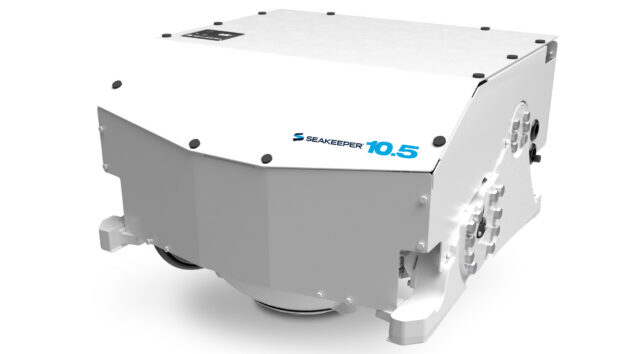
The new models deliver more stabilisation in a smaller package
Exchange programme
The other benefit of having so many units already out there is that Seakeeper can offer a part-exchange programme for existing owners as well as rebuilt secondhand gyros for those on a tighter budget. The exact trade-in value depends on the model being exchanged but can be as much as 40% off the price of a new one (35% in the case of a Seakeeper 6 against a new 7.5).
The savings on a rebuilt one (usually around 15% off the new price) are smaller as the remanufacturing process is impressively thorough. This involves a full strip down, replacement of all worn or wearable items (bearings, heat exchangers etc) and a rebuild to as-new standards with the same two-year, 2,000 hour warranty as a brand new product.
 If you enjoyed this….
 If you enjoyed this….
Motor Boat & Yachting is the world’s leading magazine for Motoryacht enthusiasts. Every month we have inspirational adventures and practical features to help you realise your sailing dreams, as well as tests and news of all the latest motorboats.
Plus you’ll get our quarterly Custom Yachting supplement where we share the last on offer in the superyacht world and at the luxury end of the market.
Build your knowledge with a subscription delivered to your door. See our latest offers and save at least 30% off the cover price.
Note: We may earn a commission when you buy through links on our site, at no extra cost to you. This doesn’t affect our editorial independence.
Verdict
We’ve yet to sea trial any of the new models (deliveries start this autumn) but the promise of more stabilising power in a smaller, faster, more reliable package is certainly an enticing one. As is the fact that bespoke integration with Seakeeper’s RIDE system brings a 20% performance increase over and above the combined effect of both. Perhaps inevitably, the new models are more expensive than the ones they replace, but Seakeeper’s claim that they represent better value in terms of stabilising power per dollar/pound combined with the clever trade-in programme helps offset that. Whether it’s enough to hold off the advances of lower- priced competitors remains to be seen. As ever, the market will decide.