

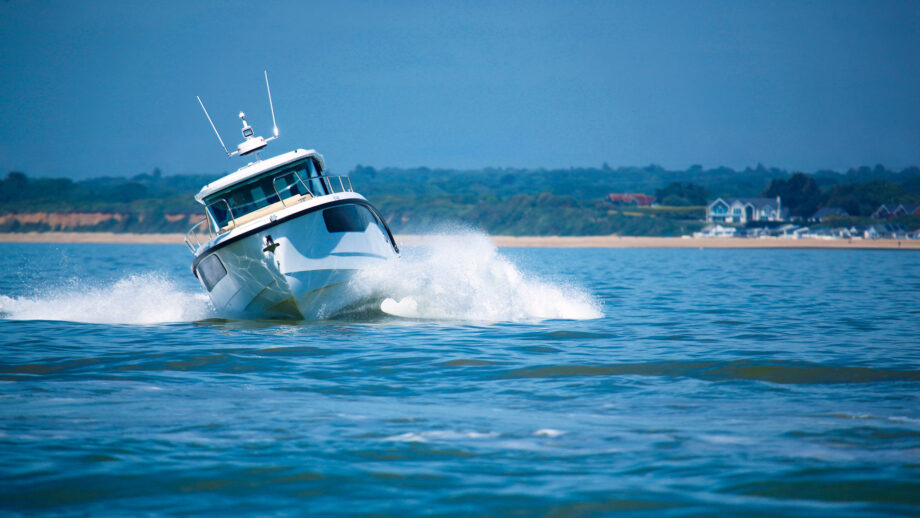
Yamarin takes a tangent with a pilothouse flagship 5ft larger than anything else in the fleet, the Yamarin Aura Cabin. Alex Smith reports
Here at Motor Boat & Yachting, we’ve enjoyed Yamarin powerboats for many years now. We’ve tried all kinds of platforms from bow riders and day cruisers to centre and side console boats and they never fail to deliver what you expect.
As an established force in Nordic boating circles, this Finnish boat builder is justly renowned for small, open, outboard-powered motorboats with traditional deep-vee hulls, finely tuned ergonomics and supremely novice-friendly helming manners.
But while all kinds of brands have been forging ahead in the adventure yacht sector with multi-purpose pilothouse platforms, Yamarin has, to this point, remained remarkably quiet on that front.
So it’s great to see the company making proactive moves with a boat that’s designed to straddle the gap between a Saxdor and a Sargo.
The idea behind that is to take the clever family flexibility of the former and the rugged practicality of the latter and to package it all in a boat that takes Yamarin’s traditional qualities into a region of the market where its small boat heritage suggests it ought to excel.
And here it is. Not just their biggest boat by more than 5ft but also the first true pilothouse model they’ve ever built.
The openness of the pilothouse feels very modern and well considered
Space allocation
The base layout taps directly into that need for practicality with a central pilothouse and a set of symmetrical walkaround side decks – and it continues with an 11ft beam. That’s pretty big for a 34ft monohull, so even with a twin rig, there’s plenty of space at the aft end for a pair of proper swim platforms.
There’s also a rack for your lines and fenders back here, plus some handy tying off points built into the back end of the transom bench. Like the bow, the cockpit itself does occupy a relatively short space – too short in fact for any freestanding furniture. But this is a deliberate ploy on behalf of Yamarin to maximise the length inside the pilothouse and they’ve worked hard to mitigate the potential impact of that by optimising the external cockpit’s integration with the internal saloon.
A pair of clever folding doors means the pilothouse opens right up at the aft end to reveal a pair of inward-facing benches. While that in itself is quite unusual, the addition of removable backrests and a roving seat module makes it highly flexible too.
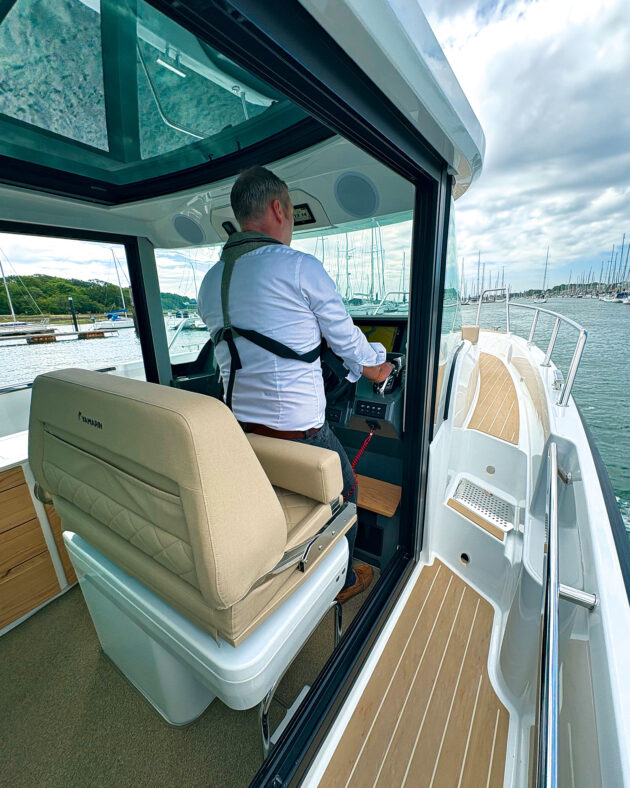
Protected, comfortable, adjustable and open, the helm station is ideal for solo boaters
You can create a forward-facing U-shaped unit, which is ideal underway; or you can rig it to look aft, across the single-level deck toward the occupants of the transom bench.
Chuck in a table (or even the additional day-bed infill) and at a stroke, you have a very sociable set-up, while retaining the capacity to empty out the cockpit for fishing or load-carrying, courtesy of an aft bench that folds neatly away against the transom. It works well – and once the under-deck locker is deep enough to house the infill, it will be even better.
The sheer openness of the pilothouse also feels very modern and well considered. The wraparound screen is supplemented with a huge overhead sunroof and those excellent aft doors.
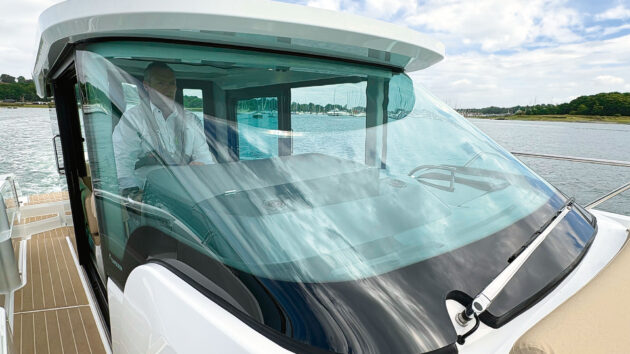
The big screen brings in lots of light but warps your view a touch at the corners
And while both sides of the pilothouse also open up, it’s the way they do so that’s particularly pleasing. Two equally large sliding doors on the port side mean you can either open up the forward end by the little wet bar or the aft end directly alongside the dinette.
The starboard side, however, uses a different approach, with a fixed aft panel and a pair of doors ahead of that. On the face of it that might seem like a shame but actually, it means you can extend the open section further aft, creating plenty of space to access that starboard side deck behind the helm seat, even when the skipper and co-pilot are in position.
Those broad, deep walkaround side decks are easy to navigate too. Upturned roof edges work really well as grabbing points without the cost (or the space-stealing projection) of bolt-on stainless steel railings.
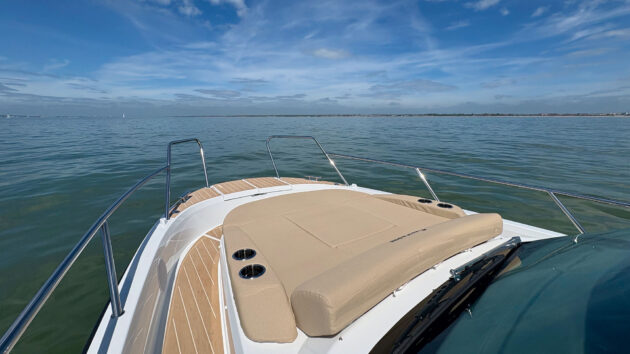
The short bow makes up for its small, simplistic sunbed with great ease of movement
A low-level rail inset into the gunwales also keeps the full breadth of the side decks available for making your way fore and aft. And when you head up a couple of steps to the foredeck, Yamarin has again done good things with a relatively short space.
The raised island sunbed is less than 5ft long but the stem-mounted anchor frees up plenty of space on the flared forepeak for a step-through bow and a fixing point for a ladder, so you can step ashore securely.
That ladder sits neatly in a dedicated bracket alongside the windlass beneath a pair of hatches. It would be good to see some optional cushions at the forepeak to help turn this section into a mini lounge for four, but it does a decent job for such a compact part of the boat.
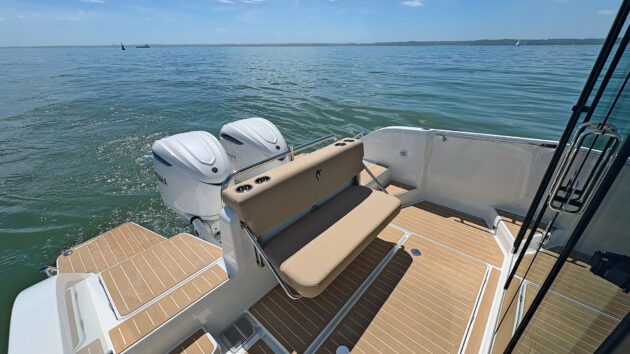
The folding aft bench enables you to clear the cockpit deck
Sleeping for four
As you might expect on a boat of this size, the bow cabin is arranged as an open-plan lower lounge. It’s big enough for four and it’s almost as clever as the upper deck. It comes with a large upholstered backrest ‘block’ that simply drops into the space to create a really large double bed within a second or two.
It’s equally easy to rig it as a lounge again in the morning and the fact that the backrest stops short of the forepeak makes good sense. It means you can dump your pillows, duvets and sheets behind it, out of sight until the evening, without clogging up any of your storage spaces.
And you don’t lose out on any living space because the backrest inhabits the region beneath the dipping deckhead for the forepeak’s walkaround deck, where you wouldn’t be able to sit up anyway.
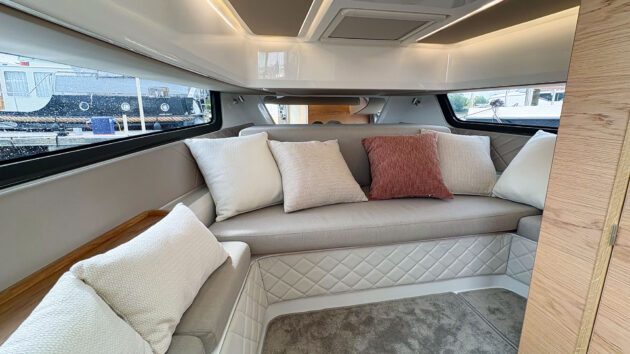
The open-plan lounge uses a cushioned block as a backrest
The narrow port seat is less well conceived, as a pretty timber shelf jabs you in the small of the back and the port side deck smacks you in the back of the head. But the ergonomics of the starboard heads compartment are much better.
It’s not big but with a large mirror, an electric loo, decent headroom for a six-footer, a sizable vanity unit and an optional wetroom-style shower fitting, it does everything you could reasonably expect of it. The guest double also does a decent job.
It runs fore-and-aft beneath the saloon deck with a good size of bed and just about enough headroom to prop yourself up for a read. There’s no natural light because panels on each side provide access to engineering spaces rather than the outside world.
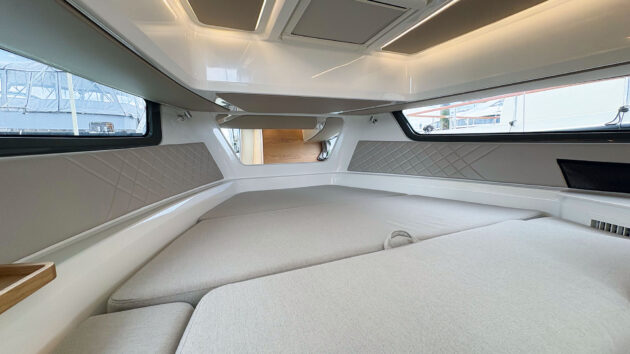
The open lounge converts to form an instant bed
But the fact that you can also rig the saloon dinette as an extra bed means that even a family of four could feasibly use this boat as a cruising machine while keeping the guest cabin spare as a dumping ground for baggage.
If you’re keen to use the boat for overnight trips, there are plenty of other options to optimise it for that. You can opt for a pair of solar panels and a lithium battery bank to supply the power for the pantry’s induction hob.
You can trade the aft bench for a wet bar and do away with the test boat’s port pantry altogether. And if you go for the diesel heating, you can trade the induction hob for a diesel one.
In fact, such is the scope for options that our high-spec test model increases the £281,000 (inc VAT) base price by 42% to around £400,000. It’s a big jump but the customisation potential it brings is a very valuable thing.
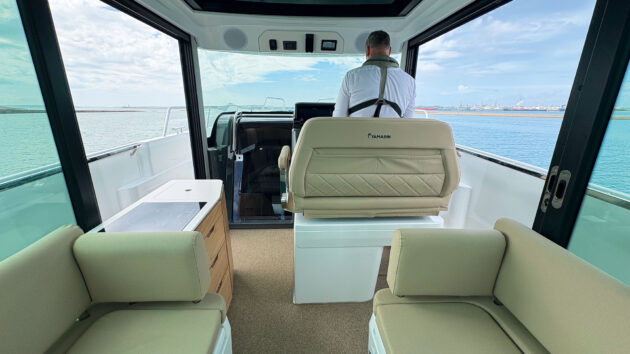
With the big sunroof, side doors and aft doors, light, fresh air and visibility are great, wherever you happen to sit
It’s still a Yamarin
The helm station on the Yamarin Aura is a peach. The twin helm seat comes with bolsters and armrests plus optional push-button adjustability with plenty of travel.
The beautiful six-spoke wheel is also adjustable and, in addition to a second 16in plotter on the main tier of the dash, we have space above the screen for extra equipment in the style of a commercial pilotboat. And talking of the screen, what a screen it is.
As a double-laminated one-piece unit, it wraps right around the sides of the pilothouse structure, creating really panoramic views and admitting oceans of natural light.
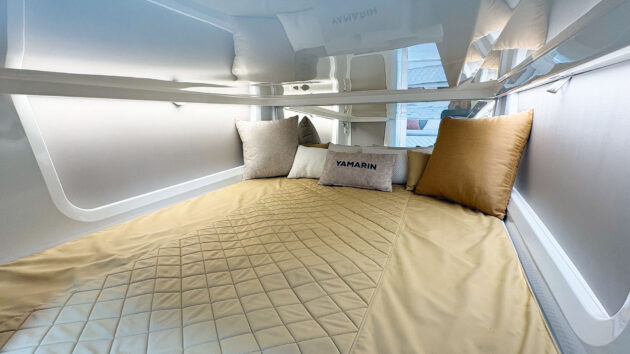
Although it inhabits a central section between engineering spaces, the guest double is a perfectly decent size
At 150kg in weight, it’s quite a major feat of engineering in its own right, but if you’re a Yamarin enthusiast, fearing that this new pilothouse model, with its extra scale, weight, elevation and windage, might disrupt the poise and balance for which Yamarin has become so well known, then fear not…
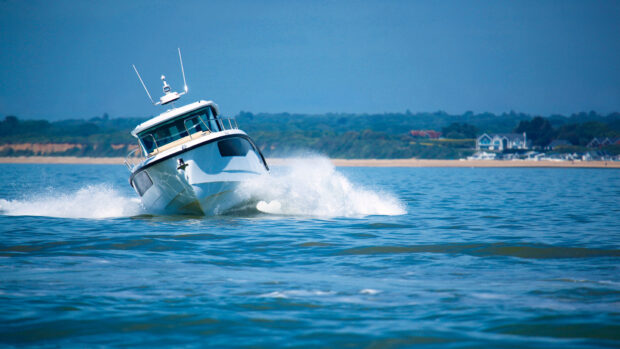
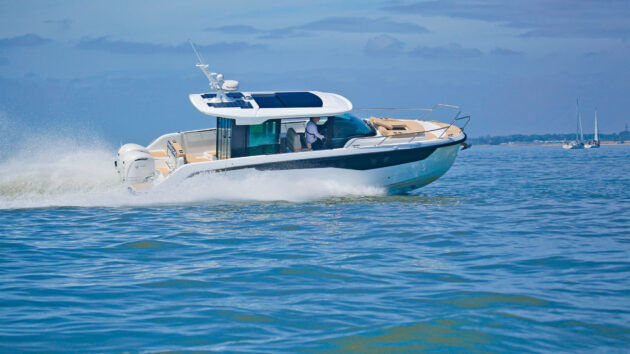
The moment you put the hammers down, the behaviour of this boat is blissfully easy to get on with. There’s plenty of grunt allied to a relatively soft, dry ride and when you throw it into a turn, there’s lots of quick-witted response.
We heel deep and power round with lots of easy ‘hands-off-the-wheel’ composure, allied to a really well-judged mix of grip and slip. It’s agile but comfortable; responsive but never hard-edged; and Yamarin’s traditional 30-knot sweet spot also seems to be present and correct.
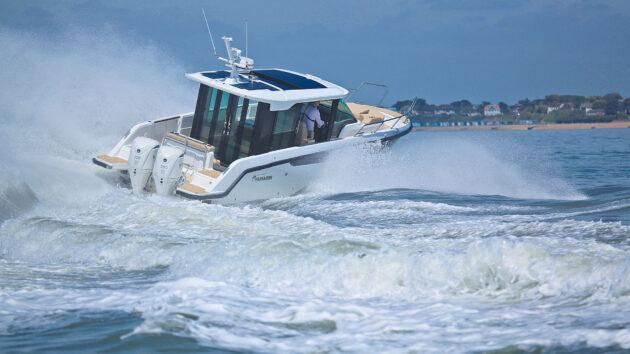
Its ingenuity is of a quieter, more modest persuasion
At everything from 20 to 30 knots, a fuel flow of 3L per mile brings a range approaching 200 miles, as well as sound readings that dip as low as 71.0dB(A) for a remarkably easy and refined long-distance passage.
With a top end approaching 47 knots, it’s impressively speedy too, but the indications are that it could well become even pacier. Trials are currently underway with a variety of props at the Yamaha test centre in Rotterdam with a view to breaking the 50-knot mark. If that’s too much for you then you can rein things in while still enjoying plenty of performance.
With a pair of 300s, which use the same 4.2L V6 block as the 350s, you can expect 44 knots; and even with the basic 250s, 40 knots is still feasible. That said, there’s no good reason to go so low.
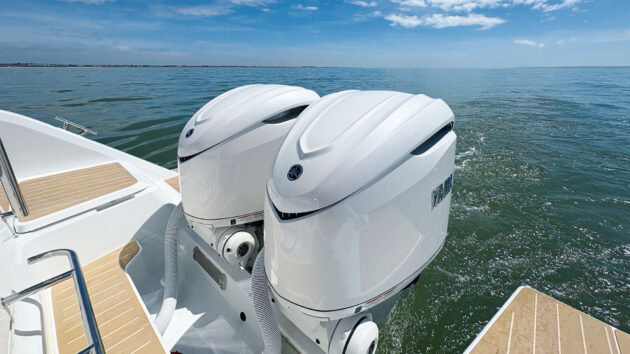
For heavy loads, rapid transits and easy watersports, the top-rated 350s are the way to go
In fact, given the excellence of the weight distribution, the modest windage, the natural balance, the user-friendly ride and the idiot-proof handling, we’d be inclined to maximise the potential of this boat for heavy loads, rapid transits and easy watersports by opting for the test boat’s top-spec 350s.
Yamarin Aura Cabin specifications
LOA: 34ft 1in (10.40m)
BEAM: 11ft 0in (3.35m)
DRAFT: 2ft 3in (0.70m)
DISPLACEMENT: 5,700kg (light)
FUEL CAPACITY: 700L
WATER CAPACITY: 100L
ENGINES: Twin 250-350hp outboards
Yamarin Aura Cabin costs and options
Price from £281,000 inc VAT. Test boat includes the following options…
Seakeeper Ride 600: £11,570
Zipwake tabs system: £4,825
Starboard side gate: £1,280
Flexiteek decking: £8,850
Launch Edition (inc heads): £23,680
Electric sunroof: £10,072
Air conditioning: £9,826
Pantry (inc sink, induction stove): £5,401
Verdict
In terms of scale and sector, Yamarin’s largest and most versatile platform yet is at once a departure for the brand and a very coherent revoicing of the things it has done so well before. There are no reverse bows or stepped hulls here. No origami-style deck furniture or cockpit-expanding terraces. Its ingenuity is of a far quieter, more modest persuasion but it’s undoubtedly there. And so is the easy-driving hull, the clean, classical styling, the dynamic balance, the user-friendly options lists and the proven-at-sea ergonomics behind the touch points and the flow of space. It’s a boat that simply works – and while the Saxdor and Sargo owners of this world will continue to favour their own boats for their own reasons, this is a thoroughly convincing (and very welcome) addition to the mix.