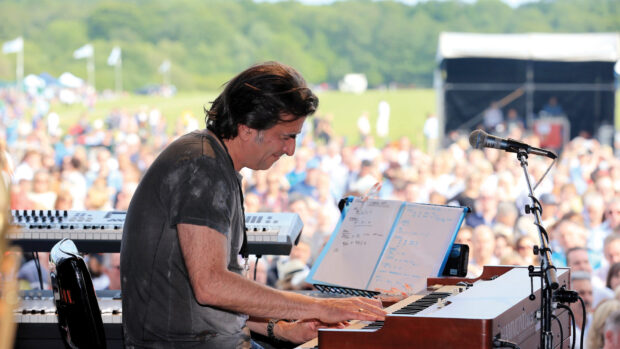

From co-founding Silent Pool gin to jumping waves at 65 knots, here is how Ian McCulloch became an offshore race boat owner
I never set out to become a powerboat racer, let alone a team owner, but after selling my business in 2023, I was looking for a new challenge. Initially I thought about buying a classic racing car.
I’ve been into cars and bikes all my life and loved the idea of being part of the classic racing scene, but when I looked into it, I realised that it gets heavily moneyed very quickly and people take it far too seriously for my liking. That’s when my boat-mad neighbour Paul Lintott suggested power boat racing.
Initially, I was wary of the idea. I grew up living in London and had no family connection with boating. For a long time the only water-based activity I’d had was taking out a wood and canvas canoe during a scout camp exercise in Devon. I can still remember the thrill of being a mile offshore in a big swell – the combination of fear and excitement was the closest thing I’d yet had to a religious experience.
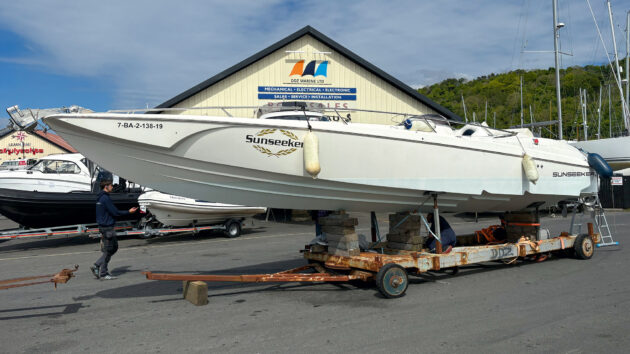
At DDZ Marine, Scotland
Gin fling
After leaving school, I went into the motor business before switching to selling air time on television. It was the start of a long career that culminated in me being appointed Commercial Director of ITV.
Over the years I’ve owned a number of fast bikes and cars but when I got married and started a family, I sold the bikes and bought a jet-ski on the assumption I was less likely to hurt myself. Not that you’d know it – I used to go out with my mates and spend all day jumping wakes and threading the Needles off the Isle of Wight.
I also got into sailing; hiring a boat for a week with an instructor so I could fast-track the learning process. That led to chartering overseas and one memorable lads weekend in Juan Les Pins where I recall sitting on the beach watching all these fancy powerboats whizzing past. It looked unbelievably cool but still I wasn’t tempted to buy one.
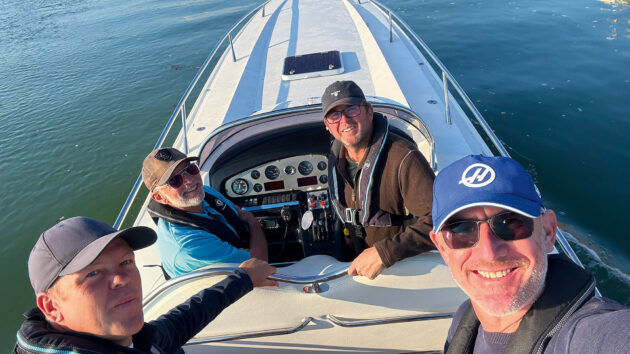
Chris, Ian, Ben and Paul
In 2007 I left ITV with a view to setting up my own business. It took me a while to settle on a plan, but in 2012, when the gin boom was still in its infancy, London was hosting the Olympics and there was a resurgence of interest in British craftsmanship, I realised there was space in the market for a premium British gin.
I wanted to tap into the zeitgeist for cool British brands like Bentley, Paul Smith and David Linley furniture so some friends and I launched Silent Pool gin.
Distilled on site in the Surrey Hills and infused with 24 botanicals, sales took off and by the time I sold out in 2023 it had become the largest selling UK produced ultra-premium gin.
I stayed on for three years to help ensure a smooth handover, but as I’m nearing the end of that, I needed a new challenge to fill my time and keep the adrenaline pumping. I’m 66 years old and have seen too many mates come down with cancer or lose a partner, so when Paul suggested buying a power boat and going racing, I decided it was worth investigating.
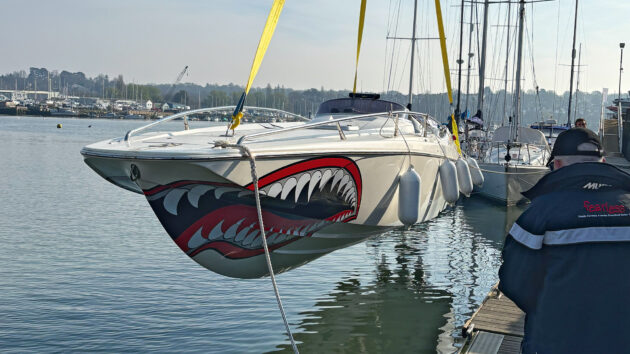
Great White Racing’s new team livery
I’d made a bit of money from the sale of the business and could afford to indulge a new passion but having never owned a boat before and knowing nothing about the racing scene, I was wary of being taken for a ride. Our first step was to attend a powerboat race together.
Buying a boat
It looked thrilling and terrifying in equal measure, but what really attracted me was the camaraderie of the competitors.
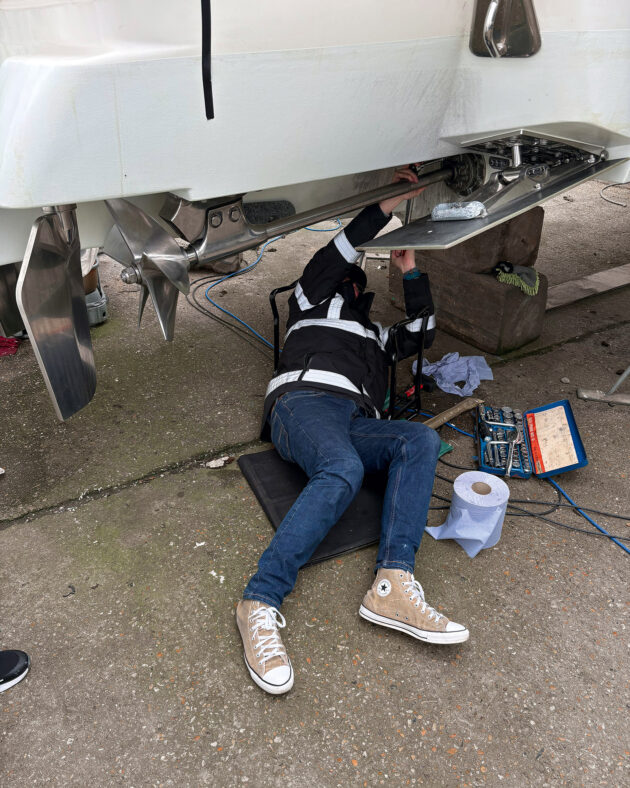
Landau set to work on the low-drag surface drives
There was no sense of them and us, everybody was happy to help each other and while some teams were clearly better funded and more professional than others, it didn’t look like success came down to how much money you were prepared to throw at it. The teams in the lower-powered classes seemed to be having just as much fun as those at the top.
I liked what I saw but it was clear we’d need professional help. Luckily Paul has an old university mate, Ben Metcalfe, who runs Landau Marine, and between them they had the knowledge and the facilities to set up a race team.
The next step was finding a suitable boat. Our aim was to compete in the UK Offshore Power Boat Racing Association (UKOPRA) championship. All the boats race together (up to 50 of them at a time) but there are three main classes based on maximum engine output and power-to-weight ratios.
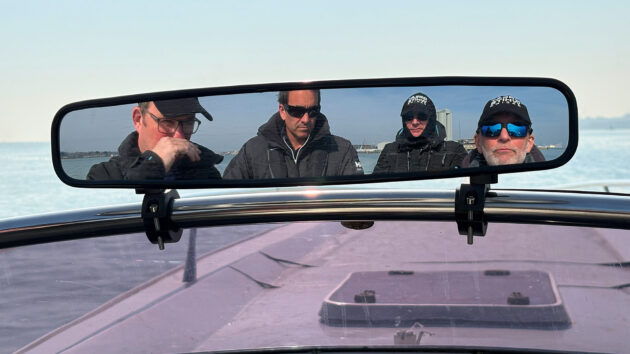
Race boats need a rear-view mirror to see what’s happening behind
We were never going to compete with the big guns in Class One, where up to 2,300hp is allowed and the boats regularly top 100mph, but Class 2 (up to 1,000hp and 4.25kg per hp) seemed a reasonable ambition.
Our plan was to buy a boat, set it up for racing and see how we got on. I had visions of a Miami Vice-style craft – all designer shades and linen blazers – and did look at buying a modern American performance boat like a Top Gun or Magnum.
Then I spotted Dry Martini for sale through an auction site. This classic 35ft Don Aronow design was raced by Italian powerboat champion Carlo Bonomi in the 1970s and 1980s and had been fully restored in 2010. I went to see it and immediately fell in love – the looks, the history, the big V8 petrols – I was utterly entranced.
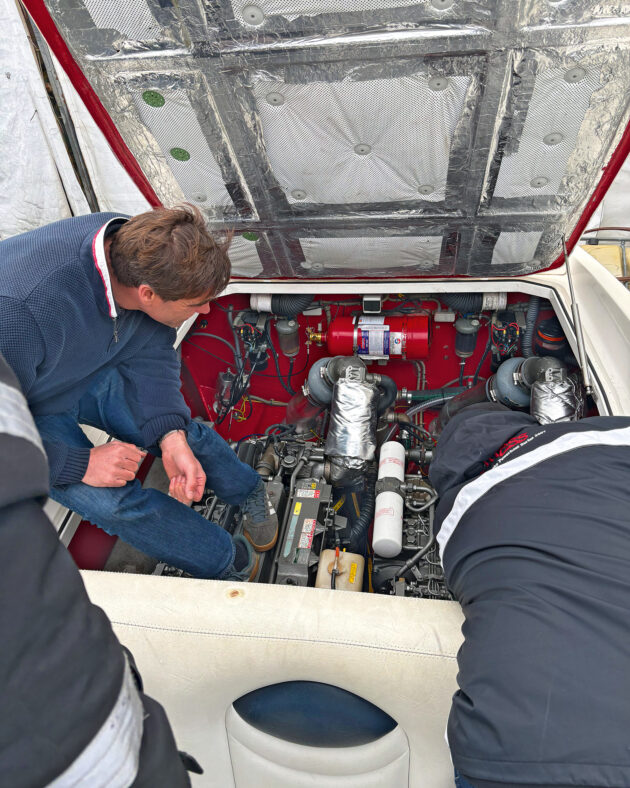
Standard 440hp Yanmar diesels give pace and reliability
However, my team mates were sceptical of going all-in on a classic race boat. The engines alone would cost a small fortune to run, and being a pure race boat, it would be unusable as a leisure boat for occasional weekend outings with the family.
Their preference was to look for a dual purpose craft like a Sunseeeker XS2000. Being a British production boat with stock 440hp Yanmar diesel engines, it would be more familiar for Landau to work on and cheaper to run. Also, if it didn’t work out, it would be easier to sell on.
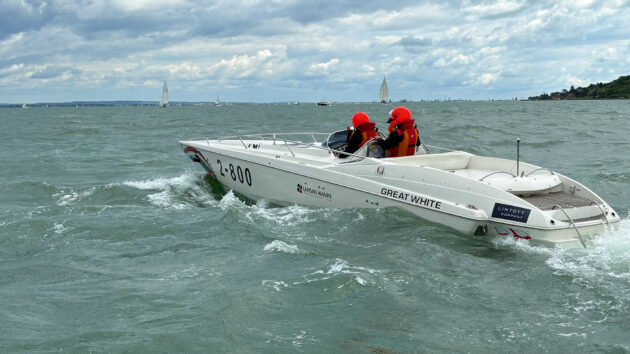
Fabio Buzzi hull is at its best in lumpy racing conditions
A more versatile option
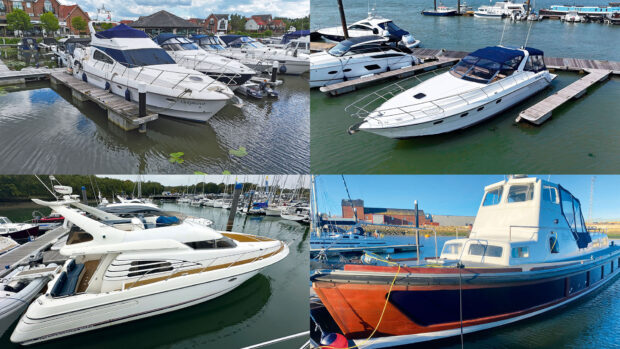
After a lot of searching, Paul and Ben found a 2006 XS2000 Challenger, one of a handful of models built for a racing series that never took off. Stronger, lighter and more race-oriented than the original XS Sport, it had spent much of its life as a superyacht chase boat and was now for sale through DDZ Marine in Scotland.
Paul and I went to see it. It may not have fitted my original Miami Vice fantasy but the engines ran well, the race-derived Fabio Buzzi hull had the pace and strength to hold its own and the two-speed gearbox and surface-piercing props were all in good shape.
I was also starting to see the sense of having a dual purpose race/leisure boat. My old man had a Mk 1 Lotus Cortina that he would go rally driving in at the weekend but bring back in time to do the school run on Monday morning. This had a similar vibe. After a bit of negotiation over some hull delamination issues revealed by the survey, we did the deal and had it transported back to Driver’s Wharf in Southampton.
As well as sorting out the hull repairs, Ben and his team at Landau Marine set about preparing it for racing. The engines and gearboxes just needed a good service but the shaft seals had to be replaced and we decided to fit a new Raymarine plotter to help with navigation.
As it was set up for solo helming, we also duplicated the trim controls so Ben could manage the trim and throttles from the portside seat leaving me to focus on helming.
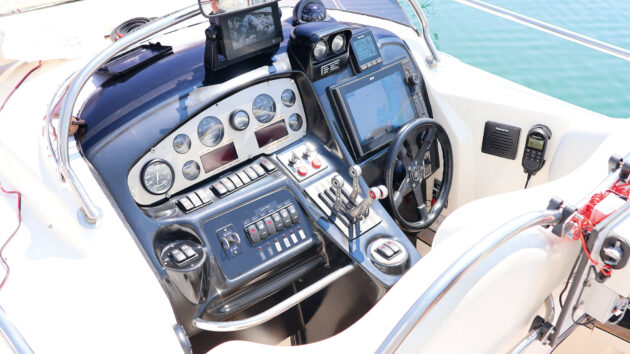
Throttles can be operated from the navigator’s seat so the driver can focus on helming
Flying start
With the first race just weeks away, we desperately needed sea miles under our belt, not to mention UKOPRA racing licences. I’d never driven a properly quick boat before, let alone raced one.
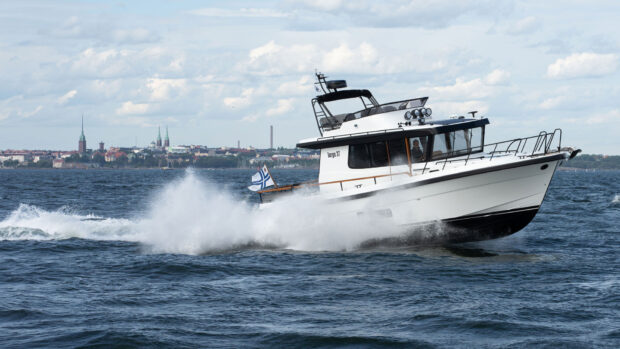
The first few runs were quite an eye-opener for all of us. The boat performed remarkably well, running at 65 knots where conditions allowed, but I don’t think any of us had grasped how physically demanding it would be.
On one run we managed to bury the bow into a wave causing a solid green wall of water to rip the windscreen off. As well as the shock, we now had less than three weeks to find and fit a new screen. That’s where the camaraderie of the UKOPRA teams really kicked in, helping us to source a new screen and ensure we made the start line.
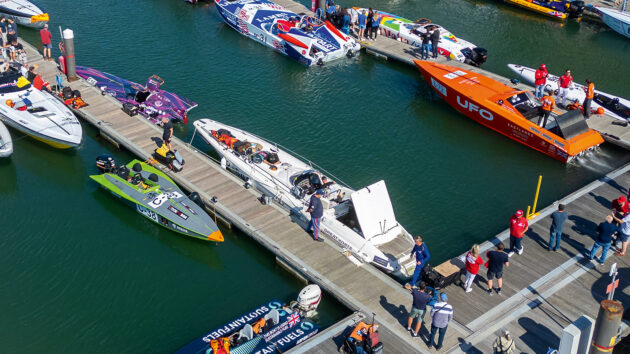
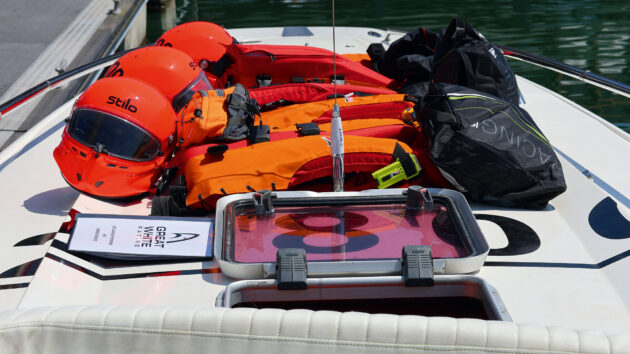
Awaiting scrutineering in the pre-race pits
One of the benefits of racing an open Class 2 boat, rather than a closed cockpit Class 1, is that you don’t need to complete the notorious dunk test. Racing licences duly granted, we agreed on a simple pre-race strategy: get to the finish line with the same number of people we started and try not to break the boat.
If we weren’t enjoying it or felt the conditions were too rough, we’d simply pull out. We were here to have fun, after all, not beat ourselves senseless.
After passing scrutineering, we made our way out to the muster point in preparation for the rolling start. Our tactic was to follow in the wake of another more experienced XS2000 run by True Blue Racing. When the flag came down, they shot off like a scalded cat while we bogged down. By the time we’d clambered onto the plane, they were gone.
That was the last we saw of them until we eventually caught sight of them limping into Totland Bay with the engine hatch up. They didn’t appear to be in any danger so we kept the throttles nailed.
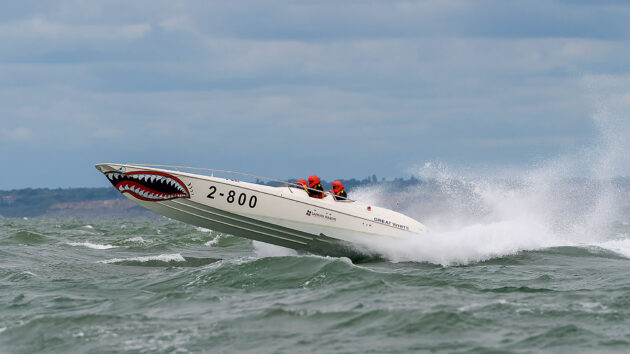
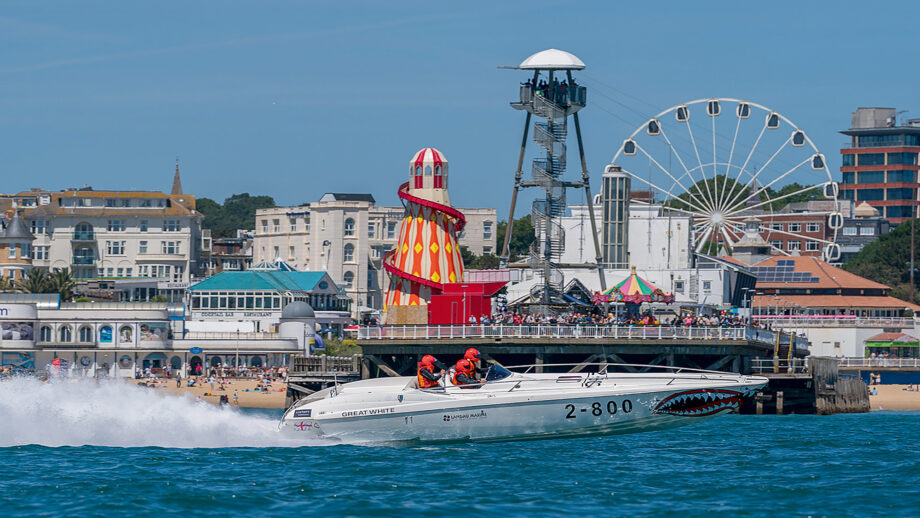
Great White Racing battles the waves off the Isle of Wight in their first race of the season
As we passed the Needles, the waves got bigger and bigger, forcing the quicker boats to slow down. This was our opportunity, but in all the excitement I made the mistake of spending a fraction too long with my eyes on the rolling road of the MFD rather than the oncoming waves.
The next thing I knew I was slammed down on the floor, badly winded with a very bruised arm. We’d taken off over a particularly big wave and, unprepared for the landing, my legs had simply folded beneath me, knocking the breath from my lungs.
Somehow Ben and our navigator, Chris Doran, managed to get me back on my feet and carry on racing. No one was more surprised than me when we crossed the line third in class. To be on the podium in our first race was a great result, tainted only by the discovery that True Blue Racing’s XS2000 had sunk before it could be recovered.
Thankfully the team had been picked up safe and sound by another boat. That and our own incident made us re-assess everything. Landau doubled the number of bilge pumps to six and re-checked every bolt, clamp and jubilee clip. Meanwhile, I booked a personal fitness trainer to build my core strength and practised keeping my eyes locked 100 yards in front of the boat regardless of what was going on around me.
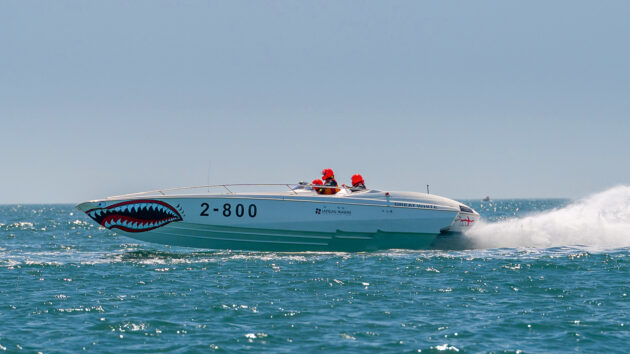
Flying along at 65 knots with the propellers barely touching the water
Race number two, a 100-mile course around Poole Bay, was another rough day. By now we’d learnt that a good result depends on much more than just a fast boat. I’d say one third of it is physical endurance, one third is good navigation (missing a buoy attracts a heavy time penalty) and the final third is raw pace.
Of the 28 boats that started the first race only 15 finished. For race two, we were determined to be among the finishers once again. Part of that would be sticking to our plan and not getting carried away.
If the boat in front was miles ahead of us, there would be no point ragging the nuts off our boat in the vain attempt to catch it. Our strategy paid off and once again we came third in class. The following race we did one better, finishing second in class.
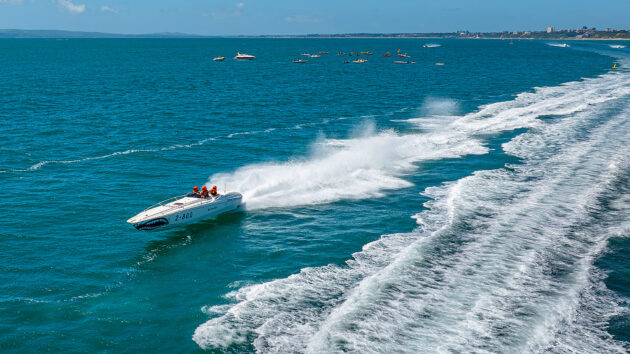
Racing around Poole Bay to their second podium finish of the series
Podium finish
I’m really proud of what we’ve achieved in such a short space of time and with so little experience, but in truth, the results have been the icing on the cake. The real pleasure comes from being part of a team and the wider racing community.
I love every stage of the process; the build-up to race weekends, the scrutineering, the banter, the after parties – it’s a tight-knit community but also a very welcoming one.
By boating standards, it’s not even that expensive; I reckon the boat and an entire season’s racing will have cost me less than £100,000 – you could spend that running a new Range Rover.
Sure, I could have bought a secondhand Axopar 28 and pottered around the Solent like everyone else but where’s the excitement in that? Racing gives me that adrenaline rush as well as the challenge of learning a new skill and meeting lots of people. In a digital world, this is as intense and analogue as it gets.
I may have come to power boat racing later in life but now I’m here, I’m going to enjoy it for as long as I can.
 If you enjoyed this….
 If you enjoyed this….
Motor Boat & Yachting is the world’s leading magazine for Motoryacht enthusiasts. Every month we have inspirational adventures and practical features to help you realise your sailing dreams, as well as tests and news of all the latest motorboats.
Plus you’ll get our quarterly Custom Yachting supplement where we share the last on offer in the superyacht world and at the luxury end of the market.
Build your knowledge with a subscription delivered to your door. See our latest offers and save at least 30% off the cover price.
Note: We may earn a commission when you buy through links on our site, at no extra cost to you. This doesn’t affect our editorial independence.