

Can De Antonio’s award-winning approach really excel on the new D60 flagship? We tested the boat to find out.
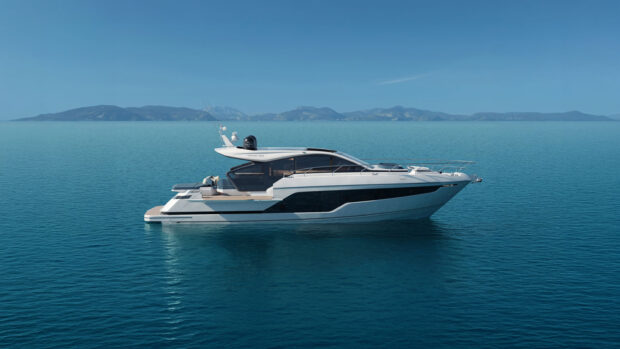
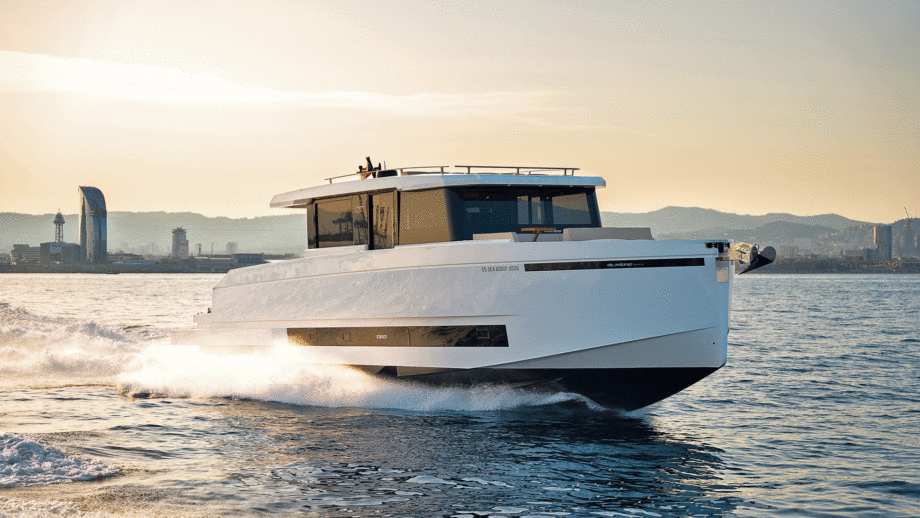
Very few design concepts have been at once so different and so successful as that of Spanish builder, De Antonio. Its distinct way of doing things involves a stepped hull with a plumb bow and vertical hull sides for maximum internal volume.
That’s paired with a walkaround deck layout and a set of outboard engines hidden discreetly from view beneath an extended sun pad that pushes way beyond the transom at the aft end. In creating additional space for a full-beam swim platform, what De Antonio is attempting to do with this De Antonio D60 is combine the poke, refinement and maintenance simplicity of outboard engines with the space and style of an inboard diesel boat.
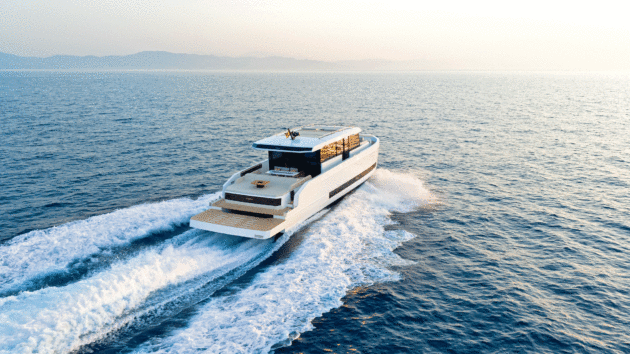
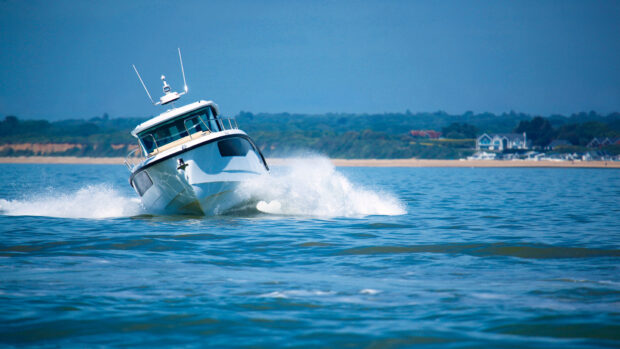
The very flat De Antonio running attitude is fine for most conditions
And by freeing up plenty of room beneath the deck, as well as on top of it, De Antonio has been able to create really competitive cruise-ready day boats at everything from 29 to 50ft. But at 60ft and more than 20 metric tonnes? Preserving the integrity of the De Antonio concept calls for a set of outboards as mighty as any you’re likely to see in Europe…
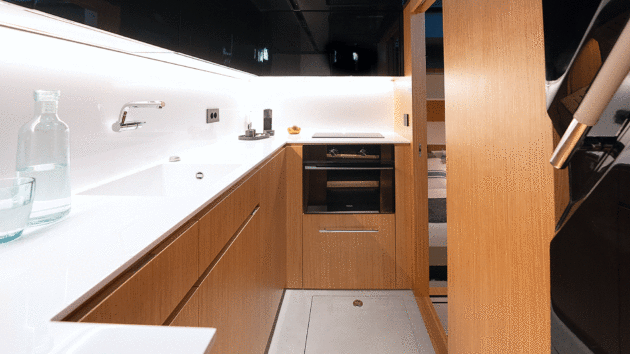
The port galley can be accessed from the saloon, as well as the lower atrium
Scaling up the concept with the De Antonio D60
While the standard rig features quadruple Mercury 400hp V10s, our test boat has four 7.6-litre Mercury V12 600hp outboards tucked away beneath the sun pad. That’s no less than 2,400hp and nearly 2.5 tonnes of engines on the transom, plus a whole load of mouldings for the sunbed itself and a big hydraulic swim platform further aft.
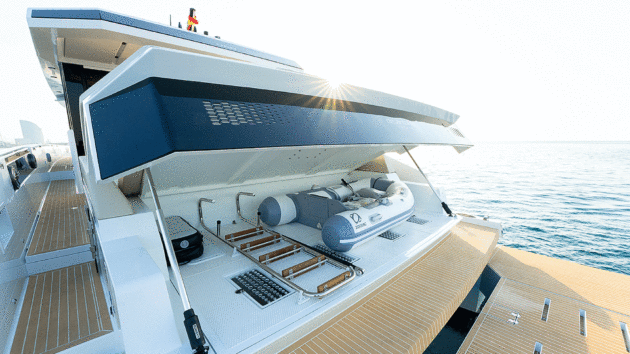
Tender space, like storage, is very well taken care of
As you would expect then, the De Antonio D60 uses the same trick as the rest of the fleet, with a pair of hull extensions that push aft of the transom on either side, much like a power cat. The idea is to provide the extra buoyancy required to compensate for all this extra weight aft. On smaller De Antonio models, that does tend to drop the nose, resulting in a resolutely (and almost unalterably) flat and level running attitude, so it’s reasonable to expect similar here.
Before we get to the drive though, it’s worth examining the deck layout because De Antonio’s classical three-way split of day boating space remains alive and well here. At the stern, the big sheltered ten-man dining station backs onto the raised sun pad, where an ice bucket is neatly integrated into the central cushion.
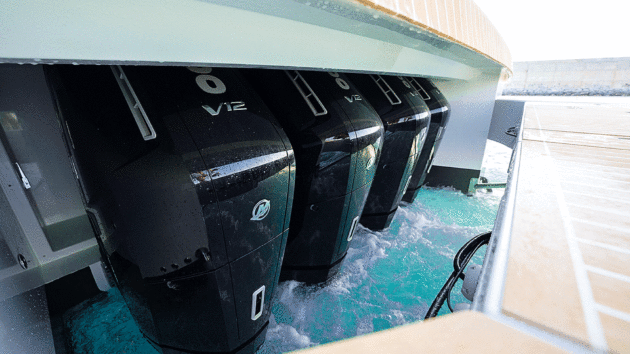
While the standard rig features quadruple 400s, the 600s are a worthwhile upgrade
At the big, beamy bow, various layouts mix a range of sofas, sunbeds and tables with the option of an integrated spa pool. And inside the pilothouse, a pair of inward facing settees leads onto a central three-man helm station that backs onto a transverse wet bar housing a sink, a pair of fridges and an integrated aft-facing TV.
If the inward-facing settees seem a shade too simplistic to be practical, that’s mitigated by a lift-and-lower fold-out table on the port side. And what’s also particularly welcome in here is the degree to which everything can be opened up.
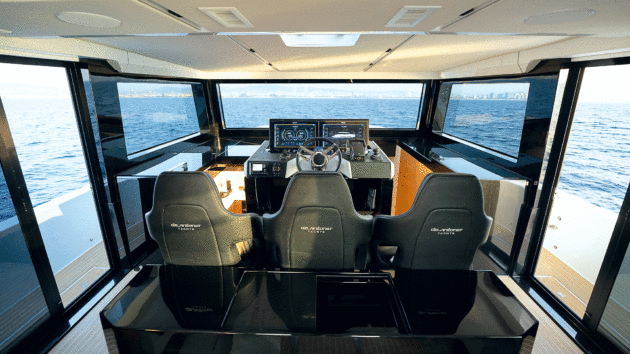
The raised, central three-man helm is set back from the vertical one-piece screen
There are sliding doors on both sides of the helm, plus a massive overhead sunroof and a pair of big one-piece side-windows that drop down out of sight behind the settees. Couple all of these with the patio-style aft doors and you can transform this zone from a sheltered wheelhouse into an open Med-style cockpit in seconds.
However, it doesn’t end there.
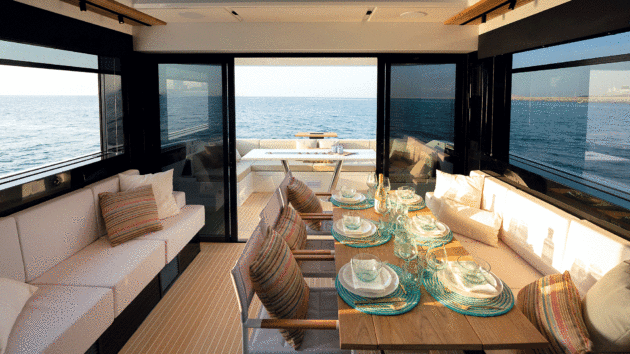
The big one-piece side windows slide down at the touch of a button
In a first for De Antonio, these day spaces are supplemented with some sunbeds on the forward part of the roof structure. To access them, you open up the big sunroof and use one of the two lateral bookcases as ready-made ladders to climb up and out. They’re entirely vertical and there’s not a lot of clearance behind the rails for your knuckles so the young, the elderly and the infirm might want to stay on the lower level. But for the rest of us, it’s worth the ascent.
A set of beds designed for four, but big enough for eight, come with integrated headrests and a low-slung but reassuring peripheral guardrail. That said, with the sunroof open, it only takes a momentary lapse of concentration to step backwards into the gaping hole you just emerged from, so an extra removable aft railing would be a handy addition.
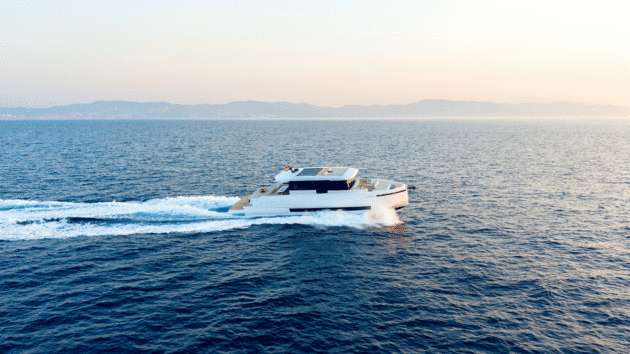
Preserving the integrity of the concept calls for a set of outboards as mighty as any you’re likely to see in Europe
Either way, if it’s not for you, you can simply exchange the rooftop sunbeds for an optional second glass sunroof and bring even more light and air into the main saloon.
Article continues below…
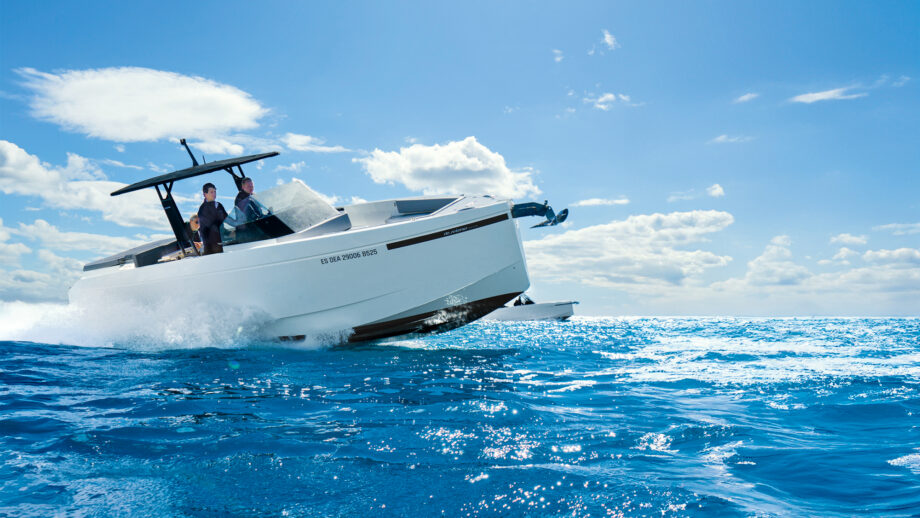
De Antonio D29 review: ‘A very cool and distinctive character’
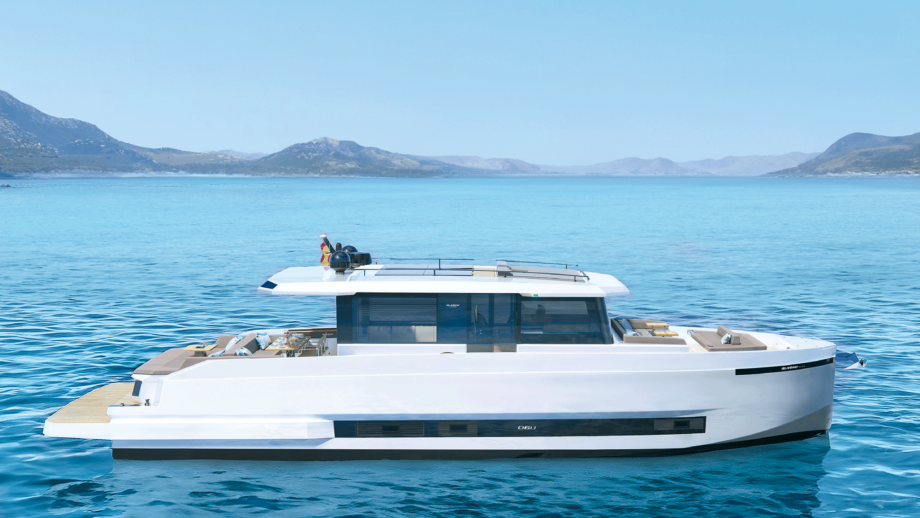
New boats at Cannes Yachting Festival: De Antonio D60 is glazed in light
Cruising for four
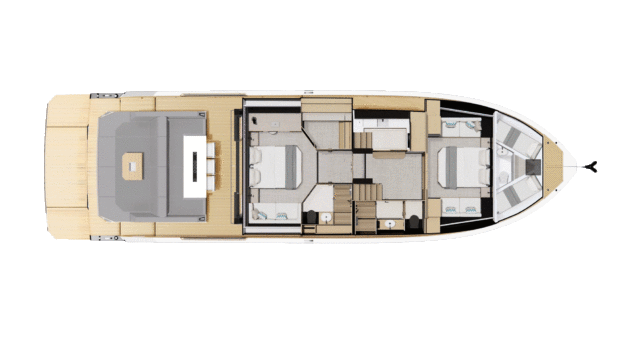
In spite of the fact that this is a big voluminous 61-footer, our test boat comes with the distinctly indulgent two-cabin layout – and thanks to a combination of a beam-forward design and a crew cabin in the forepeak, the VIP bow cabin feels uncommonly broad and square, much in the fashion of a full-beam owner’s suite.
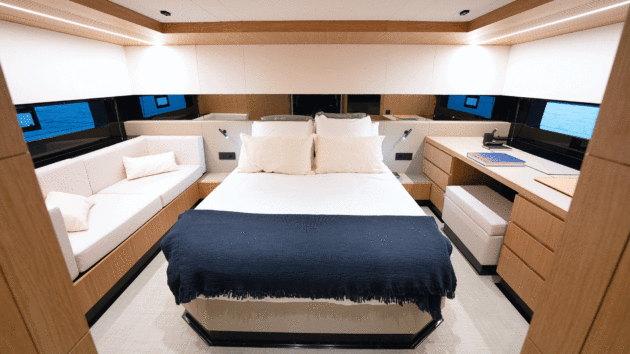
Like the big forward VIP, the owner’s midships cabin is broad, bright and open
It’s used for a large central fore-and-aft bed with a pair of settees, one on either side. If that seems like a peculiar furniture choice in a two-person cabin, you can fix it with a visit to the options list, and in all cases, the fact that the entire space is drenched in light from the big low-level hull windows is very welcome indeed.
Sliding doors make good, efficient use of the space at the VIP’s entry point, and when you head back through them, up a step, you find yourself in the double-height atrium beneath the big raised helm position.
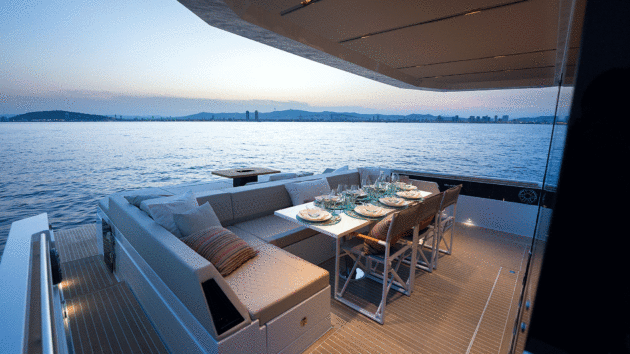
A big sheltered dinette butts up against the raised aft sunbed
This section provides natural separation between the two cabins, as well as access to a fore-and-aft galley on the port side. You also get a direct route into the galley to port of the helm, but it can be discreetly shut off for crew use if you like. As for the day heads, that sits to starboard, with plenty of space for a separate shower compartment with a seat and shower fitting, plus a forward loo that prioritises privacy by means of its own independent door.
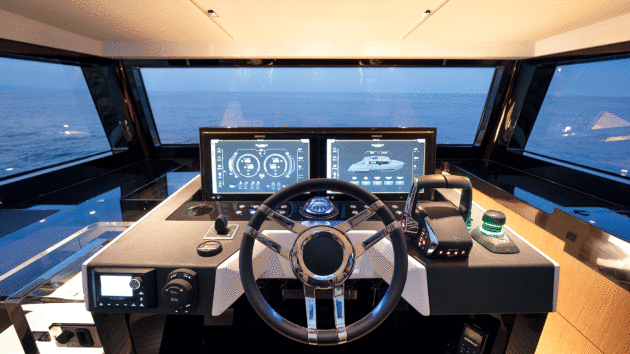
Four beefy engines, a joystick and twin side doors make the drive very simple
The main part of the owner’s cabin further aft is actually of a very similar order to the forward VIP. It’s broad, square and well-lit, with plenty of space on either side of the central bed for a dresser and a settee.
But this time, you also get a generous ensuite bathroom to starboard and a truly remarkable walk-in wardrobe, every bit as large as the bathroom, on the port side. This is, as intimated, a very indulgent way to use the space but you can of course opt for a three-cabin layout instead, where the bow cabin is divided in two.
And whichever option you choose, you still get a truly cavernous storage space beneath the aft cockpit, with standing headroom and sufficient volume for a whole collection of bikes, boards, skis and toys.
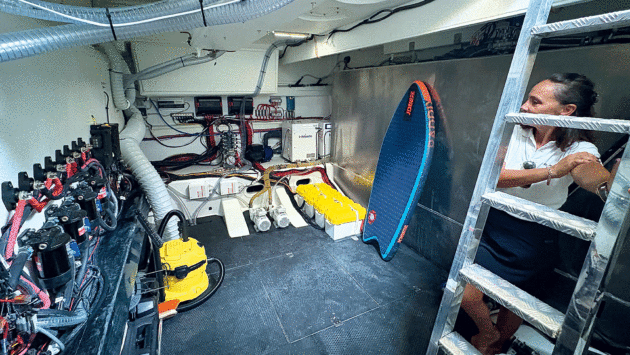
The scale of the locker beneath the cockpit deck has to be seen to be believed
Speed demon
Make no mistake. With the quadruple 600hp upgrade, this De Antonio D60 is a rapid boat. When you put the hammers down, the pick-up is marvellously quick for a platform of this scale and, thanks to the big outboards and the unique transom set-up, it’s also remarkably free of noise and vibration.
As on the smaller models, that flat De Antonio running attitude is very much in evidence but that means that, once the big outboards have shifted up a gear, you can cruise very comfortably at 20-22 knots with sound readings of just 67dB(A) and very little need for any real input or adjustment at the helm.
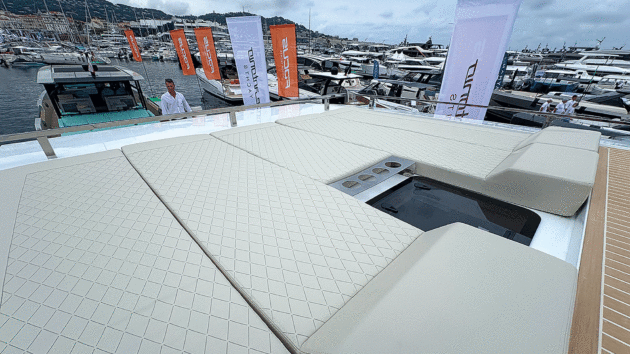
You can replace the big upper sunbeds with an optional extra sunroof instead
That said, this boat actually gets better at between 30 and 35 knots, with the V12s purring away at 5,000-5,500rpm. At around 12 litres per mile, it’s not exactly economical on fuel, but it is fast, flat and refined and, thanks to its 3,700-litre capacity spread across three tanks, it’s enough to enable a usable cruising range in the region of 250nm.
In fairness to the D60, experimentation with the leg angles does adjust the pitch a shade but, as expected, the bow does like to remain low.
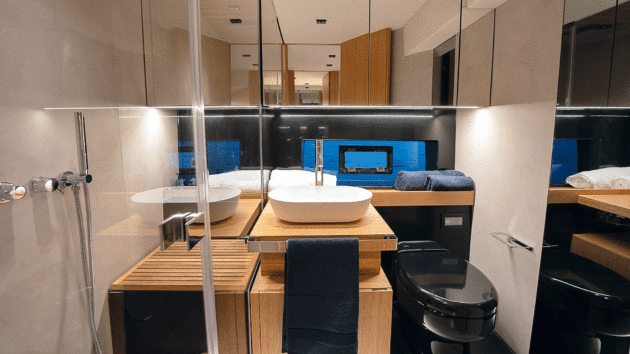
The double-height atrium leads onto the starboard day heads, the port galley and the forward VIP cabin
That’s fine for 90 per cent of cruising conditions and applications but, when you pair the flat attitude with the vertical hull sides and the absence of a forward flare, there’s likely to be a bit of bow engagement and wetness in a chunky following sea – and that’s illustrated by the fact that, when we try to scoot across a lively wake, the hull’s forward section momentarily arrests the revs and washes off a little of our pace.
Even so, windage on this boat feels well controlled and the weight distribution also feels well judged. And aside from the outright pace and the level of refinement (both of which are impossible to ignore), it’s the sheer quality of the driving position that really hits home.
A sunpad with wine cooler sits above the tender and engines
The big, vertical one-piece windscreen, set back from the raised central helm, provides vast unobstructed views. Access to the side decks is also outstanding and, with four powerful engines, a set of thrusters and a joystick, it’s so simple to drive that for most people, those forward crew quarters will be used solely as a storage space or overspill cabin.
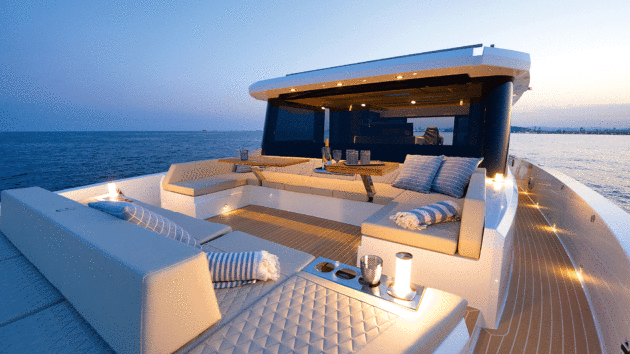
The foredeck lounge is broad, safe and very versatile
 If you enjoyed this….
 If you enjoyed this….
Motor Boat & Yachting is the world’s leading magazine for Motoryacht enthusiasts. Every month we have inspirational adventures and practical features to help you realise your sailing dreams, as well as tests and news of all the latest motorboats.
Plus you’ll get our quarterly Custom Yachting supplement where we share the last on offer in the superyacht world and at the luxury end of the market.
Build your knowledge with a subscription delivered to your door. See our latest offers and save at least 30% off the cover price.
Note: We may earn a commission when you buy through links on our site, at no extra cost to you. This doesn’t affect our editorial independence.
Price as reviewed:
£1,706,008.15 As tested, ex. VAT
Details
LOA: 60ft 8in (18.50m)
Beam: 17ft 1in (5.20m)
Draft: 3ft 4in (1.01m)
Displacement: 20,500kg (light)
Fuel capacity: 3,700L
Water capacity: 680L
Engines: 4 x Mercury Verado V12 600s