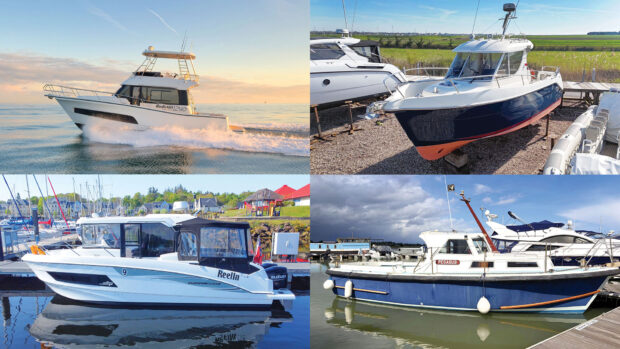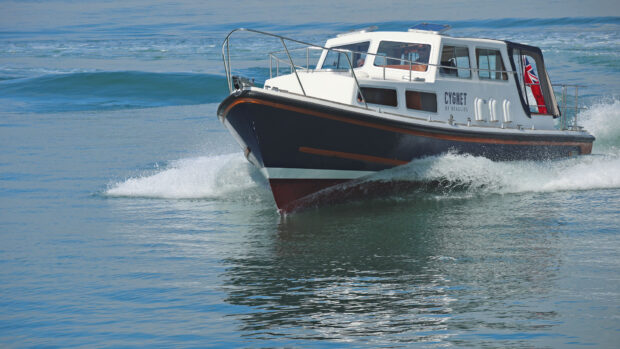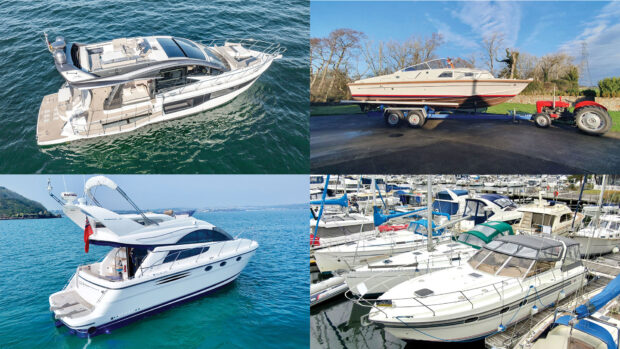


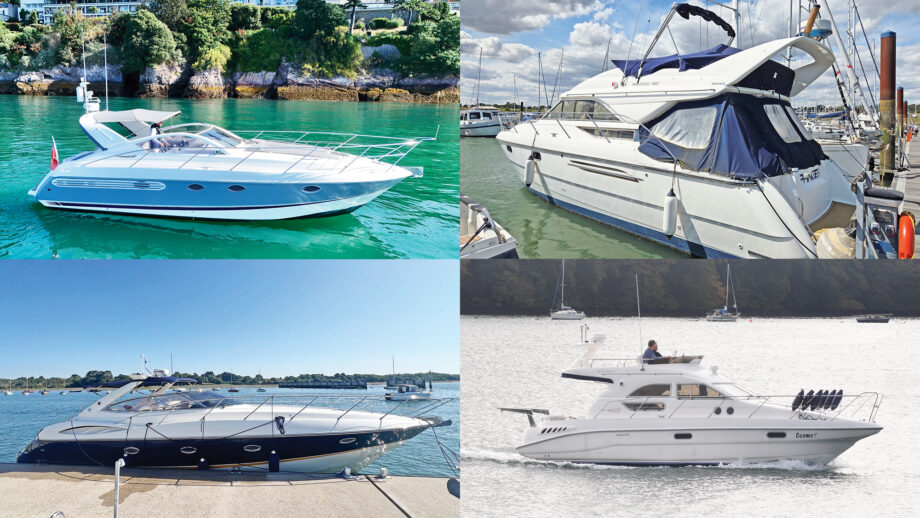
From Sunseeker curves to Sealine’s game-changing flybridge stairs, we look at 4 used boat buys that defined a decade of British design
The 1990s was a big period of change in the boating industry. You might think this was due to emerging technology or new construction methods. But interestingly, it was actually led by far more prosaic reasons, simply the need to survive.
The 1980s boom, all red braces and Porsche 911 Turbos, gave way to the early 1990s global recession and spending, particularly on leisure pursuits like boats, dried up. Some manufacturers went to ground, slashing R&D costs in a bid to survive. Birchwood Boats, a major player in the 1980s, with boats as big as the 60ft TS57, withered and died. But other companies realised that the way out was product led – give the consumer newer, cleverer, smarter boats and you might just tempt them to open their collective wallets again. It worked.
These are just some of the exciting new models from some of Britain’s biggest builders of the moment.
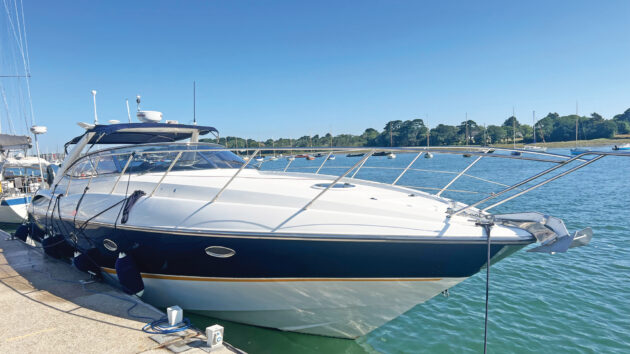
Sunseeker Camargue 44
Built: 1998
Price: £129,950
The first Sunseeker Camargue model was the Camargue 46 launched in 1989. A slightly odd layout saw a completely separate ensuite aft cabin hidden beneath the sunpad behind the cockpit, the forward accommodation providing the saloon, galley and owner’s cabin. But in the 1990s, Sunseeker really got into the groove with Camargues, producing the 55, 50 and this fabulous 44 model. Launched at the Fort Lauderdale Boat Show, over 200 of them found homes between 1997 and 2003, many in the UK.
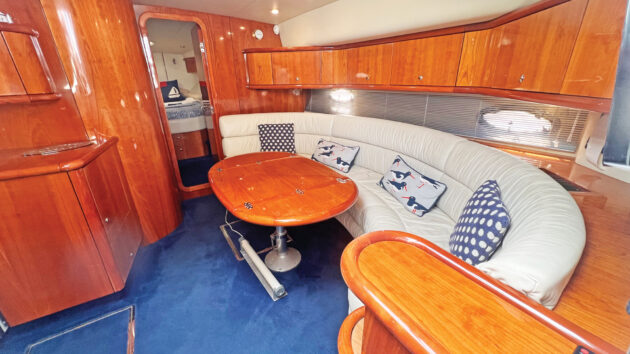
High gloss cherry looks a little dated but there’s no doubting the quality of the interior finish
Interior
The idea of the Camargue models was to create something that retained traditional Sunseeker sportiness in the styling, but offered a whole lot more accommodation than earlier models, a “sensible Sunseeker”, if you will. At 13ft wide, there’s plenty of space for two ensuite cabins, split by a saloon and one of the largest galleys you’re likely to find in a boat of this size, style and era. High-gloss cherry is arguably a little dated compared to modern pale satin finishes but it still looks fantastic.
Exterior
Despite the near 30-year-old design, this is a fabulous looking boat, all voluptuous curves topped off by an aggressively forward sloping winged radar arch. Pretty much every mid 40ft sportscruiser these days has a tender garage but if you want to store a tender on this boat, it lives on the bathing platform leaving masses of room for a big single-level cockpit.
Performance
When new, you could spec your Camargue 44 with twin Volvo Penta TAMD 63 or 74 engines, giving between 370hp and 480hp each, but the most popular engines by far were the Caterpillar 3126 offering 420hp a side for a top speed of 30 knots.
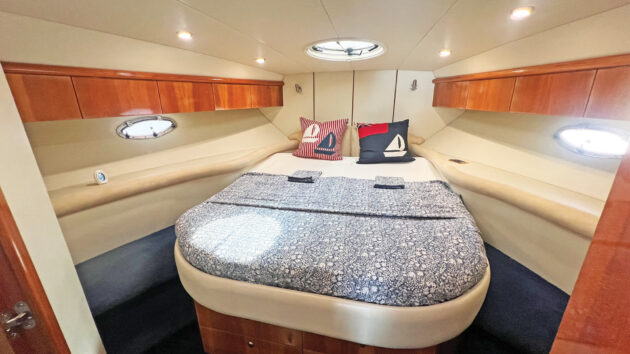
Both cabins have their own ensuite bathrooms and sit at opposite ends of the saloon
Seakeeping
The Camargue 44 was fitted with vee drives, since outdrive offerings of the time weren’t powerful enough. These send the drive forward into a gearbox then back under the engines on short-angled shafts, allowing the engines to sit further back in the hull. The Don Shead hull with 13 tonnes of displacement gives a solid ride.
Sunseeker Camargue 44 specifications
Length: 46ft 5in (14.1m)
Beam: 13ft 9in (4.2m)
Draft: 3ft 5in (1.0m)
Displacement: 13 tonnes
Fuel capacity: 1,060 litres
Engines: Twin Caterpillar 3128 420hp diesel engines
For sale: Sunseeker Brokerage
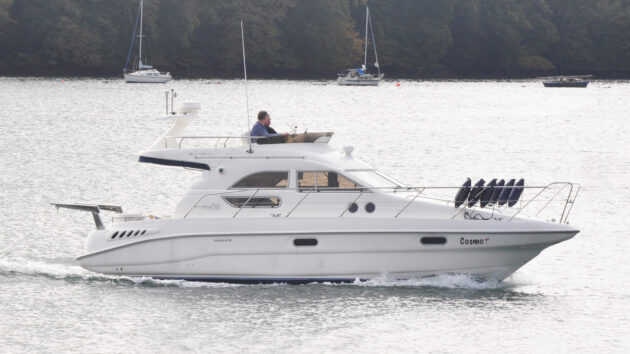
Sealine 330 Statesman
Built: 1996
Price: £64,950
The boat building industry in the 1990s was very different to today’s corporate world of investment companies. Back then, the big British builders were still owned, or at least run, by their founders – David King headed up Princess Yachts, Sam Newington was boss of Fairline, Robert Braithwaite ran Sunseeker and Tom Murrant controlled Sealine.
All of these men were boaters, in fact, Tom Murrant kept and used his boats out of Torquay Marina. He was the first to come up with stairs to the flybridge, rather than a ladder, after his wife complained it was impossible to bring a tray of drinks up a ladder – you don’t get that kind of feedback anymore.
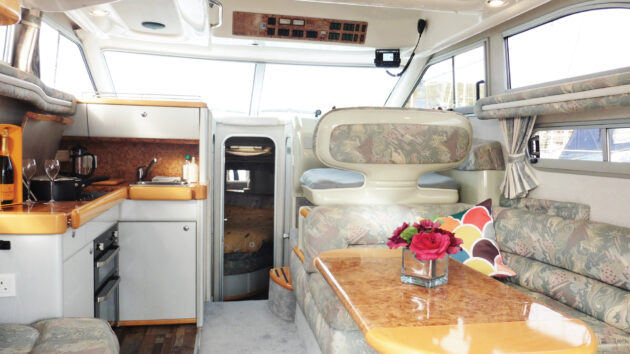
The galley-up layout was almost unheard of at the time but is now commonplace
Interior
The 330 Statesman, launched in 1994 is the perfect example of a boat developed by someone who really gets boating. From those flybridge stairs (the smallest aft cockpit flybridge boat at the time to get them) to the two-cabin single heads lower deck, this was first and foremost a practical boat. Sealine achieved space for this by putting the galley on the main deck in the forward port corner of the saloon, commonplace now but almost unheard of for compact flybridge boats at the time.
Article continues below…
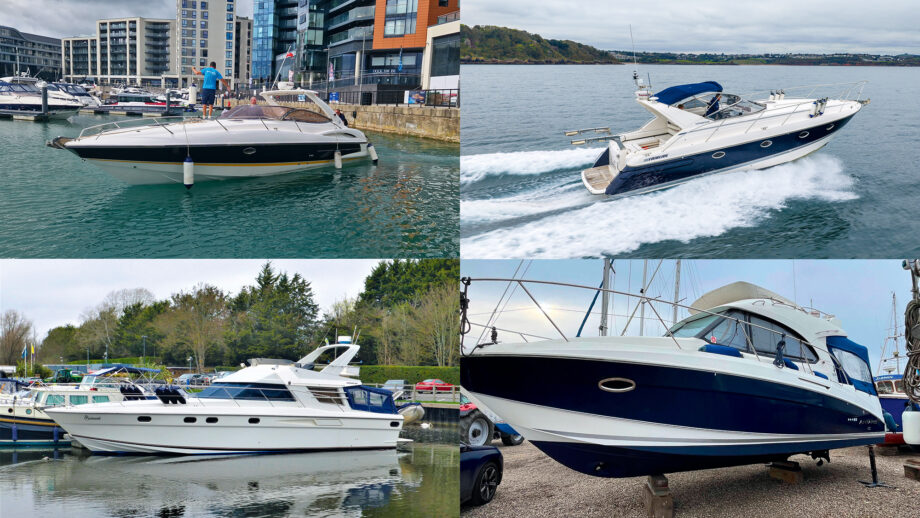
4 of the best motor yachts on the market right now for £100,000

4 of the best all-weather motor boats on the market right now
Exterior
Beyond those steps (and it’s impossible to overstate what a game changer they were – by the end of the 1990s, virtually every manufacturer had introduced them), practical details included a clamshell opening at the trailing edge of the flybridge for canopies to roll up into. The flybridge itself was necessarily small, just a three- person bench and a sunpad.
Performance
Outdrive engines helped hugely with the packaging, Sealine fitting Volvo Penta or Mercruiser engines, the former mostly KAD32 170hp, the latter usually the 180hp engines fitted to this boat giving a 20-knot top end.
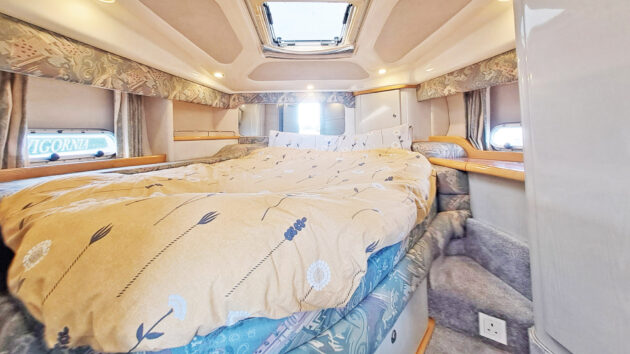
The forward owner’s cabin is surprisingly big and bright for a 33ft flybridge boat
Seakeeping
The hull was that of Sealine’s S34, itself a good sea boat. The extra height and windage of the flybridge design mean that the standard fit trim tabs are useful, and retrofitting a bow thruster is worthy of consideration.
Sealine 330 Statesman specifications
Length: 34ft 6in (10.5m)
Beam: 11ft 0in (3.3m)
Draft: 3ft 1in (0.9m)
Displacement: 5 tonnes
Fuel capacity: 644 litres
Engines: Twin Mercruiser 180hp diesel engines
For sale: Ancasta
Fairline Targa 37
Built: 1996
Price: £69,995
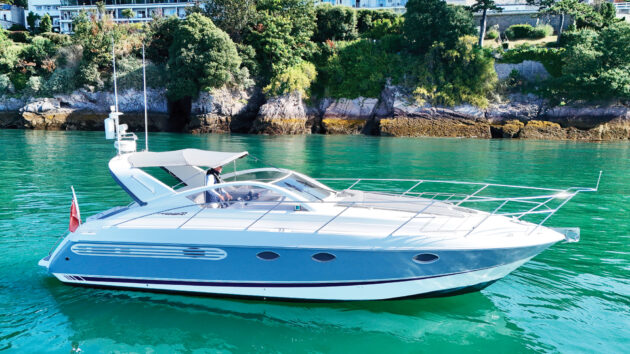
The Targa line of Fairline boats began in 1984 with the Targa 33 and blossomed into quite the range. This was the 10th Targa model that Fairline produced. It started life in 1994 as a Targa 36. This morphed into the Targa 37 by dint of an extended bathing platform. It introduced a new look for the Targa range, both inside and out, which still appears far fresher than most 30-year-old craft.
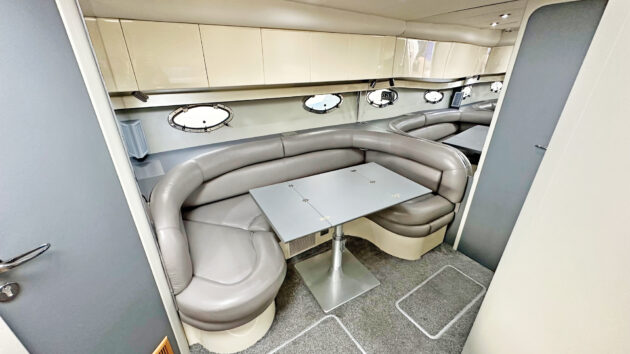
A refresh has brought the interior up to date but even the original was modern for its era
Interior
Although the layout follows the tried and tested cabin at each end with a saloon and galley between them set-up that began with the Touring version of the original Targa 33, there are some notable upgrades. The double berth in the forward cabin is a centreline island bed rather than squashed to one side, and access to the mid cabin aft is greatly improved by the L shaped cockpit seating above. However what changed dramatically was the interior finishes. Gone was traditional teak, replaced with pale maple woods and painted surfaces. Indeed this particular boat interior has been refreshed even further by its current owner.
Exterior
Transom doors and integral platforms we’d already seen on earlier Fairline Targas, but what the 36/37 model you see here brought to the party was new GRP moulded side hoops linked by a header rail forming the windscreen frame, a huge leap forward from the ubiquitous stainless steel of old. Meanwhile, the double knuckle that split the hull topsides of old was deleted in favour of a smoother more modern look. This boat is a particularly fine example that has been well maintained and belies its true age.
Performance
A few Targa 37s went out with V8 petrol engines but the vast majority of got Volvo Penta’s KAD 42 supercharged and turbocharged 3.6-litre straight six 230hp diesels, or the later KAD 44 EDC 260hp motors. Figure on low 30 knots for the former, mid 30 knots for the latter.
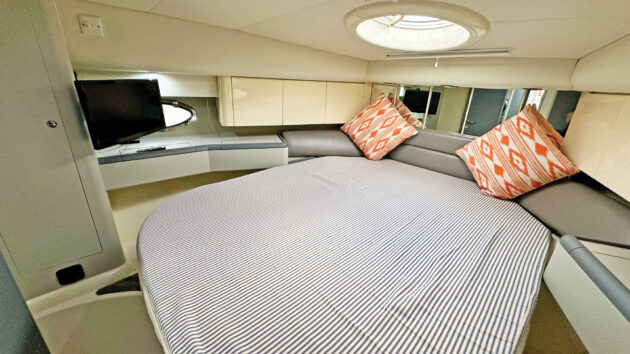
Centre line island double in the owner’s cabin is a big step up on the Targa 33’s offset bed
Seakeeping
Fairlines of this era are all great sea boats and this is no exception. Fast, well balanced and capable, it makes a fine offshore cruising boat.
Fairline Targa 37 specifications
Length: 36ft 6in (11.1m)
Beam: 11ft 8in (3.5m)
Draft: 3ft 2in (1.0m)
Displacement: 7 tonnes
Fuel capacity: 640 litres
Engines: Twin Volvo Penta KAD 42 230hp diesel engines
For sale: One Marine
Princess 420
Built: 1996
Price: £89,950
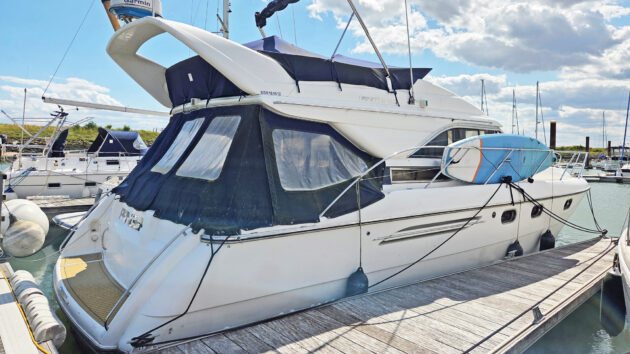
In 1973, Princess took a major step into the big league, building its first shaft drive flybridge boat, the Princess 37. At 37 feet, it was far bigger than the previous flagship Princess 32 and a big step for a fledgling builder, but it proved a good move, running for eight years. In 1981 it was replaced by the Princess 38 which set the layout template that flowed through every subsequent model since as it evolved through the 385, 388, 398, 410 before being replaced by the 420 you see here.
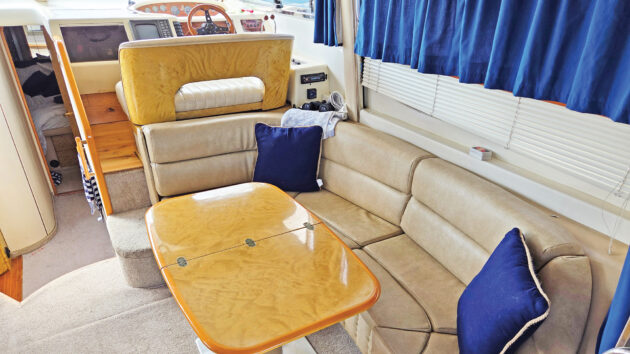
The ‘superyacht’ style burr maple woodwork was the height of luxury in the 1990s
Interior
That enduring layout was basically an ensuite double berth owners cabin in the bow, a twin-bedded guest cabin with access to the day heads and a galley all on the lower deck, and then a saloon on the main deck with a double helm forward to starboard.
It only finally changed when the Princess F45 launched, which swapped the traditional twin shaft drive diesels layout for IPS pods which, combined with a galley up layout, created space for a full beam owner’s cabin. What the 420 brought to the party was a new interior finish. After decades of teak interiors, Princess flirted briefly with pear before introducing ‘superyacht finishes’ across the range in the 1990s. Either the burr maple you see in this boat, or the much rarer dark mahogany.
Exterior
On the outside, there were various changes to entice the cautious 1990s buyer. The whole profile of the boat was far more modern, from the lower sleeker radar arch to the three- section sliding saloon doors. But the big news was following the flybridge stair trend – not just easier with a tray of drinks, but they kept the family dog, who wasn’t keen on the ladder, happy too.
Performance
Twin Caterpillar 3116TA 255hp engines were a rarity, with most leaving the factory with a pair of Volvo Penta TAMD 63P diesels beneath the saloon floor for a top speed in the high 20s.
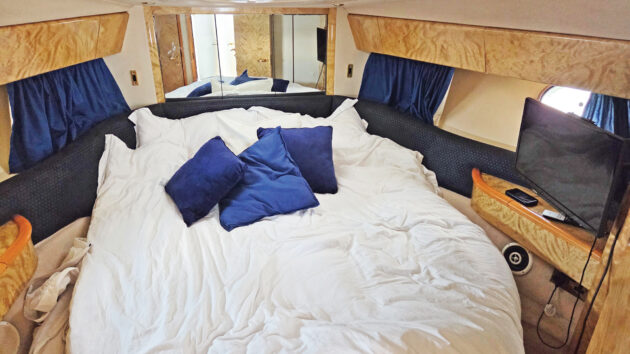
The forward owner’s cabin is supported by a twin guest cabin amidships
Seakeeping
A shaft drive flybridge was (and still is) stock in trade for Princess Yachts, so expect a solid capable cruising boat and you’ll not be disappointed.
Princess 420 specifications
Length: 42ft 10in (13.2m)
Beam: 13ft 8in (4.2m)
Draft: 3ft 3in (1.0m)
Displacement: 11 tonnes
Fuel capacity: 1,300 litres
Engines: Twin Volvo Penta TAMD 63P 370hp diesel engines
For sale: Clarke & Carter
 If you enjoyed this….
 If you enjoyed this….
Motor Boat & Yachting is the world’s leading magazine for Motoryacht enthusiasts. Every month we have inspirational adventures and practical features to help you realise your sailing dreams, as well as tests and news of all the latest motorboats.
Plus you’ll get our quarterly Custom Yachting supplement where we share the last on offer in the superyacht world and at the luxury end of the market.
Build your knowledge with a subscription delivered to your door. See our latest offers and save at least 30% off the cover price.
Note: We may earn a commission when you buy through links on our site, at no extra cost to you. This doesn’t affect our editorial independence.