

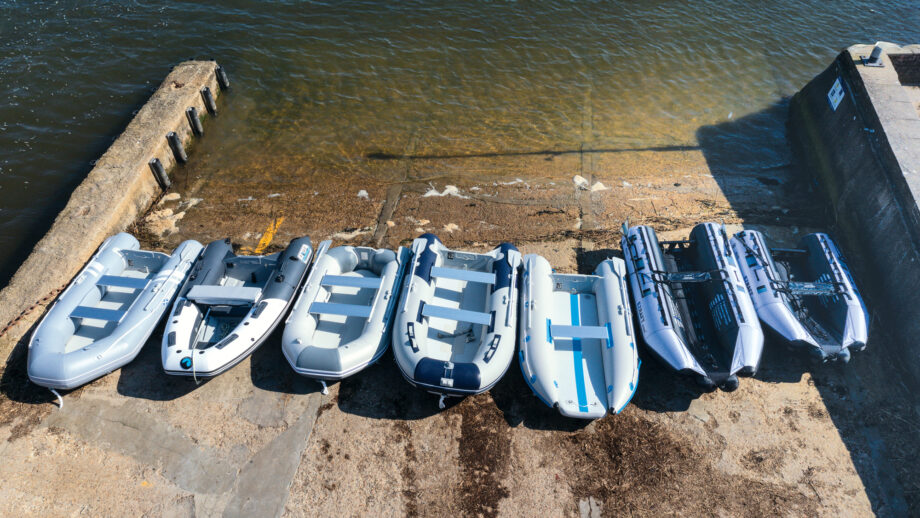
From high-tech folding RIBs to ultra-lightweight rafts, we test 6 compact inflatable dinghies to find the best ship-to-shore tender.
A tender that can safely transport you and your guests from boat to shore is an essential piece of kit. If your main boat is blessed with a tender garage or a hydraulic bathing platform then a mini-RIB or jet tender is the obvious choice. But what if there isn’t enough space to carry a rigid-hulled tender?
That’s where inflatable dinghies come into their own. Small enough to pack down into a bag and stow in a locker, light enough to move around the boat when needed but stable enough to carry three or four people at a time, they are the unsung workhorses of the boating world.
Choosing the right inflatable tender depends entirely on how you balance performance against storage and weight. Fabric thickness is the single biggest factor here; thicker material means a more robust boat, but it will be heavier to lift and harder to pack down. Floor type also matters. While a folding mini-RIB with a solid GRP hull will outperform a full inflatable on the water, a semi-rigid inflatable airdeck floor keeps things remarkably light and easy to handle.
Needless to say, there are hundreds of different options out there. I couldn’t possibly test them all, so I’ve focused on testing as many different styles as possible from a folding mini-RIB to an ultra-lightweight EZRaft and everything in between. Ranging from 2.4m to 3m long, I’ve put a variety of leading models through their paces to find the ultimate portable crew-mover.
The best inflatable tenders for boaters 2026
Boatworld Air V Type 300 – Best tender on test
Specifications: Length: 3.0m (9ft 10in) | Beam: 1.54m (5ft 1in) | Tube height: 40cm | Test weight: 40kg | Packed size: 100 x 65 x 32cm
Reasons to Buy: Very stiff and solid when inflated | High internal volume and great knee clearance | Highly seaworthy enclosed bow design | Great value for money
Reasons to Avoid: Quite a weight to shift on your own | Needs a bigger engine to get it on the plane
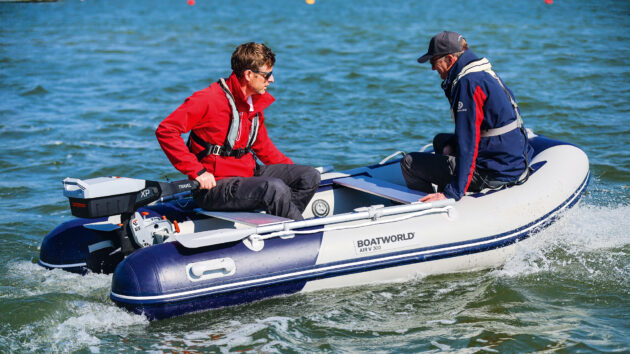
Looking for maximum boat for your buck? This could be the solution. Something of a beast on land, it is possible to move singlehanded but at a claimed 32kg (our scales reckoned it was more like 40kg with the seat, oars and bag), it’s quite a weight to shift on your own.
Inflate it, however, and you’ll soon see why. At 3m long and 1.54m wide, it is one of the larger boats on test. Built from 0.9mm high-strength PVC fabric, it’s got a full spray rail around the tubes and a deep V-hull engineered with two panels of drop-stitch air floor. This V is well protected with a triangular ridge strip along the keel, making it capable of taking some proper abuse landing on a beach or concrete slipway.
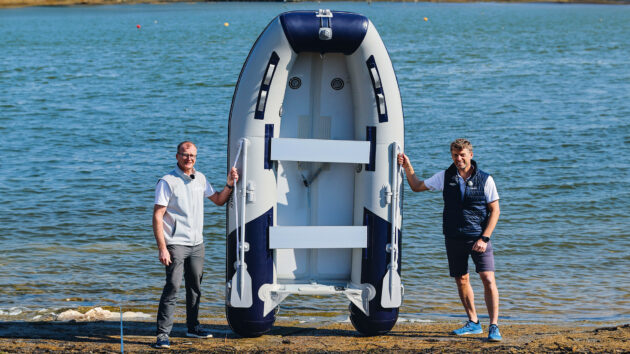
On some rivals the air floor is attached to the tube by its lower edges, creating a small gutter which traps any water that comes on board. This one has a floor that’s attached by its upper edge, pushing it lower into the water, creating more internal volume and clearance for your knees, as well as increasing the boat’s buoyancy and freeboard. Given that it’s already got some of the larger tubes on test (40cm in diameter) and a nice wide bow, this makes it a really seaworthy boat that can happily take on longer trips in more exposed water.
The long waterline length and efficient hull shape ensure decent speeds under power, but it’ll need a bigger engine to get it on the plane. We still managed to reach a top speed of 4.7 knots (joint fastest on test) at the Torqeedo’s max 1.6kW output. There is a securing strap and reinforcement under the midships seat for a separate fuel tank or battery if needed. It also comes in a wide range of different sizes.
Once inflated, it feels very stiff and solid. It’s rated for four adults and a child, and with two thwarts, there’s plenty of space to sit. We got six adults in without it feeling precarious. Rowing was easy with sliding seats allowing us to find the best possible position for a comfortable stroke. If you’ve got space to stow it and don’t need to carry it very often, this is a robust, well-specced tender at a very good price.
ForeRunner 290 folding RIB – Best tender for performance
Specifications: Length: 2.9m (9ft 6in) | Beam: 1.6m (5ft 3in) | Tube diameter: 38cm | Test weight: 44.5kg + 6.4kg | Packed size: 105 x 95 x 55cm
Reasons to Buy: Most robust and stable feel on test | Rigid GRP hull cuts through chop beautifully | Premium welded seams and cushioned seat
Reasons to Avoid: A serious two-man job to carry | Water can ride up the tubes during tight, fast turns
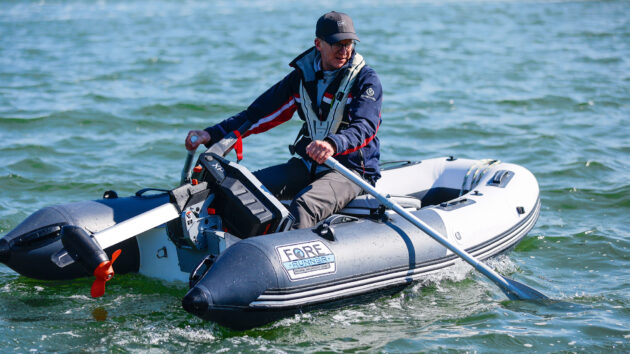
Much like the original FRIB concept, this neat little tender has a solid GRP floor made up of three interlocking sections connected by flexible watertight flanges and high quality inflatable tubes. This allows it to fold into a package a third of its original length. As you inflate it, the pressure in the tubes causes it to unfold and lock together into a sturdy mini-RIB.
The tubes are made from a durable Heytex material that is both UV- and mould-resistant, which in combination with its solid floor, smart finish and top-quality fittings give it the look and feel of a much more upmarket tender than the more affordable inflatables. The seams are all welded rather than glued, sturdy rubberised handholds replace the usual plastic ropes, chunky carry handles at each end double up as cleats and stainless steel lifting points allow it to be lifted by a crane or carried on davits. There’s even the luxury of a cushioned seat rather than an unforgiving plank.
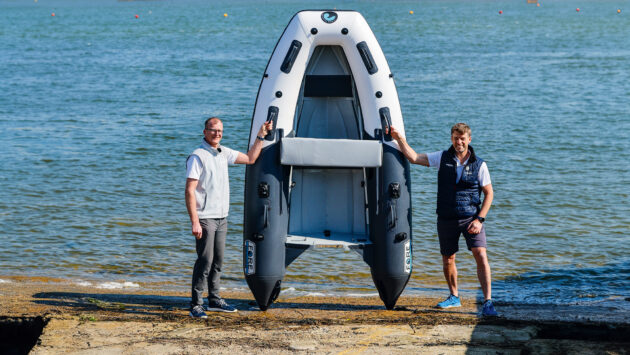
On the water this felt the most robust and stable of all the dinghies. There was no sign of any movement between the three hull sections, even when loaded up with four people. Its rigid V-shaped floor allowed it to cut through the chop better and turn quicker than the inflatable-floored craft, and while the 1.6kW motor didn’t have enough grunt to get us planing, the fact it can take up to a 15hp petrol outboard tells you a lot about its performance potential. We did, however, get a wet bum when turning too quickly, causing water to ride up the 38cm diameter tubes.
The sturdy aluminium oars tuck under the tubes when not in use, but once correctly inserted into the mounts (it took us three attempts to get the rowlocks facing the right way), the smooth finish of the GRP hull means it rows very efficiently.
The size and weight of the folded package is a bit of an issue. It may be smaller than a one-piece RIB but it’s still considerably bigger and heavier than a full inflatable. The main pack weighs 44kg, with a second bag for the seat, oars and accessories adding another 6kg. In reality, it’s a two-man job to carry it.
Ecosse Lightweight 290
Specifications: Length: 2.9m (9ft 6in) | Beam: 1.4m (4ft 8in) | Tube diameter: 40cm | Test Weight: 25.4kg | Packed size: 98 x 62 x 26cm
Reasons to Buy: Excellent compromise between low weight and durability | Fast under power | Easy to deflate and pack away
Reasons to Avoid: Narrower beam can leave knees touching when fully loaded | Lacks a built-in spray deflector
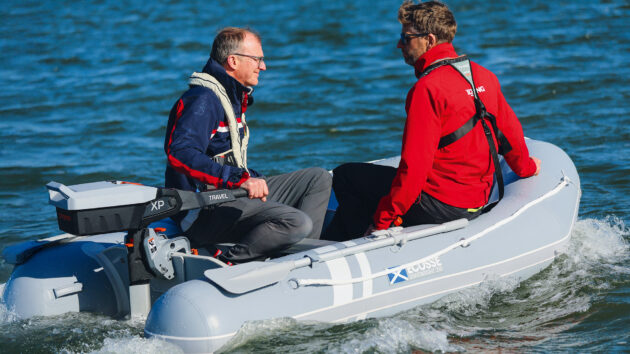
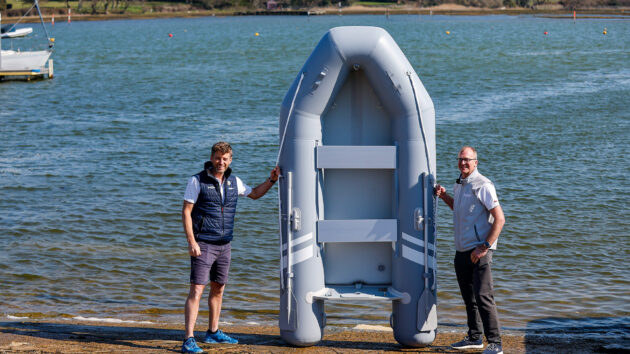
The Ecosse Lightweight 290 is a lighter version of a traditional inflatable tender, but rather than cutting the specification down to the bone in an effort to shave off every last ounce, it strikes a happy compromise between weight and durability. The tube fabric for instance is 0.7mm thick, compared to 0.45mm for some lightweight tenders, and it has a basic rubbing strake and keel strip to boost its wear-resistance when being dragged up a beach or moored alongside a dock.
As a result it tipped our scales at 25.4kg, including the seat, oars and bag, but not the pump. That’s around 10kg more than the ultra-lightweight EZRaft but still 5kg less than an O2Lite 290 and almost 15kg less than the admittedly slightly longer, wider and more robust Boatworld Air V-Type 300.
Other than being a little narrower in the beam than some of our 2.9m rivals, it doesn’t appear compromised by its lighter build. The inflatable V-shaped floor feels firm underfoot, the 40cm tubes give the same freeboard as normal and it’s rated to carry four people and up to 447kg. It can even handle the same maximum engine power as the V-Type 300 – up to 10hp.
At this size most people will opt for a smaller electric motor, and the 1.6kW Torqueedo XO did a good job of propelling it. We maxxed out at 4.7 knots with two of us on board, one of the fastest of our group, and even at a modest 500W we were still making 3.8 knots. That light weight and slender beam also pays dividends when rowing. Loading it up with four people did leave our knees touching in the middle and it didn’t feel quite as rigid as the heavier duty boats, but despite the lack of a spray deflector, it wasn’t noticeably wetter or lower in the water than its competitors.
As hoped, it was easier to deflate, roll up and pack into its bag than the heavier craft. Time will tell if it lasts as long but if you’re looking for a capable, good-value all-rounder that’s easy to carry and doesn’t take up too much space, this seems like a well thought-out design.
EZRaft Q300 + 240
Specifications: Length: 3.0m (9ft 10in) | Beam: 1.45m (4ft 9in) | Tube diameter: 50cm | Test weight: 15.3kg | Packed size: 65 x 45 x 32cm
Reasons to Buy: Incredibly lightweight and half the packed size of rivals | Easy to move singlehanded | Innovative skin/bladder design is simple to repair
Reasons to Avoid: Awkward to row with clumsy strap rowlocks | High seating position reduces legroom | Susceptible to flipping if towed in high winds
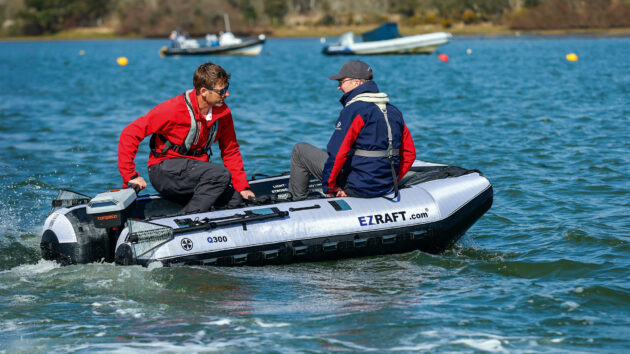
Size and space is always an issue when it comes to tenders, with weight making a dinghy hard to move and difficult to pack. That’s why two Dutch innovators decided to rethink inflatable tenders from scratch. The result is EZRaft, a radically different kind of inflatable tender that weighs just 15kg (10kg less than its lightest competitor) and packs into a bag roughly half the size.
That’s because instead of using PU ‘rubber’ tubes it has a lightweight Dacron outer skin with inflatable bladders inside. They claim this solution is as robust as a normal inflatable but easier to repair as the inners can be patched and the outers stitched or stuck back together with sail patches. Kevlar reinforcing strips on the underside mean you can even drag it up the beach with impunity.
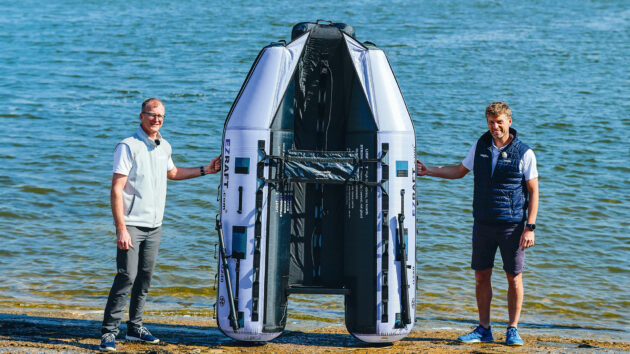
You sit noticeably higher than in a normal tender, but because of the raised floor there is less space for legs and knees. Being so light and with relatively little drag, it doesn’t need much power to propel it. Even at 500W with two people on board we were making 3.6 knots. Handling was good, thanks to the natural tracking ability of its catamaran shape, and it didn’t feel skittish even with four on board. However, towing it behind a bigger boat might be an issue as it wouldn’t take much wind to flip it.
Rowing it was less effective. We liked the telescopic carbon-fibre oars but the webbing-strap rowlocks, sailcloth oar blades and high hand-height required by the large sponsons made this rather awkward to row. The fabric seat that doubles up as a stowage pocket is a neat idea but isn’t as stable as a solid aluminium one. Stiffer oar blades are coming but it’s still not a boat you’d want to row any distance.
Moving the boat around, whether inflated or not, was a doddle – we found it easy to pick up single-handed and packing it away was by far the simplest. We also tried the smaller Q240 but the shorter length made it more sensitive to trim and it felt cramped. For the modest increase in cost we’d advise upsizing to the Q300.
Boatworld KAT 275
Specifications: Length: 2.7m (8ft 10in) | Beam: 1.4m (4ft 7in) | Tube diameter: 40cm | Test WEIGHT: 29.3kg | Packed size: 85 x 60 x 29cm
Reasons to Buy: Sporty catamaran design tracks beautifully | Flat airdeck floor is very firm | Packed with useful lifting and towing points
Reasons to Avoid: Highly sensitive to fore and aft trim | Open bow structure means you can expect a wetter ride
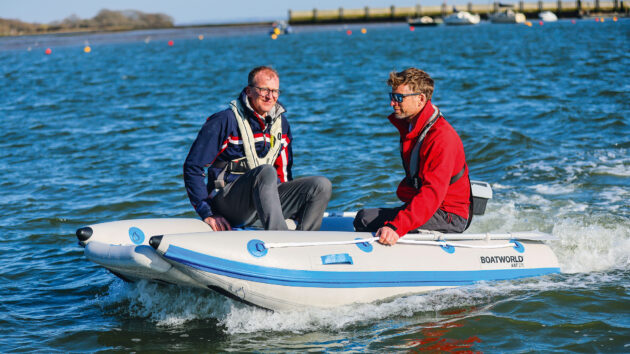
We really liked the look of Boatworld’s sporty little Kat 275. With its 40cm sponsons tapering to sharp bow points, it looks the business, and when fitted with the maximum 8hp engine, should be pretty rapid too.
The flat airdeck floor feels firm under foot and though at first the bow looks a little open, an impression increased by the small gaps between the pointy end of the tubes and the floor, it is raised up to help prevent waves coming over it. A couple of fabric strips filling the gaps might help here too.
We noticed it was more sensitive to fore and aft trim than the rest of the group. As soon as engine power is applied, the bow lifts slightly, helping to keep it clear of the waves, but come off the throttle too quickly, and the bow nods downwards, occasionally letting a wave spill over the front. This also limits the effective loading capacity of the boat – even though it can take four adults and feels stable, they’ll want to sit towards the stern, which restricts manoeuvrability due to limited room for moving the outboard’s tiller.
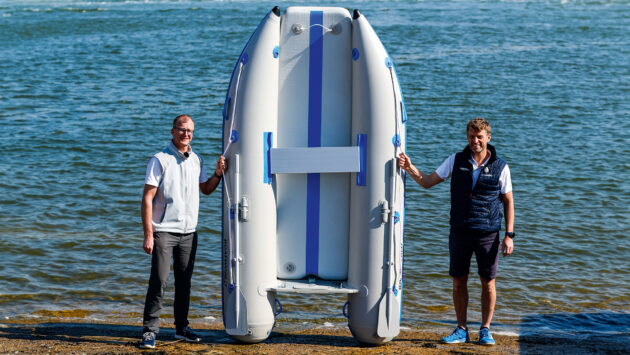
Grab handles on top of the bow and inside the stern make it easy for two people to carry and at 26kg it’s admirably light too. It also has internal loops at the bow, to help pull yourself aboard from the water, as well as loops for a towing bridle and davit lift points.
The adjustable seat can be set in a variety of positions for rowing, while the catamaran shape ensured it tracked well and was easy to propel under oars or power. We reached a top speed of 4.4 knots with our 1.6kW Torqueedo but with a bigger petrol engine it would’ve been much quicker. That flat-floored design should enable it to plane easily, while the outer tubes should mean good directional stability and fast turns.
In summary it should be a lot of fun for younger crew who don’t mind getting a bit wet. However, if it’s load-carrying capacity you’re after, you’d be better off with an enclosed bow design that adds buoyancy and wave protection. Packing away was slightly easier than most due to the lack of a bow tube.
Boatworld ST 240 – Best budget tender
Specifications: Length: 2.4m (7ft 10in) | Beam: 1.35m (4ft 5in) | Tube diameter: 34cm | Test weight: 26.7kg | Packed size: 89 x 55 x 28cm
Reasons to Buy: Innovative short transom maximizes internal space | Incredible price point | Very easy to carry single-handed
Reasons to Avoid: Not suited for larger | Heavy outboard engines | Sharp turns when fully laden can spill water over the stern
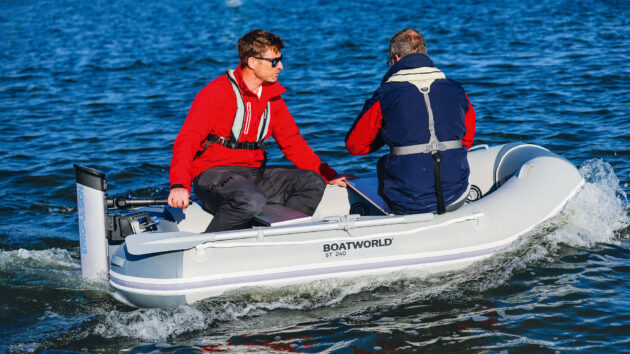
This little tender really took us by surprise. It was the joint smallest on test (2.4m long) but what sets it apart is the design of the stern. The ST in the name stands for Short Transom, and it’s wedged in between two angled stern tubes right at the back of the boat rather than a full-width transom set 50cm further forward that’s held in place by the side tubes. This means that the full length of the boat is available for crew and load carrying.
This design might not be so good for supporting the weight or thrust of a large outboard motor, but it’s ideally suited to a lightweight electric motor (such as the 500W 7kg ePropulsion eLite) and means that it has the same capacity as boats half-a-meter longer.
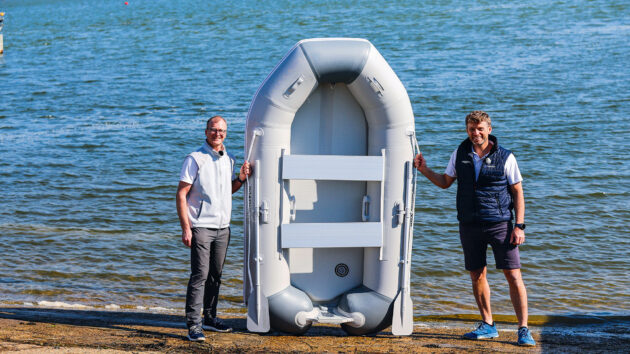
It’s rated for three people but we managed to get four fully grown adults on board without it feeling unstable. Yes, the freeboard was a little lower than ideal, and turning sharply would induce some water spillage over the stern, but there was loads of space for us all to sit comfortably and securely. You could certainly fit two parents, two children (or dogs) and a couple of bags for shortish journeys in calm conditions.
It didn’t have davit-lifting points but it did have midships cleats, which formed the bases for the rowlocks, grab handles fore and aft and internal carry handles, making it easy to pick up and carry on your shoulder single-handed.
Rowing the boat was easy and comfortable enough – there was more than enough leg room even with the outboard tilted up. Even when using the smaller 500W ePropulsion eLite motor rather than the more powerful 1.6kW Torqeedo Travel XP, the ST240 still went well, reaching 3.2 knots at 500W and 3.7 knots at its temporary boost power of 750W.
At £550 this is the least expensive boat on test and you get a lot of boat for your money. At 24kg, it’s within 5kg of the very lightest of the conventional-style tenders on the market, which makes it a good all-rounder, as long as speed isn’t of the essence.
How I tested the best inflatable tenders
To assess them fully, we weighed every model in their bags, complete with oars and seats but not the pump (on the basis that most people now use an electric one). We then inflated them and tested them one-up to see how they rowed under human power.
Next, we went two-up with a 1.6kW Torqueedo Travel XP electric outboard to accurately gauge how they motored, tracking speed across incremental power levels of 0.5kW, 1.0kW, and 1.6kW. Finally, we loaded each tender with as many people as they were rated to take to thoroughly test their stability, buoyancy, and freeboard limitations on open water.
 If you enjoyed this….
 If you enjoyed this….
Motor Boat & Yachting is the world’s leading magazine for Motoryacht enthusiasts. Every month we have inspirational adventures and practical features to help you realise your sailing dreams, as well as tests and news of all the latest motorboats.
Plus you’ll get our quarterly Custom Yachting supplement where we share the last on offer in the superyacht world and at the luxury end of the market.
Build your knowledge with a subscription delivered to your door. See our latest offers and save at least 30% off the cover price.