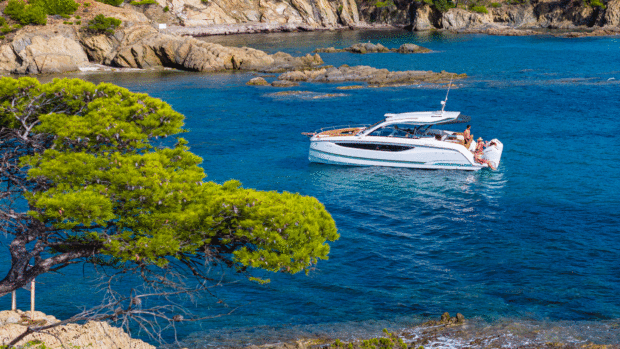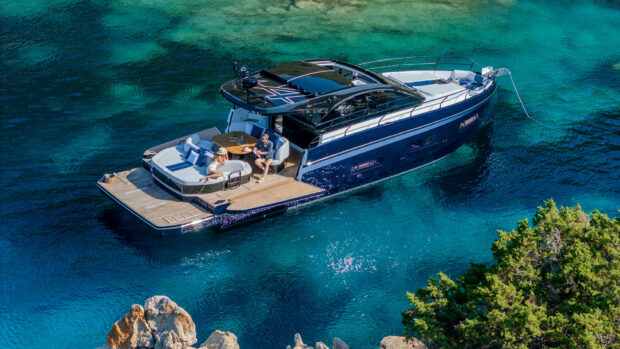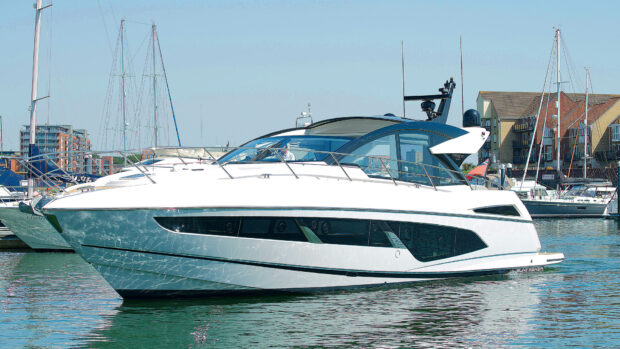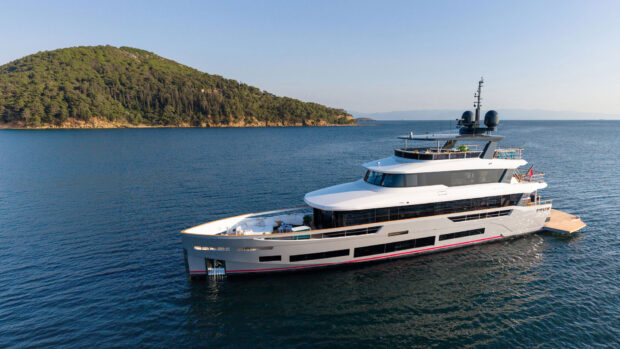


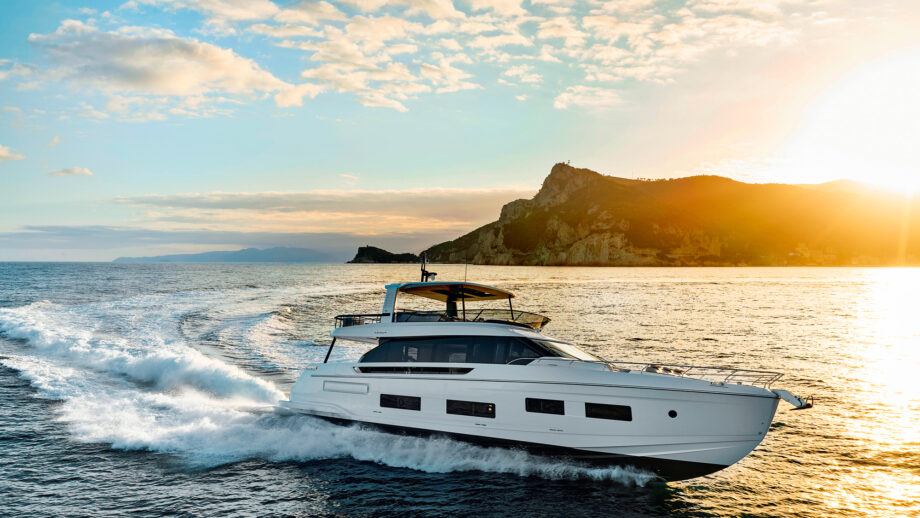
Its purposeful silhouette stood out from the crowd at the Cannes Boat Show, but does the new Azimut 82 offer fun and seaworthiness in equal measure?
Surrounded on all sides at the recent Cannes Boat Show show by the wild excesses of modern motor yacht design, Azimut’s big new flybridge boat stood out for its no-nonsense air, its snubbed bow more mission statement than fashion statement.
An absence of unnecessary curvature and those black-glazed horizontals lend a seriousness of purpose to the Fly 82’s profile that is almost military, as if to remind us that for all the Avigliana shipyard’s Seadecks and Magellanos and S-boats, flybridge yachts are the core of the business, as they have been at Azimut for more than 50 years.
Fads and fashions come and go, but this matters. Not getting it right is not an option.
Any sense of seriousness ebbs away as you get closer, however, for at heart the 82 is a great big floating pleasure palace, from the extensive real estate of that broad bow, complete with roomy sunbed and sociable sofa arrangement, to the versatile appointments aft.
The principal focus for outdoor fun and relaxation will be provided by the substantial flybridge, with its dining table and bar shaded by an expansive hardtop, and its spacious seating area aft. The forward sunlounger has a well-padded backrest, and would be an excellent spot from which to watch the world go by.
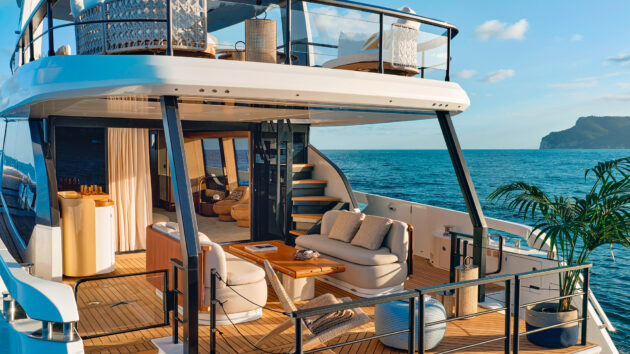
The outside deck spaces are immense, even by the standards of other 80ft yachts
Carbon superstructure
The flybridge’s long overhang, constructed of carbon along with the rest of the superstructure to keep the centre of gravity down, performs sterling service in sheltering the cockpit, which has paired sofas facing each other across an elegant folding table.
This yacht’s party piece is the hinged transom that lifts up to extend the cockpit. Dubbed Deck2Deck, it’s a €40,000 extra that was first seen in the shipyard’s Grande series of yachts. It does work well, and adjusting the guardrails is not a major inconvenience, but one cannot help wondering whether it occurred to anyone in the design department that simply making the cockpit bigger in the first place was perhaps an idea worth pursuing.
This might also have allowed for a larger tender garage underneath – although there is nothing much wrong with the existing one, which can swallow a five-seat Williams 385.
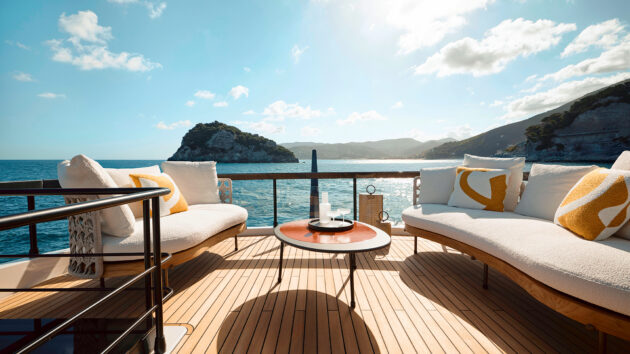
Freestanding furniture can easily be swapped for a different style
Speaking of optional extras, the list is long and impressive. In common with most boatbuilders these days Azimut feels it necessary to put things on it that you and I might regard as essential, such as a hardtop (€123,850), some nice teak decking for the flybridge (€52,900), a second helm seat up there too (€5,900), a telescopic passerelle (€52,400) and even, these days – this is how spoiled we are getting – Volvo’s clever joystick control package (€75,000).
On the subject of such other essentials as fiddle rails to keep your lunch off the floor, or handholds to keep you from joining it, the extras list is silent. But we mustn’t gripe. It has never been easy to make a profit building boats.
Step-free access leads seamlessly from the cockpit through to the saloon, where you start to appreciate the benefits of all that glazing, and the cutaway bulwarks too, which offer sensational views out over low-profile furnishings.
Article continues below…
Absolute Navetta 62 review: Trawler functionality meets modern Italian flybridge style

Pershing GTX80 first look: 80ft Sports Utility Yacht
That dining table is a cool, circular slab of solid marble. Forward, the helm station is separated from the guests by a full-height bulkhead for a proper big-yacht feel, with a door out to the starboard side deck. This too is a comfortable space, with its little dinette, and shares its dignified seclusion with a rather basic galley, over to port.
A companionway leads down from here to the crew accommodation in the bows, which, even allowing for the fairly narrow corridor, is still a very much more civilised arrangement than the usual vertiginous descent from the cockpit, into what often seems like little more than an upholstered stowage locker next to the engineroom. Crew facilities consist of either two or three single berths, an ensuite head and shower compartment, and a reasonable amount of stowage space.
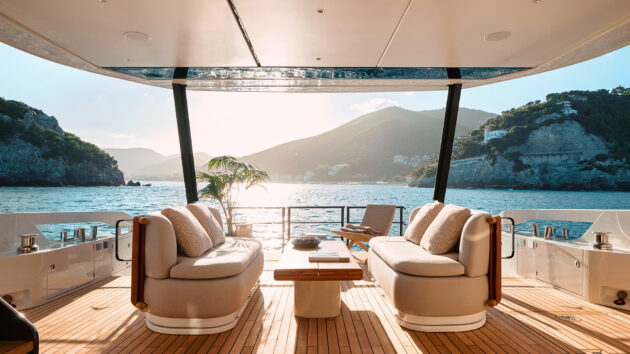
The cockpit benches and table are arranged longitudinally so nobody ends up looking into the boat
Triple IPS drives
Forward crew quarters are not the norm in motor yachts of this class, but IPS drives allow the engines to be set well aft, clearing space for guest accommodation in the widest part of the hull and allowing the crew cabin to be placed up in the bows, where the VIP is commonly found in a conventional shaft-drive design.
In addition to its enthusiastic adoption of IPS, Azimut has also got into the habit of fitting three smaller engines instead of two bigger ones, to keep the engineroom as short as possible without sacrificing horsepower. This can also lead to fuel savings over the equivalent twin-shaft-drive set-up, and the weight penalty is not as bad as you’d think (see our Azimut 77S report, 2015) – although it’s best not to dwell too much on the extra servicing costs.
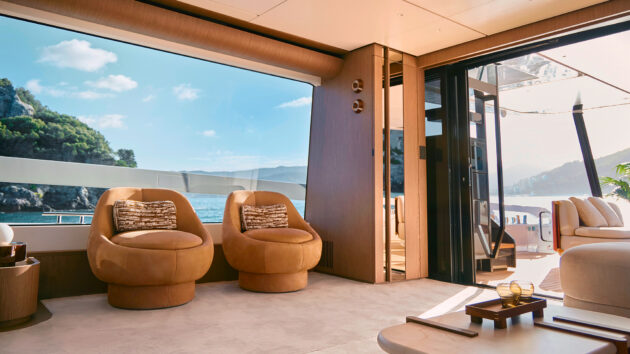
Low furniture and tall picture windows bring the outside in
Triple-IPS thinking seems to have worked so well for Azimut that it has moved on from the sporty and narrow-beam S-class boats, into the Seadeck models, and now to the two largest yachts in the Fly line-up. Volvo D13s might be slightly narrower than, say, MAN V12s, but even in a hull with the 82’s generous beam, once you’ve crammed three of them in side by side there is very little room for anything else, least of all a mechanic. But on the plus side the owner’s and guest cabins have plenty of breathing space.
Guest access to the lower deck is amidships on the starboard side, down a companionway that deposits you at the door to the master cabin. With its walk-in wardrobe and head compartment arranged across the aft bulkhead to insulate the cabin from the machinery space, along with a sofa to starboard, plenty of floor area and panoramic windows, it is every inch the luxe retreat.
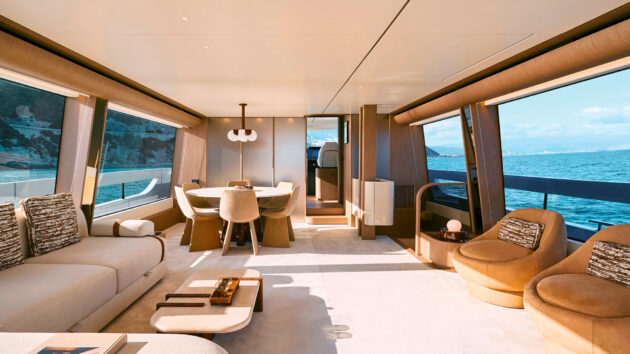
Cutaway bulwarks offer sensational views out over the low-profile furnishings
From here a slightly unusual corridor leads you around a right-angled turn and up a couple of steps to the twin berths of the port guest cabin, and the double cabin across the corridor. Further forward, through a door and up a couple more steps, and you find yourself in the VIP.
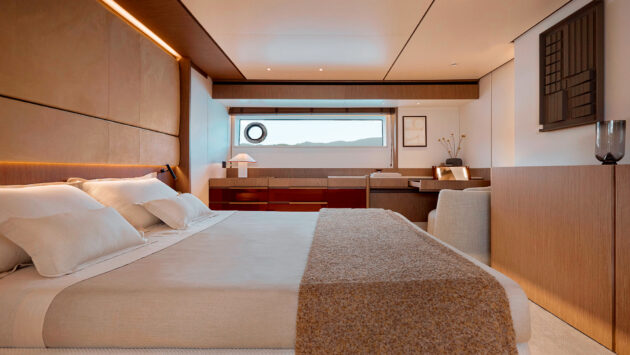
The owner’s cabin is as big and luxurious as you’d expect
Sharing the bow sections with the crew, this forward suite has been offset to the starboard side, which gives it a squarer and more comfortable floorplan than a conventional V-shaped VIP in the bows. It is far less impressive than the master, which is hardly a surprise, but its diagonal layout is practical and pleasing, and with two good hanging lockers it is pretty well off for stowage space.
Four ensuites
All three guest cabins have their ensuite facilities, and for space and comfort there is little to choose between them. Headroom throughout the lower deck is a creditable 6ft 6in (1.98m) and all the beds, too, pass the crucial length test at 6ft 5in minimum (1.96m), although at just 27in wide (68cm) you might want to reserve the twins for your younger or slimmer guests.
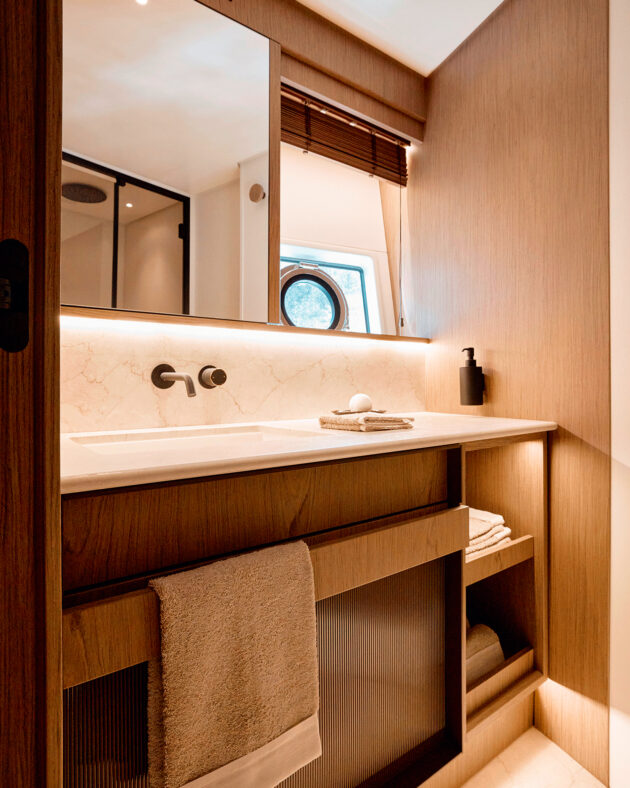
The owner’s ensuite bathroom
The level of detailing is impressive: fine workmanship, and neat little features like the notches cut in bedside locker lids for your phone’s charging cable, and drawers with interior illumination, all of it complemented with a pleasing mix of materials and textures. The decor options list is limited, but includes choices of marble over natural or synthetic stone on some of the floors and surfaces, and you can have a quartzite galley worktop in lieu of laminate.
Otherwise the interior design is pretty much as prescribed by the Milan studio of Fabio Fantolino, who will also be happy to design you a house, style your restaurant or cheer up your office space. This is his third project for Azimut. If I thought for a moment that my critique of an interior design had any value, I might say that the inside of Azimut’s Fly 82 looks a bit beige. But a colourful cushion or two will work wonders.
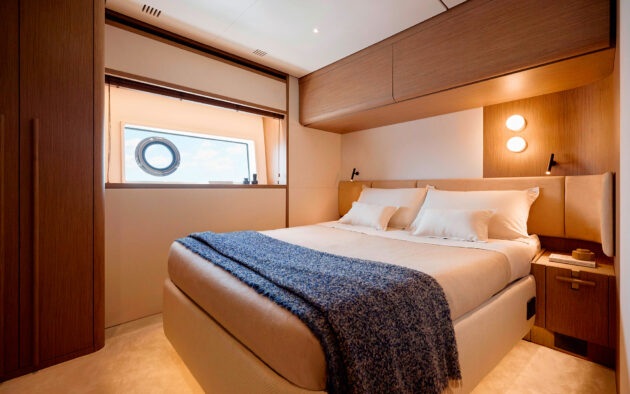
The starboard double is much the same size as the forward VIP
Alberto Mancini’s design team were responsible for the 82’s exterior styling, while Pierluigi Ausonio took care of things beneath the waterline. The hull is an easily-driven medium-V, with 16.3 degrees of deadrise aft, and what a powerboat racer would call a ‘pad’ flattening the central section right aft, not for stability at 70 knots but to accommodate the middle IPS unit. With a gentle twist, the hull bottom sections sharpen up as they lead forward to culminate in a fine forefoot.
A triple-IPS installation is never going to be dull, even in an 82-footer, and our test boat was fitted with the larger of the two available engine options, providing no less than 3,000 horsepower. First thing in the morning at the Cannes show is usually a period of calm, before the crowds come down and the land heats up, but the previous evening’s Force 3 to 4 had continued through the night, and although it was coming off the land it was raising chop on the water.
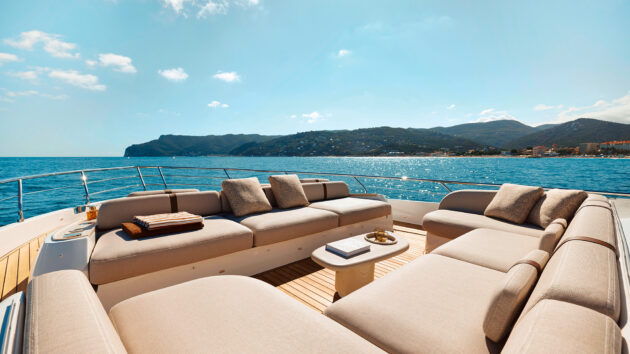
The foredeck lounge is almost as big, versatile and inviting as the flybridge
Nothing to worry our 60-tonne pleasure palace, however. Although a notional MAN-powered Fly 82 with two V12s might have 600 more horsepower, our Azimut managed very well with its triple-IPS1350 power plants, even with a significant load of fuel and water aboard, not to mention a crew of 12 that included a number of time-served journalists who would probably admit to a largely sedentary lifestyle.
Impressive handling
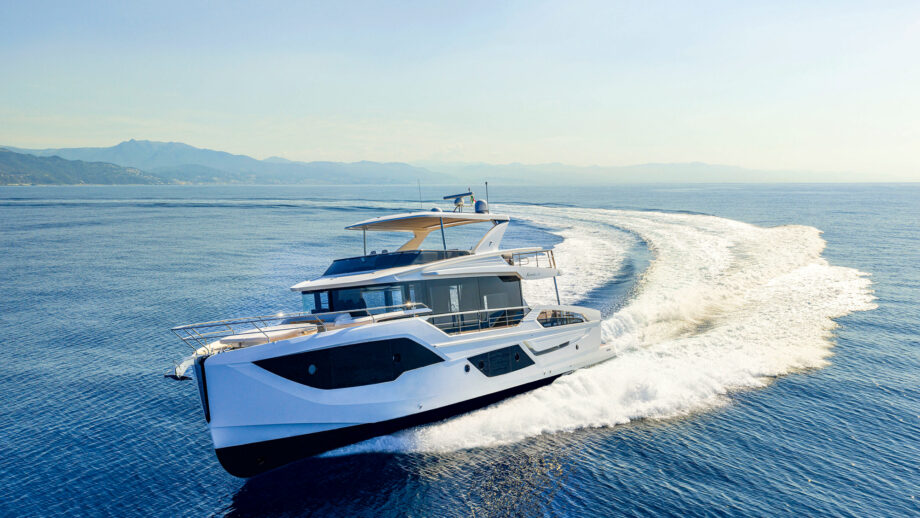
The IPS drives shrugged off the weight and the 82 accelerated keenly, leaning well into the turns in spite of the Seakeeper – which we kept on, along with the automatic trim system – and even the hardest helm inputs hardly scrubbed off any speed. Volvo’s IPS1350s might lack the torque of MAN’s V12-1800s, but I doubt that any Fly 82 owner would find anything amiss in the way this yacht handles and performs. Whether the IPS1200s would make an equally positive impression is open to question. The 1350s certainly felt like a perfect match.
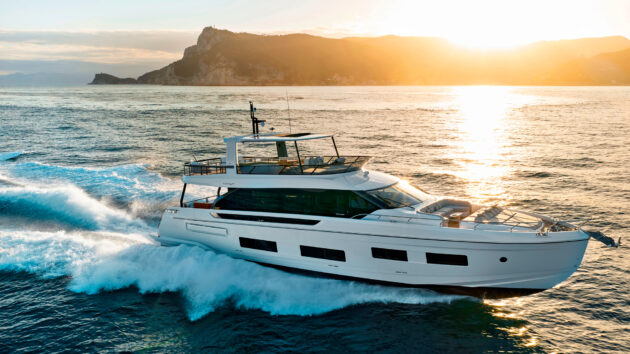
Fun as it was to drive the 82 – way more fun than boats this size usually are – there came a time when we had to straighten up and sharpen our pencils. The 3ft chop had no effect at all on our progress, and although the odd creak could be heard from the lower deck, we could easily have powered on all day at 25 knots with little discomfort and no complaint.
Top speed averaged 32.2 knots, spot on the advertised figure. More important was the 82’s willingness to remain on the plane at around 18 knots, a useful trait when the water gets properly choppy, so that with very little change in trim you can select a cruising speed according to comfort or economy from the high 20s all the way down to the high teens.
Azimut 82 specifications
LOA: 81ft 3in (24.79m)
BEAM: 19ft 3in (5.87m)
DRAFT: 5ft 7in (1.70m)
DISPLACEMENT: 63.2 tonnes (full load)
ENGINES: 3 x Volvo Penta IPS 1200 or 3 x Volvo Penta IPS 1350 diesel
FUEL CAPACITY: 5,700 litres
WATER CAPACITY: 1,100 litres
RCD CATEGORY: A for 16 people
CONTACT: www.azimutyachts.com
Azimut 82 costs and options
From: €4.5 million ex taxes with IPS1200s
Upgrade to IPS1350: €95,150
Seakeeper 26: €314,200
Bow bimini with carbon poles: €47,650
Deck 2 Deck cockpit extension: €40,500
Platinum electronics package: €58,350
Tender launch system: €22,650
 If you enjoyed this….
 If you enjoyed this….
Motor Boat & Yachting is the world’s leading magazine for Motoryacht enthusiasts. Every month we have inspirational adventures and practical features to help you realise your sailing dreams, as well as tests and news of all the latest motorboats.
Plus you’ll get our quarterly Custom Yachting supplement where we share the last on offer in the superyacht world and at the luxury end of the market.
Build your knowledge with a subscription delivered to your door. See our latest offers and save at least 30% off the cover price.
Note: We may earn a commission when you buy through links on our site, at no extra cost to you. This doesn’t affect our editorial independence.
Verdict
The Fly 82 excels in every department, from its spacious accommodation to its performance and handling. It’s an extremely luxurious vessel, designed primarily to impress and pamper your guests on sunny day excursions. However, it also has the range and seagoing capability to undertake quite ambitious trips. All it would take to transform it into a much more practical cruising boat is some fiddle rails and a few more handholds, and of course a better galley. Then it might be said to have the seriousness of purpose that its businesslike profile suggests. If you broached the subject with the Azimut sales team, they would probably just hand you a brochure for their Magellano range, and they’d have a point. There is no doubt that in the Fly 82, Azimut has achieved what it set out to do. And they didn’t just get it right: this is about as right as it gets.