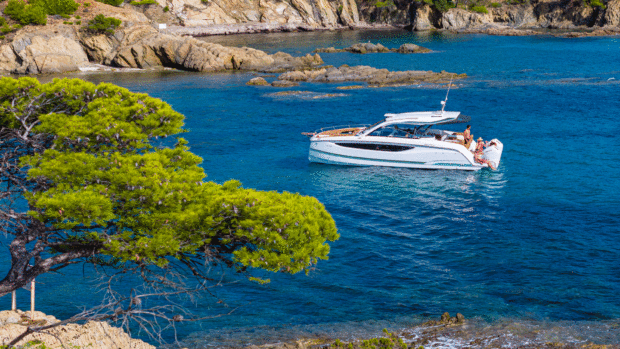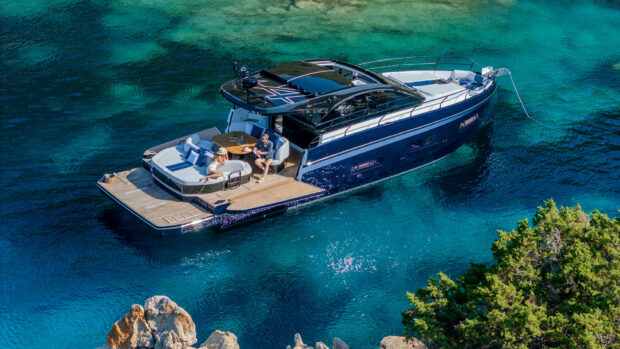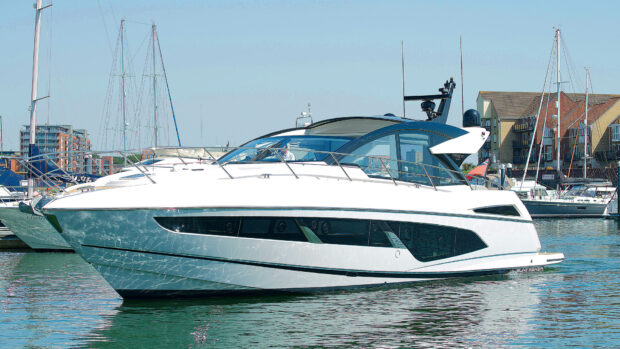


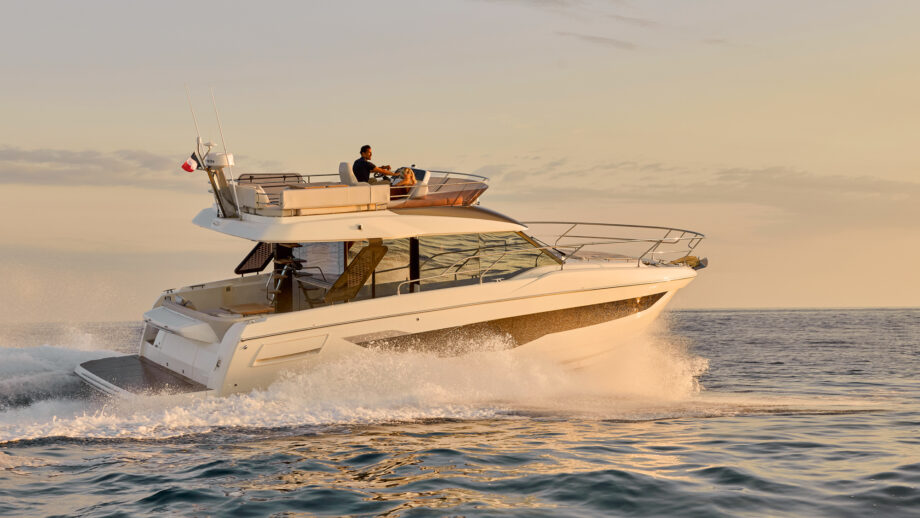
The F4.3 is Prestige's smallest F-Line model, aiming for a younger clientele. We test its innovative full-beam cabin and high-volume design
With an overall length just shy of 43ft and a package price that starts at €635,000 plus tax, we’re told that the new Prestige F-Line cruiser is a boat aimed at a younger, more dynamic clientele. But having seen both the F4.9 and F5.7, that seems like a slight betrayal of Prestige’s larger flybridge cruisers.
Both the F4.9 and F5.7 bring decent looks, bright internal spaces, fresh galley arrangements, large flybridge party spaces, and lower decks that sidestep the norm with raised bow cabins. This is for owners who want that little bit more in the way of privacy and separation.
The sheer individuality of that F-Line design DNA feels youthful in its own right, so implying that they are otherwise is to miss the point. It’s certainly very pleasing to see that this smallest F-Line model yet adopts the same principles that have made Prestige’s “next-generation” cruisers so much fun. For proof of that, just take a look at that raised bow. Instead of crowbarring a cabin into the tapering V of the hull, they have elevated the forward space to shift it up beyond the most restrictive point of compromise and maximise the volume.
In tandem with the big upper deck, that forward elevation does of course limit the dynamism of the styling. However, Prestige has pulled out a fair few design tricks to help mitigate that. There are long dark hull windows to cut through the fibreglass. There’s lots of mirrored superstructure glazing above that, plus grey mouldings at the leading edge of the flybridge to reduce the scale of the profile.
Prestige’s trademark “fashion panels” at the aft end are raked to add a pleasing sense of movement. Even then, it’s by no means the sector’s most beautiful boat. But when you step inside, the impact of that design approach feels remarkably positive.
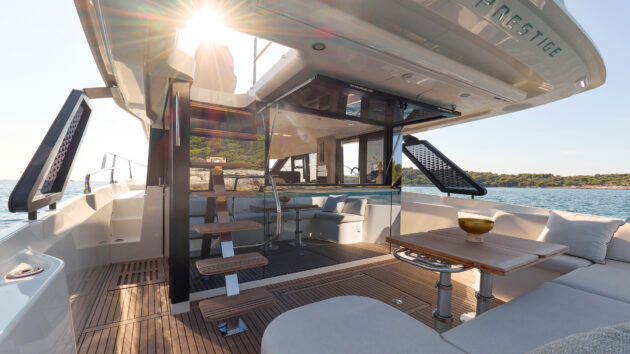
Space and light are very strong but the windows do narrow a bit at the raised bow
A tale of two cabins
On the larger models, the owner gets the benefit of that raised bow with a forward cabin, very cleanly separated from the guest spaces further aft. Here, though, that mid-level deck, half-way down the steps from the forward saloon, is used as the VIP zone. It features a large bed with good space on both sides and very decent headroom, plus a pair of lateral cabinets. There’s also direct access to the optional second bathroom on the starboard side.
On this two-cabin boat, this second bathroom is likely to be a more popular option than the alternative utility room. It comes with a separate shower, but the loo is also tucked in there to make the limited space work more effectively. You also see that pragmatic approach to spatial management in the provision of a two-part door to access the cabin itself.
Continuing down the steps aft, you find yourself in the full-beam owner’s ensuite cabin. That’s an impressive feature in its own right on a boat of this size, and the use of V-drives is of course fundamental to that. The finish is pleasing too. Like its larger siblings, it uses every trick in the book to make the space feel as big, bright and generous as possible.
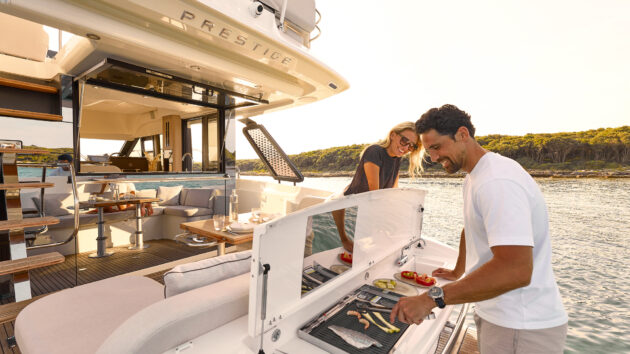
The aft wet bar is a brilliant option on a boat of this scale
Inset LEDs, mirrored panels, sliding doors, clever deck level fluctuations, and pale woods and fabrics do a great job of mitigating any sense of spatial tightness. And as in the bow cabin, there’s also a sense of muted luxury down here, thanks to the kind of premium-feeling fittings and attractive bulkhead fabrics that you don’t necessarily expect. In the absence of a settee, there’s nowhere to sit, the headroom is quite limited except on the port side, and you do have to perch on the bed to use the dressing table. This dressing table is cleverly integrated into the port cabinet.
A proper full-beam cabin is a rare treat on a boat like this. As the owner’s space, the port ensuite provides sufficient room for a toilet in the main body of the bathroom, as well as a separate shower.
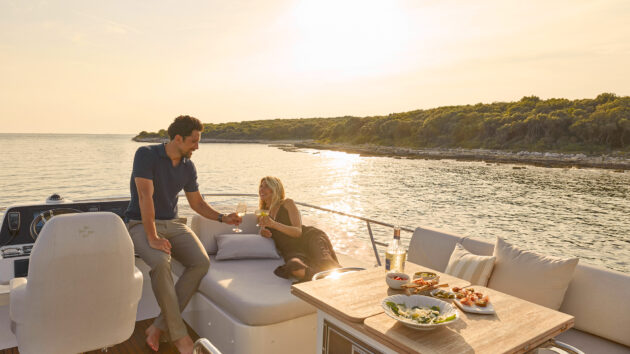
In the absence of cooking facilities, the flybridge is all about sociable seating
Pick your party zone
The aft end of the F4.3 is beautifully arranged. There’s a hydraulic high-low platform with direct access to a spacious low-level locker for your toys. A well-positioned wet bar sits beneath a lift-up lid with an electric barbecue and sink. Further forward, the cockpit again does everything it can to maximise the value of the space with an asymmetrical layout.
A port walkway frees up the rest of the deck for a shallow U-shaped settee and a fold-out table. An electrically operated awning extends out at an angle from the overhead moulding. This provides shelter, as well as some useful extra privacy from pontoon sightseers on Mediterranean berths. The dining area faces forward toward an aft “Ocean View” galley that also adapts the F-Line approach to get better value out of the available space.
While the larger models use conventional aft doors to connect the internal galley and the aft cockpit, the more restricted beam of the F4.3 uses a pair of side doors instead. That enables Prestige to factor in an enormous one-piece window that hinges up against the underside of the flybridge. This provides exactly the same degree of connection between the two spaces as the larger boats.
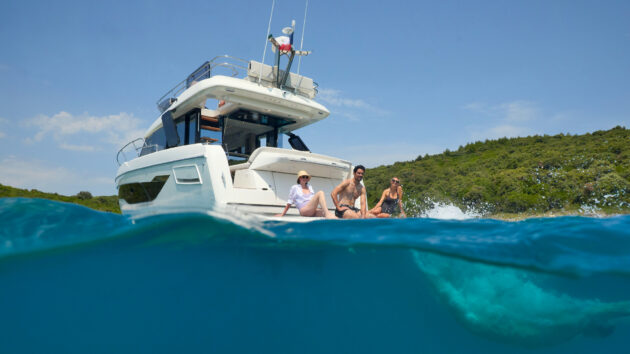
The high-low platform is a key option on a boat with such an appealing aft end
You get outstanding light, views and fresh air from the galley, and it’s extremely sociable too. You can face directly out from the galley toward the cockpit seating. That arrangement feels even better when you use the newly designed bar and arrange the cockpit’s forward deck with a couple of bar stools. There’s not a lot of space in the engine-room though.
In fact, it’s so limited that there’s no room for a telescopic passerelle. If you want one, it has to stay visible, projecting out from the starboard side of the transom above the aft platform, even when not in use. But it’s by no means a problem. It’s good to see that the flybridge steps on the cockpit’s port side occupy much the same space as the full-height unit that contains the fridge freezer, which helps limit any obstruction to that all-important galley view.
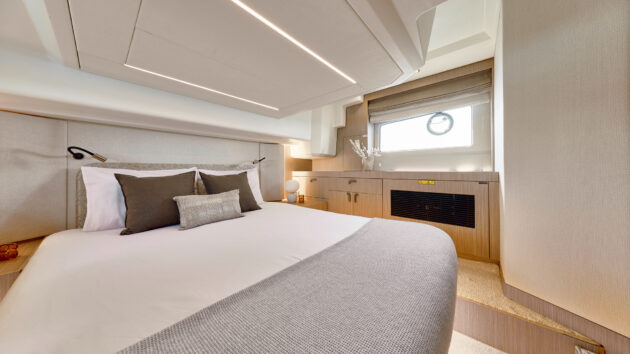
You don’t tend to expect a full-beam owner’s cabin on a 43-footer
While the flybridge steps themselves are a shade steep, the scale of the upper deck is also impressive. There’s no wet bar up top, but there’s plenty of seating for up to seven people at the starboard dining station. A proper fridge is built into the chunky table leg. There’s also room for some extra companion seating that extends in sunbed form, beyond the dining area to starboard of the helm.
All of this is supplemented with a perfectly serviceable bow space. There’s no clever furniture here; no sunken footwell, moving backrests or facing seats. But the bow is easy to access via deep, wide side decks and its slightly squared-off shape enables the inclusion of three positions on the central sun pad, each with a lift-up backrest for extra comfort.

Mirrors, LED lights, pale fabrics and two-part doors make the very most of the space in the raised bow cabin
Simplicity at sea
The F4.3 uses the same hull as the 420 flybridge, partly because there was nothing wrong with the old one. This also enabled them to get a new boat to market much more quickly than starting from scratch. As you would expect, they’ve also taken the standard Prestige no-options approach to the engines, so it will come as no surprise to learn that the F4.3 feels very well sorted on the water.
With twin Volvo D6-440s on V drives, we’re seeing a top end of 31 knots and a remarkably rapid cruising sweet spot of 28 knots. At 28 knots, 5L/Nm provides a range from that 1,170L tank of nearly 190 miles. You can feel a bit of mild judder from the upper helm as you push onto the plane or when you run through some lumps, but it’s otherwise a very comfortable place to be.
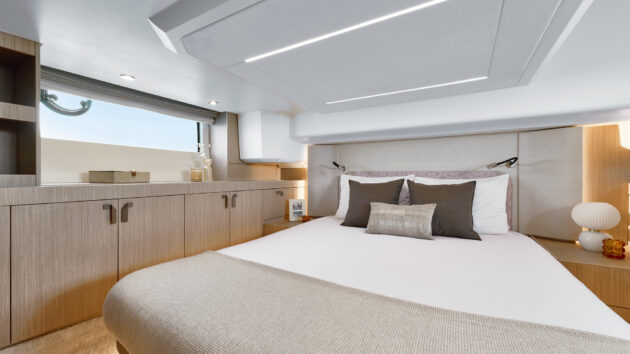
In spite of a dipping deckhead, the owner’s cabin retains full standing headroom on the port side
The flybridge features a fully specced helm, an excellent seat, and good protection from the optional hardtop and the wraparound wind deflector. As a relatively compact cruiser with a big flybridge and substantial elevation, we do find that it takes about 60% tab to counteract a beam wind. You could of course forget about that by popping the tabs on automatic.
Keeping things on manual enables you to get a much better feel for what the boat’s doing and to avoid the often over-active input of the auto settings. And that’s worth doing because, while everything happens quite gradually here, there is nonetheless a decent bit of heel in the turn and a commendable sharpness to the steering. We find a fast 180-degree arc takes only three boat lengths or so to execute, and that’s very handy for picking your way through a seascape.
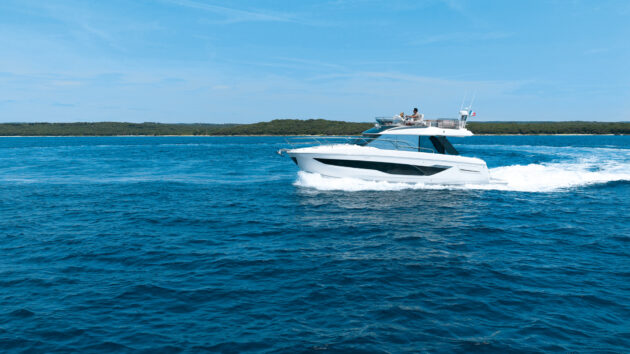
Once you get beyond displacement speeds, the best range is to be had at 28 knots
As for that main deck helm, it’s not quite on the same level. The roof is low and the view forward from the port dinette is obscured by the raised forward mouldings that are so fundamental to the way the Prestige’s lower deck operates. Similarly, standing at the lower helm isn’t really that practical so you need to take a seat instead.
When you do take a seat, the single bench-style seat is a shade basic. That said, it is adjustable, as is the wheel, and there’s also an angled foot brace plus some very welcome air vents down by your feet. There’s also direct access to the side decks on both sides of the galley plus optional windows on both sides, so you can get an excellent flow of air through the boat underway. When you couple these features with the optional joystick, parking this boat, even for a novice crew or a single-handed skipper, becomes a very straightforward operation.
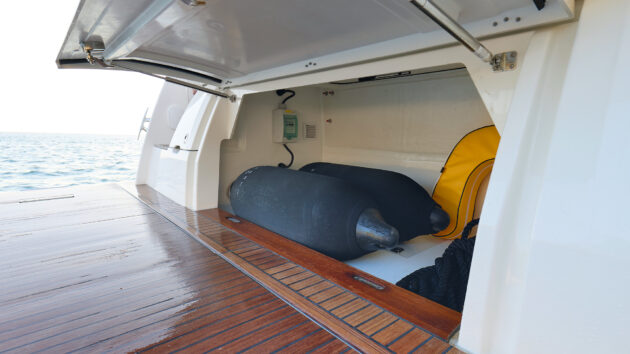
There’s a very welcome toys locker beneath the optional transom wet bar
Prestige F4.3 specifications
LOA: 42ft 10in (13.07m)
BEAM: 13ft 5in (4.10m)
DRAFT: 3ft 11in (1.19m)
DISPLACEMENT: 10,800kg (light)
FUEL CAPACITY: 1,170L
WATER CAPACITY: 300L
ENGINE: Twin Volvo Penta D6-440s on V-Drives
 If you enjoyed this….
 If you enjoyed this….
Motor Boat & Yachting is the world’s leading magazine for Motoryacht enthusiasts. Every month we have inspirational adventures and practical features to help you realise your sailing dreams, as well as tests and news of all the latest motorboats.
Plus you’ll get our quarterly Custom Yachting supplement where we share the last on offer in the superyacht world and at the luxury end of the market.
Build your knowledge with a subscription delivered to your door. See our latest offers and save at least 30% off the cover price.
Note: We may earn a commission when you buy through links on our site, at no extra cost to you. This doesn’t affect our editorial independence.
Verdict
The new F4.3 comes with what Prestige calls an “aggressive price”—namely €635,000 plus VAT for the starting package or around €800,000 for the test boat. That’s pretty good value in the market context. This is particularly true given the day-boating fun of the aft cockpit and galley arrangement, the scale of the flybridge, the quality of the two cabins, and the straightforward reliability of the drive. As mentioned, the lower helm isn’t great, the engine-room is tight, and the styling is a bit average. So, if you can stretch to the F4.9, it remains a very worthwhile upgrade. But if you’re looking for an entry-level family flybridge cruiser for four, then with its smallest model yet, Prestige’s F Line continues to impress.