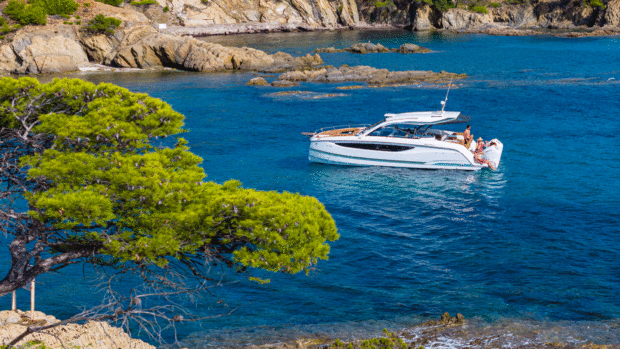


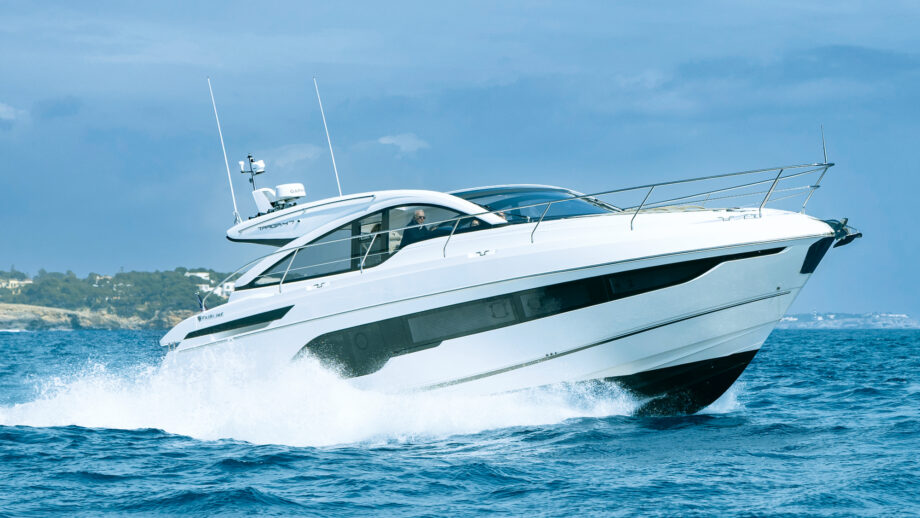
Sleek lines, clever design, and a flat fuel burn make the new Fairline Targa 47 Open a masterclass in traditional sportscruiser luxury
There’s something really satisfying about a traditional sportscruiser. The sleek, aggressive looks that come with a low roofline and inboard diesels; the dynamic drive made possible by a deep centre of gravity and a sporting hull; the promise of proper cruising accommodation as well as sociable day spaces; and the knowledge that if the weather turns, you’ve got a proper downstairs lounge with galley.
It’s that combination of talents that saw nearly 100 Fairline 45s sold in either GT or Open form during its five years or so of production. And given that the new 47 Open is once again the work of Fairline’s lead designer, Christian Gott – the same man responsible for the 45 upon which this boat is based – it’s no surprise to see that the Fairline Targa 47 Open looks every bit as attractive as Targas of the past.
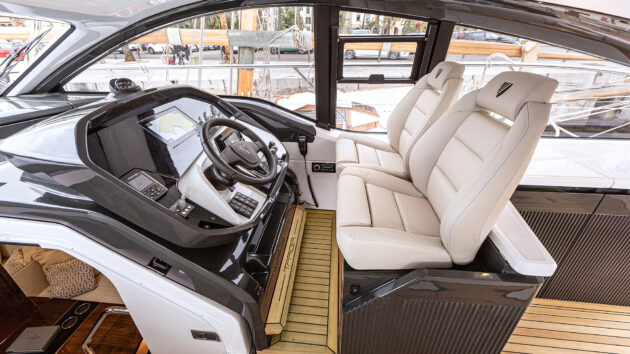
As a fairly traditional open sportscruiser, the driving experience is a key part of the mix
Open day spaces
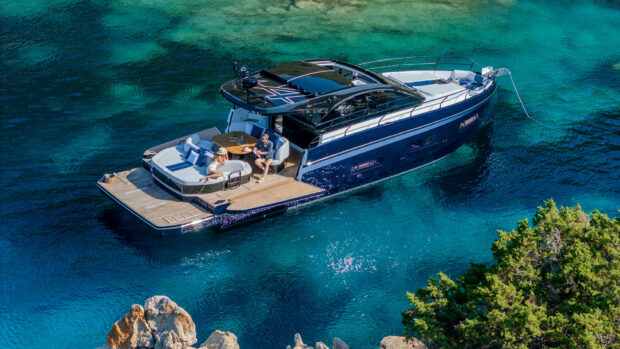
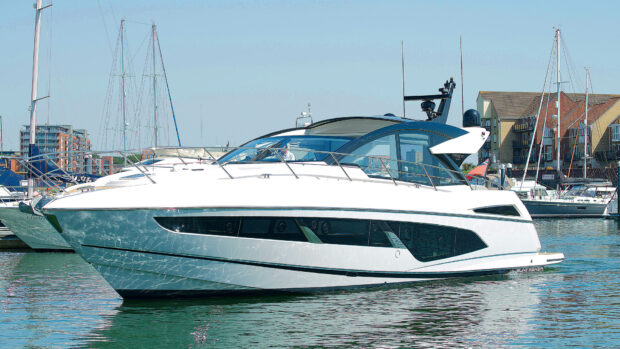
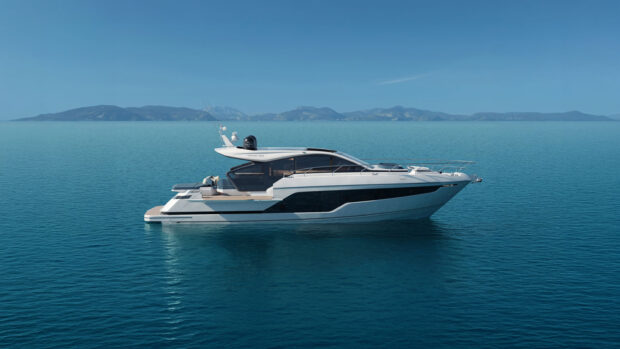
This is an indisputably good-looking boat. The topside mouldings are significantly raised above the rubbing strake, and the bow’s island sunbed also gets some generous elevation. That is designed of course to generate extra headroom in the cabins but what it also does is make the superstructure feel very low-slung and hunkered down by comparison. It’s a potent part of the aesthetic and it’s made to feel all the more dynamic by means of long, plunging one-piece hull windows, which are neatly mirrored by the shape of the cockpit glazing and aft vents.
Once you step on board, the deck layouts are specifically designed to foreground what an ‘Open’ model is all about.
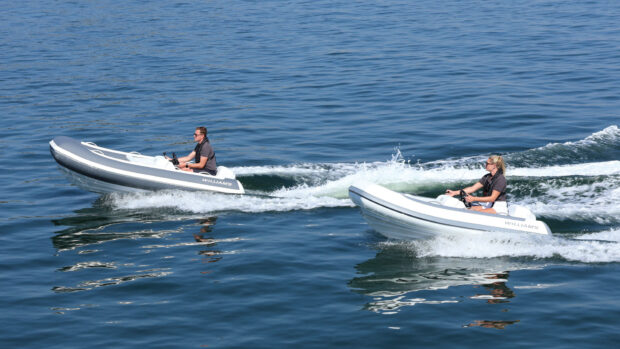
At the aft end, a raised central sunbed straddles the zone between cockpit and swim platform. There’s space beneath the hatch for a 2.85m Williams Jet Tender with a drop-down hydraulic platform for easy deployment; and if you hinge up
the tray for that tender, you get direct access to a pair of Volvo D6-480hp diesels on IPS pod drives.
You can also get into this space via a port hatch at the top of the steps but you do find yourself quite restricted by the generator and a partial bulkhead, so if you want proper access to the engines, shifting the tender out and lifting the tray is by far the better option.
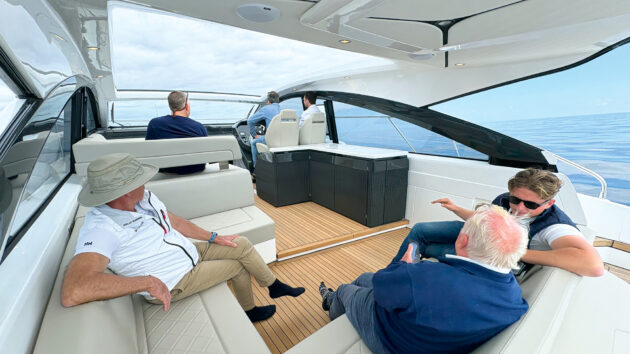
A small wet bar and a table that folds out of sight means masses of space for sociable seating
Further forward, the cockpit, wetbar and helm are of course very much integrated as a single, continuous space on this Open model. The lower aft section is filled with a huge C-shaped dinette, and on the upper forward level, that leads onto some casual companion seating opposite a twin helm and a starboard wet bar.
Even without freestanding furniture, the dinette is large enough for eight people and it’s clever as well as big. You can reverse the aft backrest to expand the island sunbed and face aft over the transom. And as on the Targa 40, the rather beautiful cockpit table is mounted on a hinged strut, which enables you to fold it out of sight beneath the port bench when you want to open up the party space.
The inclusion of a proper galley down below (told you this was a proper sportscruiser) means you can make do with a relatively compact wet bar up top, which is great, both for ease of movement and seating capacity. But the L-shaped wet bar that butts up against the helm seats on this new 47 is actually a much more practical solution than the corner seat that occupied this same space on the old 45.
It comes with a grill and a large sink, plus a fridge and icemaker and, rather thoughtfully, it also provides lids with significant overhangs so you don’t trap your fingers when you close them. Ventilation is, of course, no problem on this open model but it’s made all the better by a massive canvas sunroof, which encompasses two thirds of the hard top – and the fact that it comes as part of the standard package illustrates just how critical it is to the nature of the open boating experience.
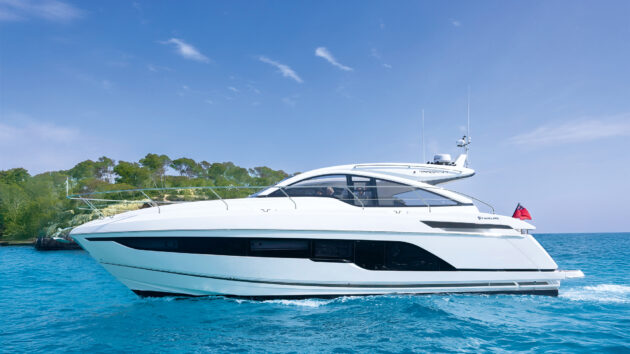
There’s some attractive continuity in the hull windows, upper glazing and aft vents
The bow’s island sunbed is a pretty straightforward piece of design by comparison. It’s big enough for three or (at a stretch) four people and it comes with lifting backrests to add a bit of extra comfort. There’s also a teak-lined walkaround deck with a good toe rail and lofty guardrails, so there’s no trepidation in making your way fore and aft at sea.
As intimated, this is designed to be a proper purist sportscruiser so there are no sunken bow lounges or facing furniture pods to furnish you with a place to tuck yourself away with a glass of wine. It’s merely a place to access the anchor, tie off lines and have a sunbathe or read a book.
It’s interesting to note, though, how important subtle angles are to the way this boat feels. For instance, the step that delineates the threshold between the upper and lower cockpit is gently angled and so is the worktop in the transverse section at the forward end of the wet bar.
The point of this is not just to add interest and character (though it does plenty of both). It’s to optimise ease of access and flow of traffic in a subtle but very attractive way – and when you head down below, that same approach to angles in the steps, settees and bulkheads feels equally rewarding…
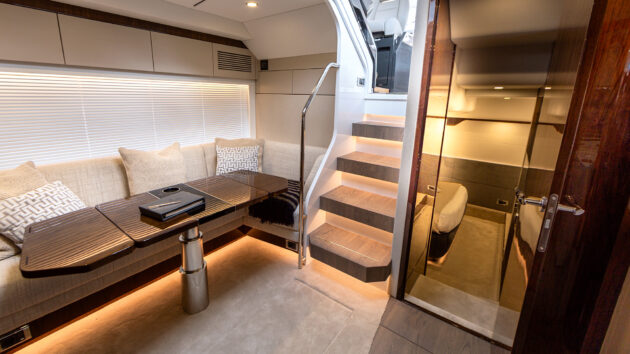
The lavish dinette converts to an occasional third berth when needed
Two-cabin layout
This might be a 48ft boat but it only has two cabins so when you head below decks, the scale of the central living space feels really quite surprising. A convertible L-shaped dinette to starboard comes with high-level storage, a long deep hull window and attractive fabric-lined bulkheads.
There’s also a fluted walnut bulkhead at the leading edge of this dinette that looks and feels rather lovely, but you can also spec this section of the boat with an elegantly lit glass drinks cabinet instead, in the perfect place to serve yourself at the table.
That would, of course, reduce the width of the transverse walkway to access the peripheral settee and the day heads but not critically so – and with Gott’s mastery of angles, such is the 47’s ease of movement that this is an option we would be very keen to investigate.
Opposite this on the port side sits a very serviceable galley with a large fridge, lots of storage and plenty of space to expand the two-ring induction hob to something larger and more workmanlike.
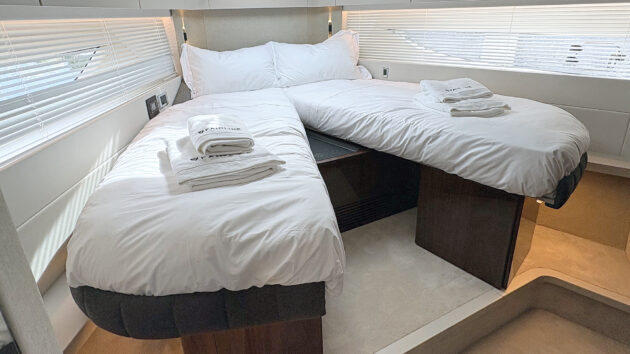
If you pick the aft cabin as the owner’s space, the bow cabin is best specced with scissor berths
Light and views are also very strong and the fact that there’s some really deep storage space beneath your feet means you can tuck away your weekend baggage without cluttering up any of your primary cupboards and cabinets.
In the interests of manufacturing efficiencies, the arrangement down here is pretty much fixed but there are ways to finesse things a little bit. The owner, for instance, can pick either the bright, spacious forward cabin with its lofty deckhead, expansive hull windows and direct access to the day heads. Or they can opt instead for the full-beam midships cabin with its larger private ensuite, transverse bed and port settee.
If they do that, then it makes sense to spec the bow cabin with the optional scissor berths so it can be used either as a guest twin or a guest double. But either way, this is a boat with a pair of cabins that are large, bright, elegantly designed and sumptuously finished so most people who are familiar with cruisers of this length are likely to be genuinely content with either.
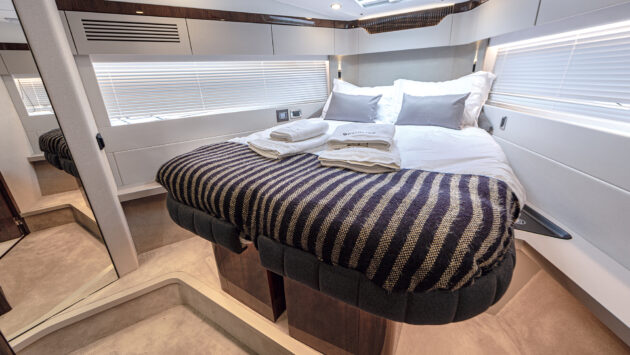
The tall bow and big hull windows ensure the forward cabin feels bright and spacious
Fun from the helm
Oddly enough, when you slot yourself in at the helm station, it’s clear that things are not quite as polished as the rest of the boat might lead you to expect. The seat feels too high to make proper use of the dedicated foot brace. The MFDs are angled in such a fashion as to reflect the sky when the big sunroof is open.
The tabs and thrusters are on the left-hand side rather than the right. The midships cleat is too far aft to reach from the skipper’s side window. And the glossy dash material delivers way more glare than is necessary. But such is the driving fun on offer from this new 47 that these concerns seem to evaporate once you get underway.
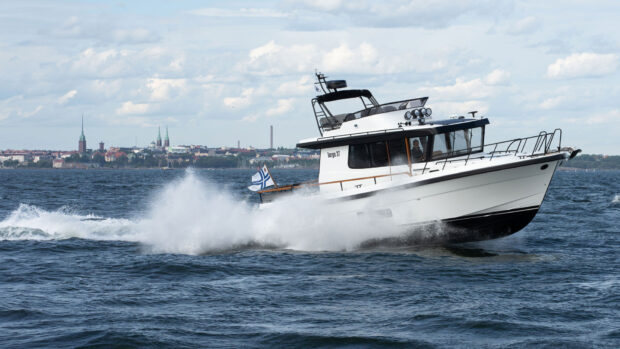
Now with a top end in the region of 32 knots, this is not an especially quick boat, but everything about its conduct en route to that feels very strong. From 21 knots right up to wide-open throttle, the fuel flow sits resolutely at 6L per mile, so it really doesn’t matter how fast you choose to cruise. The refinement is also remarkable, particularly for an open boat, bringing decibel readings that only increase from 70 to 74dB(A) in that same cruising band.
And the handling is a delight. There is a fair bit of bow-up attitude at lower speeds but it’s easy to dial that out with extra pace and a tweak on the tabs. And when you throw it into a turn there’s lots of heel, lovely composure, good grip and rapidfire resumption of natural trim the moment you come back onto the straight. It feels very much like a boat with the weight deep down and, as an open inboard-powered sportscruiser, that is exactly how it ought to be.
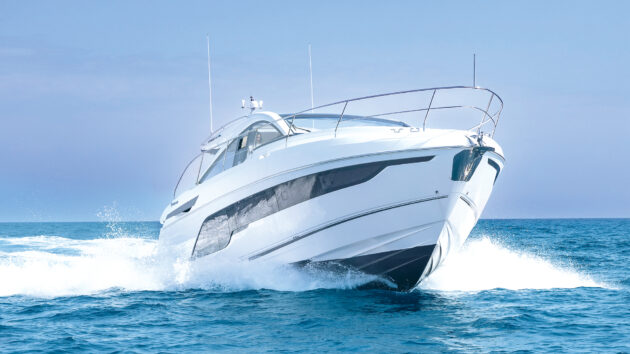
This boat is more effi cient at wide-open-throttle than it is at 20 knots
The Volvo Penta joystick is good fun too. You can of course use it for assisted docking, with easy 1ft increments to help shunt yourself gradually toward a berth, plus the capacity to sit absolutely still in the water if you need to take stock or attend to the fenders. But you can also use it to helm the boat at pace without touching either wheel or throttle.
To get the best from it, particularly when changing course, you need to apply steady, progressive input rather than coming on and off the lever. But it’s a great little gadget and one that would be all the more satisfying if it were positioned on the armrest of your chair so you could sit back and relax without having to lean forward to reach it.
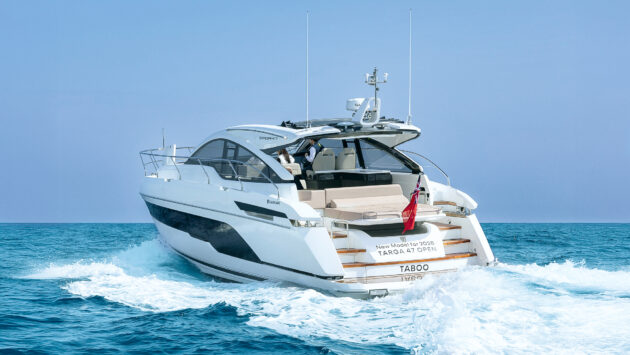
Its design cleverness elevates it above the norm and it drives an absolute treat
Fairline Targa 47 Open specifications
LOA: 48ft 4in (14.73m)
BEAM: 14ft 2in (4.32m)
DRAFT: 3ft 8in (1.15m)
DISPLACEMENT: 12,300kg (light)
FUEL CAPACITY: 1,300L
WATER CAPACITY: 400L
ENGINES: Twin Volvo IPS-650 D6-480 diesels
Fairline Targa 47 Open costs and options
Price: from £895,000 ex-VAT. Test boat includes the following options…
Mid master cabin layout: £9,000
Lower saloon bed conversion: £9,300
Forward scissor berth: £3,300
DPS with Assisted Docking: £13,787
Humphree Interceptors: £8,900
Submersible bathing platform: £30,200
Reverse cycle AC: £33,300
Verdict
As a refinement of a successful formula, the idea behind the new 47 Open was to combine luxury living with sportsboat agility and it very much achieves that. It looks beautiful, it feels plush, there are elements of design cleverness that elevate it above the norm and, notwithstanding its modest outright speeds, it drives a treat. The dash ergonomics could do with fine tuning and it would be good to see an extra option or two. But with Oliver Southwell, its dynamic new CEO at the helm, Fairline seems to be taking exactly the approach required to make this famous heritage builder the modern success story we’re all so keen for it to be.