

Alex Smith set off to Oslo for some purist powerboating, Cormate style. What he found there was a boat that delivers exactly what lovers of Cormate enjoy
You almost have to force yourself to dismiss what you know about modern market trends when you come across a boat like this. Forget volume. Forget expandable decks. Forget crowd-pleasing toys. What we have instead is something far simpler and more purposeful.
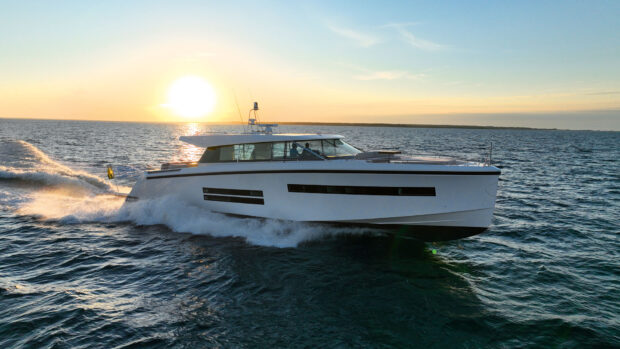
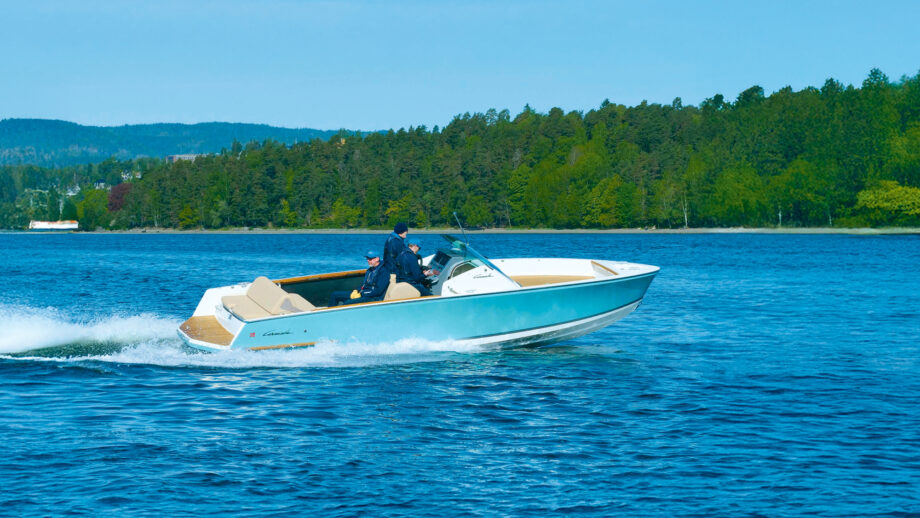
A clean, slippery, stepped hull with a fine entry and a subtle bow flare; a gently swept sheerline lined with smooth teak rails; and an elegant open transom with a beefy inboard engine tucked out of sight beneath the deck. Throw in some duck-egg blue gelcoat, some stitched leather furniture, an empty teak foredeck and some gleaming steel accents and you have a surefire recipe for a fantastic looking boat.
But of course, that’s nothing new to Cormate. For a long time, this race-derived Norwegian brand has been about the creation of purist driving machines that are simple, lightweight, fast and premium. And whether you’re looking at the 23, the 32, the 35 or this new 27, each boat continues to stick very closely to that proven formula.
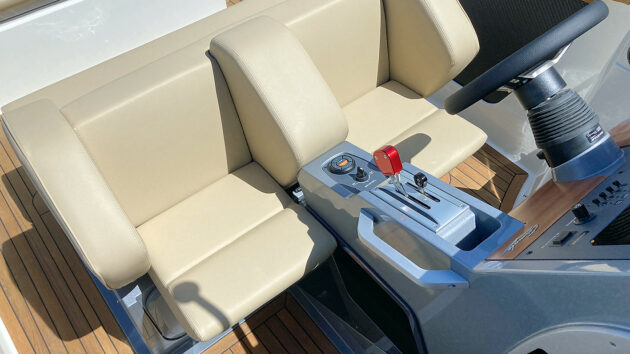
Very few helm stations are better set up for comfort and control at speed
Pared back but posh
When you step on board, the subtle, understated luxury of the Cormate ethos shines through. Elements like the metallic glint of the subtly silvered gelcoat on the internal furniture and the lovely teak work leave you in no doubt about the calibre of this boat. And it’s also good to see how hard the deck arrangement works to make proper use of limited space.
The aft sunbed, for instance, sits in the centre of the deck, directly on top of the engine bay, with a clever triangular backrest that hinges forward and aft. That enables you to rig it as a large aft-facing lounger or as a pair of benches, one facing forward into the cockpit and the other facing aft over the elegantly angular swim platform.
There’s a pair of cupholders machined into the centre of the aft cushion and when you rig the table and look toward the bench that butts up against the back of the two helm seats, you find yourself at a very attractive four-person dining station.
The clarity of thought is clear to see here, not least in the provision of an optional fridge beneath this forward bench, plus a slot to stow the table on the underside of the bench’s lid, exactly where you would want it. There are also beautiful teak grab rails lining the gunwales on either side of the dining area and beneath those are what appear to be large carbon-fibre panels.
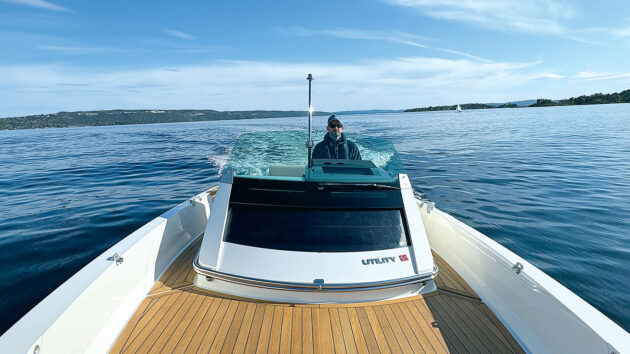
A low-speed plane of 15 or 16 knots is very easy to achieve
On many boats, these would simply be carbon coloured vinyl wraps but here they are proper carbon-fibre hull reinforcements. That makes sense as keeping the weight down (in this case to just 1,740kg) is a key priority both in the construction and the fit-out. You see further evidence of that in elements like the rimless windscreen, the carbon-fibre lid on the anchor locker and the optional carbon-fibre toilet.
When you head forward, up a step, beyond the console, the entirely flat teak-lined foredeck is also a very pretty thing. You can, of course, opt for an alternative decking material and you can add a set of cushions up here too. Those cushions come with a central fore-and-aft seam, so you can hinge one side over and continue to use the deck for berthing duties without putting them away.
But even on the relatively sparse test boat, the foredeck works harder than you think, thanks to a spray hood rail and a very slick little 60W solar panel, which wrap so neatly around the console moulding that you barely notice they’re there.
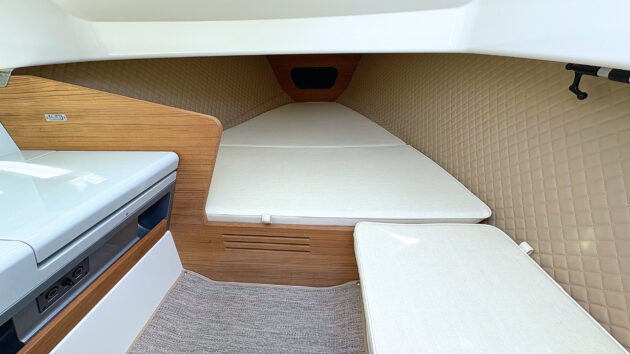
The changing seat gets the benefit of a lifting deckhead and good natural light
Is the Cormate Utility 27 really a weekender?
You don’t expect a lot from the cabin on a boat that looks as swift and svelte as this; nor from one with such a flat foredeck, such a narrow beam or such an emphasis on shaving off the weight. But such is the fuss-free cleanliness of the Cormate approach that you get much more volume than you think.
Heading down through a generous sliding door with a handy port grab rail, you see a space divided broadly in two. The forward section contains the bed, with a decent bit of storage underneath and upholstered hull sides so you can roll over without bumping shoulders on chilly fibreglass. Aft of that is a changing seat to starboard and a sink and loo module to port with a low-level partition providing a slightly fanciful nod toward privacy.
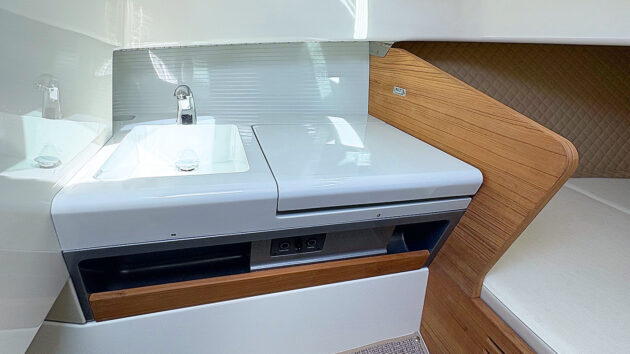
The loo and sink unit makes great use of very limited space
There are no hull windows of course, but what you do get is a pair of letter-slot windows in the leading edge of the console for some natural light down below and, in tandem with the very spare and modern fit-out, that actually makes it feel fairly bright and pleasant.
Of course, with 45L of water and 32L of blackwater capacity, the tankage is at a premium, so it’s best used for relatively brief weekends away. But the short answer is yes. If you’re a cosy couple and you don’t mind a bit of camp-style overnighting, you have all the most critical basics right here.
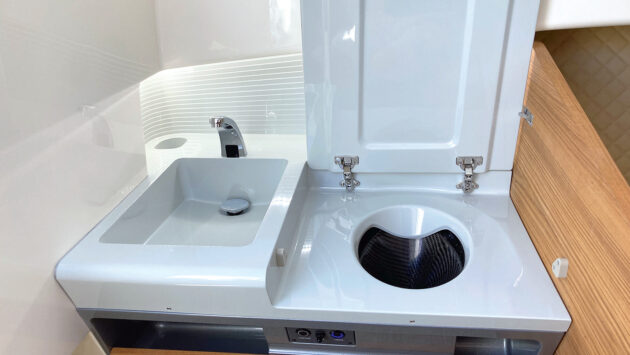
The optional carbon fibre toilet is about impact resistance from the waves, as well as reduced weight
Fine-tuned performance
Like the Cormate 23, 32 and 35, the new 27 comes in both inboard and outboard variants and the choice is extensive. The XS variant brings a wide range of outboards into play, from the entry-level Mercury ProXS 200 right up to the Mercury V10 400R. And the inboard model provides similar flexibility with everything from 250 to 425hp.
In fact, you could even spec a Mercury V6 TDI 270hp diesel for speeds in the region of 50 knots and that’s something that may well appeal to a lot of UK buyers. But with its Mercury 6.2L V8 350hp petrol inboard tucked away beneath the aft deck, this test boat still looks like a very sage choice.
It’s apparently the most popular rig on the Utility 27 – and given that it’s about six grand more affordable than the outboard model with the Verado 300, as well as a knot or two quicker and significantly better looking, you can see why.
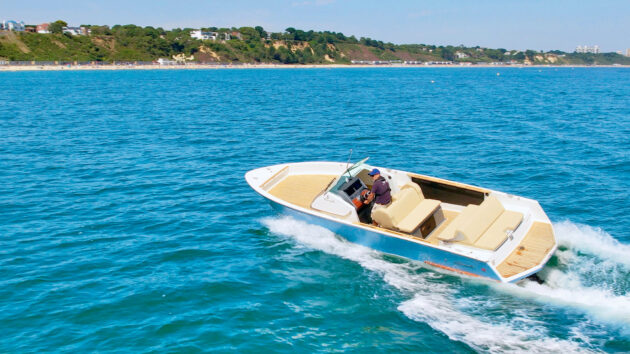
From 25 to 45 knots, we’re sipping fuel at an extraordinary 1 .1 to 1 .3 litres per mile
As for the helm station, that really is a delightful place to be. It’s very deep-set with supremely secure leaning posts and outstanding lateral support. The screen is raked and rimless to help keep the weight down but there’s no shortage of grabbing points to help compensate for that. And like the thruster switch, there are some very attractive Second World War fighter plane vibes to the toggle switches on the dash.
The same goes for the simple rocker switch that you use to operate the single port tab that controls the lateral balance. It’s not just about style, the toggle switches each come with their own fuses so there’s no need for a separate breaker panel and it’s also good to see that the twin 9in plotters and that lovely Isotta steering wheel both come as standard on this relatively high-spec Supermarine model.
It feels delightfully different and, when you get underway, the Cormate’s dynamic personality reinforces that. It will plane quite happily as low as 16 or 17 knots but there’s more joy to be had – and better fuel efficiency to be enjoyed – when you treat it to a bit of pace.
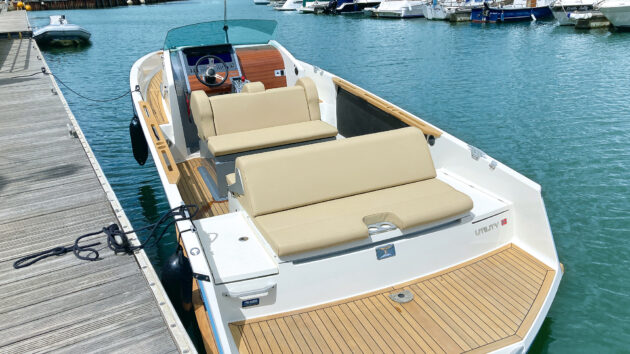
You can use the backrest to create both forward- and aft facing bench seats
From 25 to 45 knots, we’re sipping fuel at an extraordinary 1.1 to 1.3 litres per mile. To put that in perspective, when we tested the comparably sized Arksen 8 with 400hp of outboard power, that drank about 2.4 litres per mile at 35 knots. And we’ve tested smaller lightweight aluminium boats with less power than this that struggle to beat 1.5L per mile at 32 knots, so the sheer efficiency on offer here is exceptional.
The Zero Effort aluminium racing throttles are also very pleasing. They enable you to use one lever to select forward, neutral or reverse and a second lever to operate the revs, which means that, aside from looking very cool and exotic, they give you a much finer degree of control over your pace, simply by virtue of the extra travel enjoyed by the lever.
In short, this boat is a pleasure to drive but it’s also a learning experience. With a stiff, lightweight vacuum-infused hull, a narrow beam and a 350hp petrol inboard operating through a single prop, it will let you know quite rapidly if you start getting out of shape. But driven with respect, it flies flat and linear onto the plane, picks up pace with outrageous urgency and heels with plenty of grip and aggression.
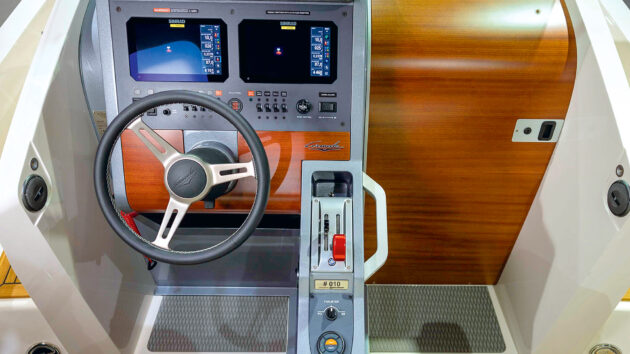
Twin plotters and that lovely Isotta steering wheel both come as standard
As a small, fast open platform for up to six, it probably feels more like a cool day boat for Mediterranean socialites than an offshore adventure boat for outdoorsy northern Europeans but it’s certainly none the worse for that.
Cormate Utility 27 Supermarine specification
LOA: 26ft 11in (8.20m)
BEAM: 7ft 6in (2.29m)
DRAFT: 1ft 10in (0.55m)
DISPLACEMENT: 1,740kg (light)
FUEL CAPACITY: 260L
WATER CAPACITY: 45L
ENGINES: 200-500hp outboard/250-520hp inboards
CONTACT: cormate.com
 If you enjoyed this….
 If you enjoyed this….
Motor Boat & Yachting is the world’s leading magazine for Motoryacht enthusiasts. Every month we have inspirational adventures and practical features to help you realise your sailing dreams, as well as tests and news of all the latest motorboats.
Plus you’ll get our quarterly Custom Yachting supplement where we share the last on offer in the superyacht world and at the luxury end of the market.
Build your knowledge with a subscription delivered to your door. See our latest offers and save at least 30% off the cover price.
Note: We may earn a commission when you buy through links on our site, at no extra cost to you. This doesn’t affect our editorial independence.