

Motor Boat & Yachting's resident expert, Jon Mendez, reports on how best to cope with a medical casualty at sea
While conducting a Yachtmaster Instructor training course recently, I had to put my own teaching into practice in the most dramatic way possible. It was a grey day with intermittent rain, light winds and relatively calm sea.
We were 30 minutes away from port and one of the instructor candidates had just completed an excellent explanation of how to perform a man overboard (MOB) drill.
Having completed the explanation, the whole team did an excellent demonstration of exactly that process. At that point, our trainee instructor stood up and turned to leave the helm. As he turned, he lost his footing. His feet shot out from under him, and his body crashed to the deck.
By some miracle, his head was cushioned by the end of the seat next to me. Without a hint of pain or panic in his voice, he said, “I’ve broken my leg”. Incredulous at how calm he was, I said “You must be joking”. Then I saw a wave of pain cross his face.
So what did we do? First, a crew member positioned themselves by his broken leg to stabilise the foot and knee. I put in a VHF call to the Coastguard on channel 16, and another crew member went below to grab some cushions for the casualty’s head and leg.
As soon as he was reasonably comfortable, we turned for home. At this stage, my VHF call was not a Mayday as, whilst scary for all involved, it was not life- or vessel-threatening. However, the Coastguard was struggling to hear us from the fl ybridge VHF set so I went inside to try again. When this proved no better, I called 999 instead.
So, what did I learn from the experience?
- The safety briefing at the start of the day was invaluable; we all knew where to fi nd key equipment like the VHF radios, procedure cards and fi rst aid kit.
- Check your VHF at regular intervals; the boat’s owner had reported that he was struggling to transmit on a particular channel. It transpired that we were struggling to transmit at all.
- Liaise as early as possible with the coastguard and the harbour chosen for an evacuation; the early communications paid dividends as they were able to co-ordinate a land-based team to assist.
- The RNLI were superb. Most importantly they were able to assist with pain management and casualty reassurance. Both the Coastguard and RNLI were also much better equipped to move a heavy, injured casualty at sea.
- The UK emergency services are very stretched; we were initially advised it would take eight hours for an ambulance to reach us, which later grew to ten hours. We ended up taking the casualty three miles upriver to another marina and evacuating him in the owner’s car instead.
Never be complacent
It started as a perfectly normal day afloat – rather grey and wet, practising for the RYA instructor exams. From here we went out into open water for MOB training drills.
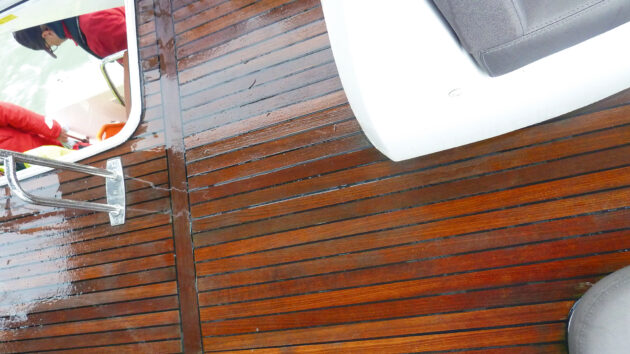
Slippery when wet
Despite an excellent safety briefing, our trainee instructor somehow managed to slip on the wet decks, falling down hard between the helm seat, my feet and the rails around the hatch to the cockpit.
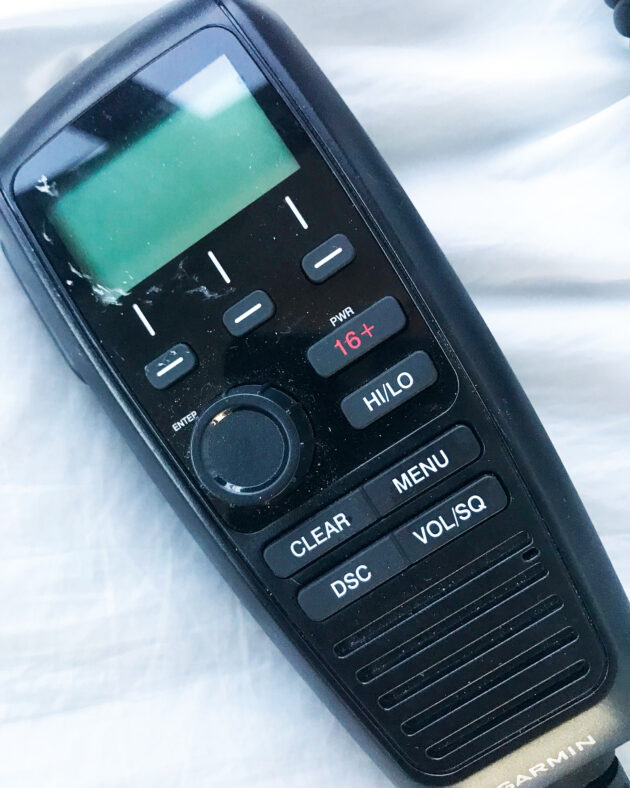
Check your equipment
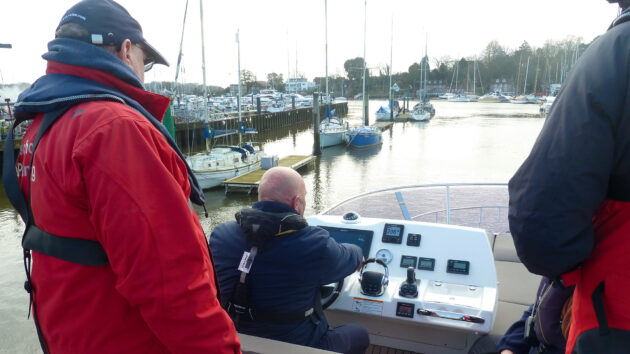
The built-in VHF set on the flybridge would not transmit effectively, nor would the set in the saloon, so we had to revert to calling the Coastguard on a mobile phone and a hand-held VHF.
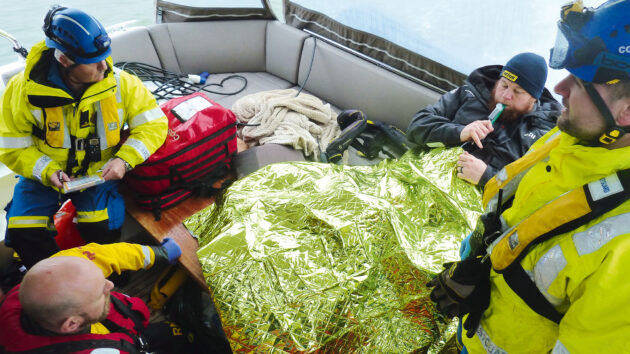
Make them comfortable
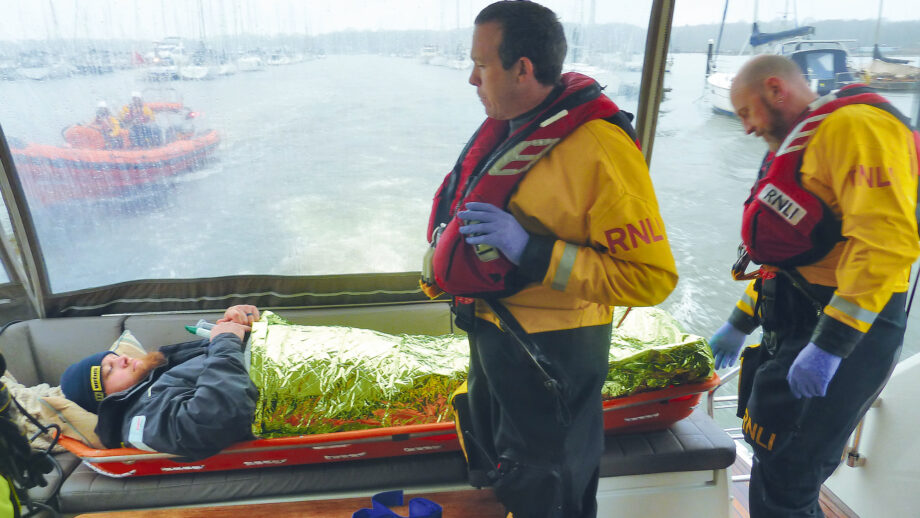
Once safely off the flybridge and into the cockpit, the casualty was made as comfortable as possible and attended to by both the Coastguard and the RNLI with stronger painkillers.
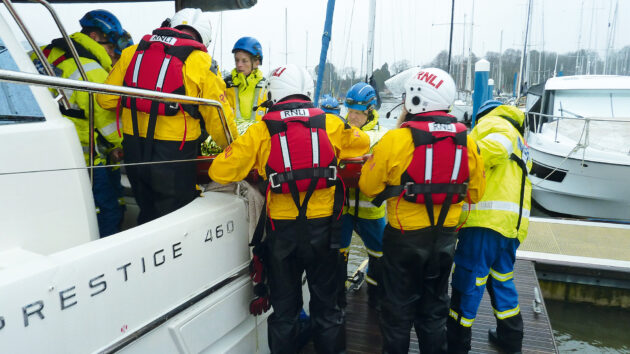
Lift ashore
Once the casualty was positioned on the stretcher, they strapped him down for the lift ashore and along the pontoon. I was a little surprised by this. How, if they dropped the stretcher and he fell in, was he supposed to get out?
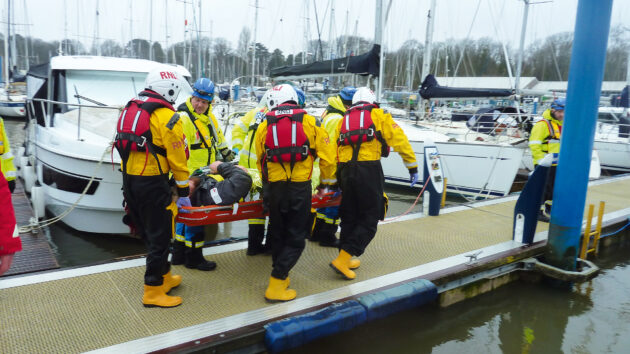
Seek professional care
Ultimately we needed to get the casualty to hospital. Thanks to a great team effort by all involved, we finally managed that. It turned out that his leg was broken in four places. Take care, this boating lark can be dangerous!!
 If you enjoyed this….
 If you enjoyed this….
Motor Boat & Yachting is the world’s leading magazine for Motoryacht enthusiasts. Every month we have inspirational adventures and practical features to help you realise your sailing dreams, as well as tests and news of all the latest motorboats.
Plus you’ll get our quarterly Custom Yachting supplement where we share the last on offer in the superyacht world and at the luxury end of the market.
Build your knowledge with a subscription delivered to your door. See our latest offers and save at least 30% off the cover price.
Note: We may earn a commission when you buy through links on our site, at no extra cost to you. This doesn’t affect our editorial independence.