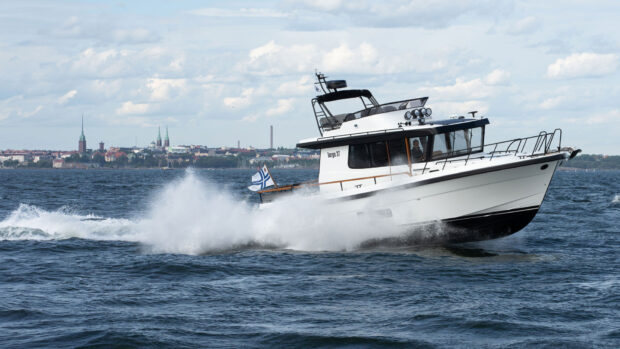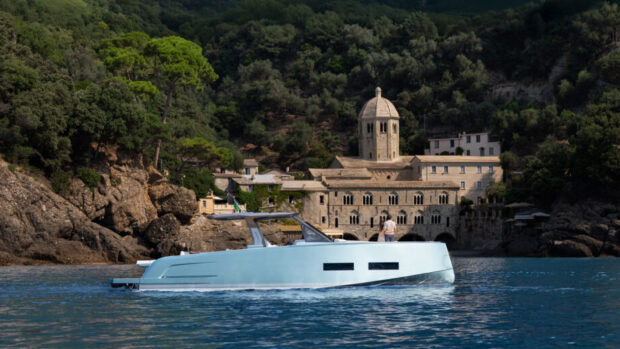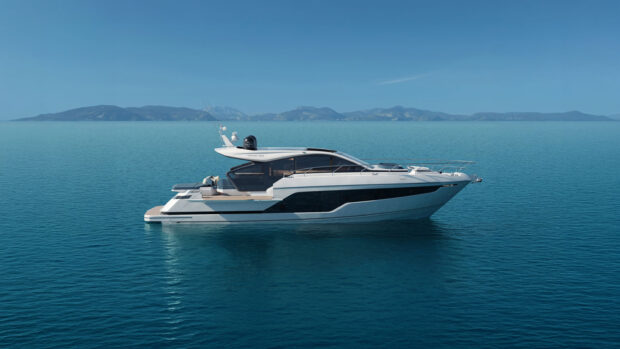


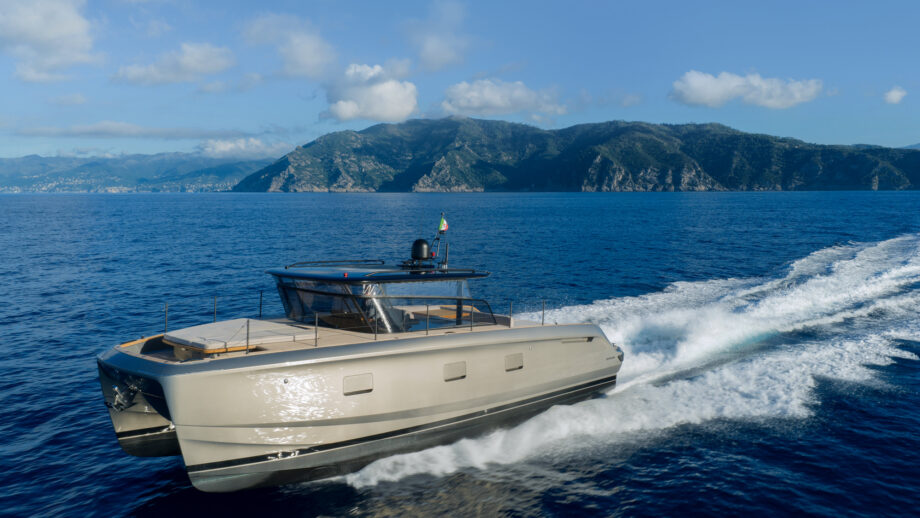
The latest powercat from Bluegame looks unlike anything else on the market and features an underwater foil to increase speed and efficiency. We take it for a spin to see how it performs at sea
Bluegame likes to sell itself as a disruptor, a company that refuses to play by the rules, building boats that no other company either has or would. It’s a high risk, high reward strategy. Get it right, as it has so far, and it will carry on carving itself a very profitable niche in the market, charging premium prices and distancing itself from the hurly burly of mainstream competition. Get it wrong and it could be left with a costly white elephant that nobody wants, regardless of price.
The new BGF45 is a prime example of that strategy. Drawing on the knowledge gained from developing the BGS-HV, a high tech 50-knot foiling chase boat for the America’s Cup, it has designed a larger leisure oriented sportscruiser that it hopes will attract “visionary owners seeking something truly different”.
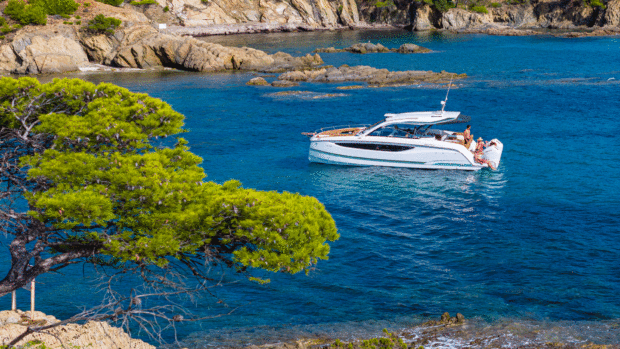
It’s certainly different. The BGF45 doesn’t look like any other boat on the market and the chances are it won’t behave like one either. Technically, it’s a powercat but it’s by no means a conventional one. At 16ft 10in wide it’s much slimmer than most cruising catamarans and there’s a vestigial third hull running down the middle of it to help cut through any waves that pass between the hulls.
As if that weren’t enough, it also has an underwater foil roughly two thirds of the way back from the bow. This doesn’t lift it clear of the water, unlike Candela’s fully foiling P12, but it does raise it enough to reduce the wetted surface, cut drag and increase both speed and fuel efficiency by as much as 40%. It’s also claimed to result in a smoother, softer ride that ‘kisses’ the tops of the waves rather than pitching up and down over them. It’s a bold claim and one that we’ve got a chance to test for ourselves…
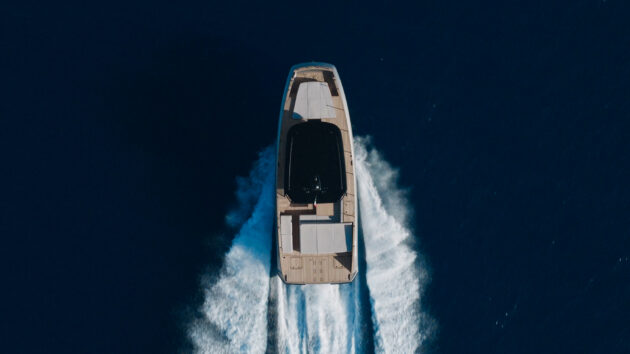
The BGF45 is narrow by cruising cat standards and skims across the surface on a drag- reducing foil
Day Spaces
Before putting it through its paces it’s worth taking a moment to appreciate the BGF45’s other assets – it may not have any direct rivals but it still has to offer much the same functionality as more conventional monohull sportscruisers from the likes of Pardo, Fjord, Solaris and Sunseeker. After all, at around €2.1m ex taxes for a sensibly specced boat it’s in the same financial ballpark as a Pardo 50 or Superhawk 55.
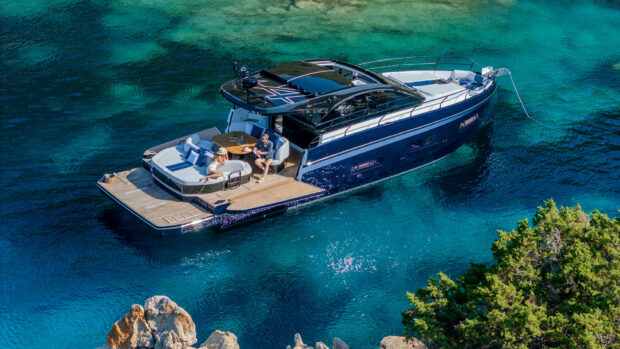
As far as deck space goes, it’s a pretty even match. It may be slim by powercat standards but it’s still significantly beamier than most 45-60ft monohulls – it’s actually a couple of inches wider than a Sunseeker Predator 65 for instance. You notice it the moment you step aboard via its clever (but optional) Transformer platform that acts as both a quayside passerelle, a height-adjustable bathing platform and a tender launch system. It feels way bigger than its 45ft LOA would suggest. The sunpad alone looks like it belongs to a 60-footer with room for 3-4 people to spread themselves across and another on the separate chaise longue next to it.
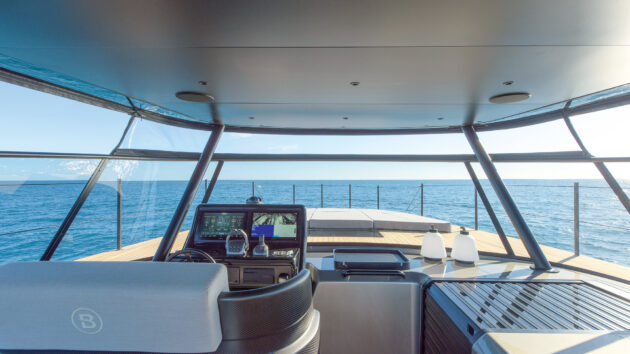
Tall windscreen and hard top can be linked with clear plastic panels to create a virtual wheelhouse
It’s not all one-way traffic, though. Big as the bathing platform is, the lifting mechanism of that Transformer platform is limited to 200kg, ruling out a Williams jet tender. And although the sunpad lifts up to reveal a giant storage locker, perfect for fenders, covers, paddleboards and the like, it’s too shallow to house anything other than a flat-floored inflatable tender.
No such limitations at the aft end of the cockpit, however, where a folding teak table doubles in size to reach most of the way across the beam. It might not quite manage the full complement of 14 passengers, which it’s rated to carry, but you could certainly sit 10 with the help of a few director’s chairs.
Article continues below…

Best power catamarans: 8 of the best models fully tested
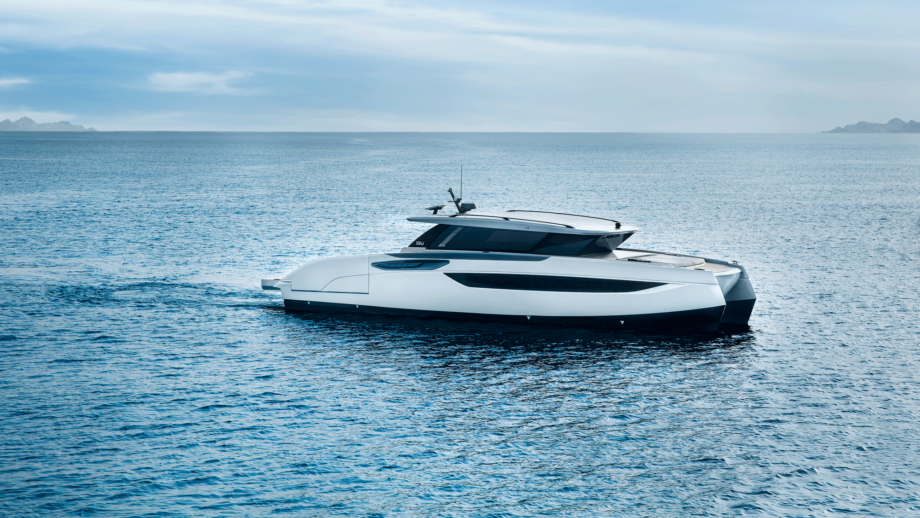
Sunreef Ultima 55 first look: A chic and sporty powercat with a penthouse feel
The only shame is that the hard top doesn’t extend this far aft so you’ll need to erect the optional bimini if you want to stay out of the sun while eating.
The middle section of the cockpit is less versatile. In order to create enough headroom in the cabins and heads below, the deckhead mouldings have to extend up into the cockpit. On the starboard side this is disguised by turning the front and top part of it into an outdoor galley with a chunky teak worktop. To port there’s just a plain waist-high moulding and stairs leading down to the guest cabin and day heads. Together these two intrusions occupy most of the forward cockpit space, only leaving enough room between them for a central walkway.
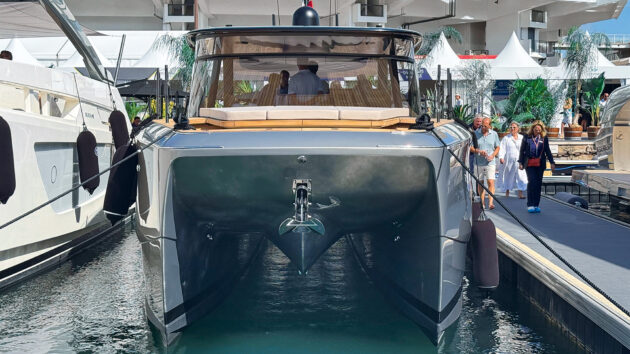
The central vee is there to stop waves slamming against the deep bridge deck that houses the forward owner’s cabin
You can prop yourself up against the wet bar here if you want to stay out of the wind and sun on passage but other than the two-person helm seat that’s your only option.
The helm itself is close to perfect. Embraced by the bench’s curved carbon-fibre backrest and tucked behind a surprisingly tall reverse-angled screen, you enjoy excellent protection and a commanding view over the bow. In fact, you can go one step further and enclose the whole of the space under the hard top with a set of zip-in clear canopies to create a quasi wheelhouse effect for year round use.
Removable carbon-fibre guardrail stanchions with composite wires add reassurance when moving along the side decks to the bow. Here too, Bluegame has done its best to disguise its catamaran roots by tapering the beam and filling in the gap between the hulls with a full-length deck so that it looks like a stubby monohull from the helm.
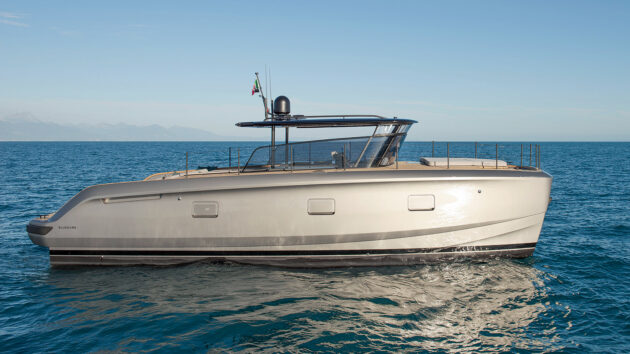
The BGF45 was inspired by the hydrogen-powered foiling powercat built as a chase boat for the America’s Cup
There’s room for another sunpad here, the leading edge of which doubles as a lovely little bench with a sunken footwell for your feet. Our only grumble is the decision to manage this drop in levels with a steep curving slope rather than a couple of shallow steps, making it surprisingly awkward to negotiate.
Night Games
One of the joys of a catamaran design is the privacy it offers when overnighting – there’s something rather special about each of the two primary cabins having its own separate staircase. These are situated on either side of the cockpit and can be closed and locked using a clever roller shutter when left unattended.
In both cases the stairs lead down to a heads on one side and cabin on the other, but whereas the rather dark guest cabin is tucked longitudinally along the middle to aft section of the port hull with the shin-high mattress filling the entire width of it, the owner’s cabin occupies the front half of both hulls and the gap between them.
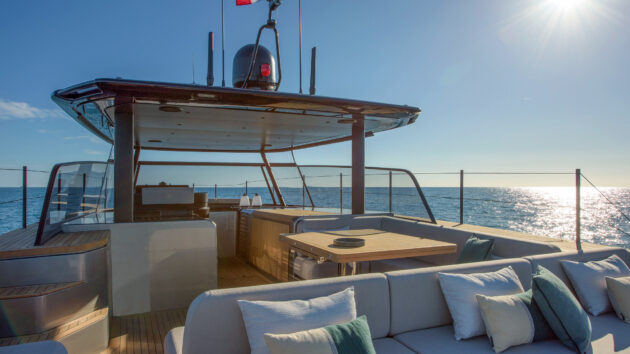
This handsome teakfaced wetbar also creates headroom for the owner’s heads compartment
To make that possible the bridge deck linking the two hulls is just deep enough to squeeze in a bed – any deeper and it would risk impacting with waves. As a result the mattress itself has to be mounted on a tall plinth with several steps up to it. Surrounded by a rather hard, black composite frame with limited natural light from the two small hull windows and a deliberately dark colour palette, it’s not the softest or most welcoming of environments, but there is something rather cool about it.
With the structural engineering of the deckhead deliberately left on show and the locker doors alongside the bed made from a lightweight honeycomb material sandwiched between thin layers of clear acrylic, it all feels very high tech, like sleeping inside a surprisingly luxurious race boat.
There is an option for a third single crew/guest cabin in the aft end of the starboard hull with access via a vertical ladder under the dinette cushions, but it’s hard to imagine anyone wanting to sleep down here so we’d suggest keeping it as another large storage locker instead.
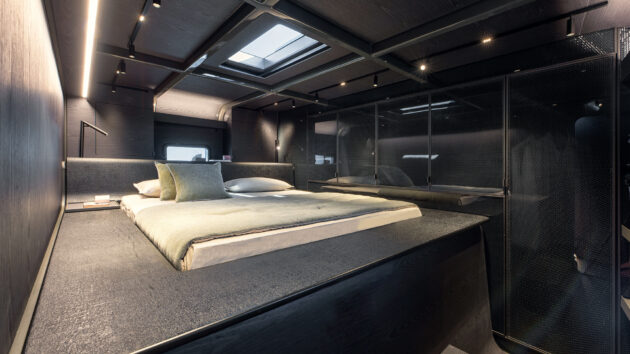
The owner’s cabin faces across the beam with the bed mounted on a tall plinth inside the bridge deck between the hulls
If the BGF45’s amenities are the warm up act, the way it drives is the main event. Powered by a relatively modest pair of 440hp Volvo Penta IPS600 pods as standard, it relies more on the efficiencies of that foil-assisted hull and the lightweight carbon fibre-reinforced build than raw power to achieve its aims.
Our test boat had a bit of extra help in the form of the optional upgraded 480hp IPS650s but we were still taken aback by just how well it performed. Even at displacement speed it slips along very cleanly, taking full advantage of the natural stability and low drag of those slender twin hulls to deliver quiet, comfortable, economical progress and a range of almost 800 miles at 6 knots. But the magic really starts to happen when the turbos kick in and it lifts up onto the plane.
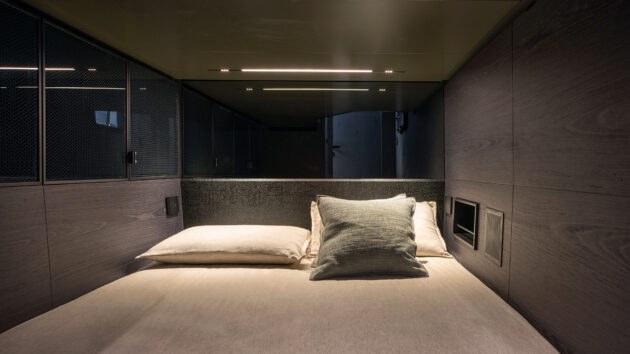
The guest cabin is tucked longitudinally into the port hull. Both cabins have their own stairwells and bathrooms
It’s not immediately obvious what effect that foil is having but the numbers say it all. Flat out it reaches an impressive 37.6 knots. Bear in mind that a Pardo 50 packing a pair of 600hp IPS800s runs out of steam at 34 knots and even a Superhawk with its prodigious 725hp IPS950s can only muster an extra few tenths. But it’s the fuel consumption that gives pause for thought; at 20 knots the BGF45 is burning just 82lph compared to 123lph for the Pardo and 150lph for the Superhawk, giving it a cruising range of 300nm from its 1,500-litres tanks with 20% in reserve.
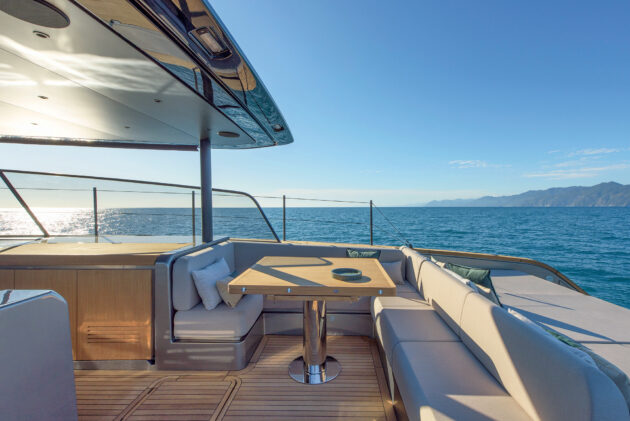
Near 17ft beam creates masses of space for the cockpit dinette and sunpads
From behind the helm it all feels remarkably easy. You can pick pretty much whatever speed you fancy without it straining the engines or stressing the hull. It responds quickly and effortlessly to the throttles and its grip through turns is prodigious with zero hull slip, just a hint of lean and an impressively tight turning circle.
Most of the time you’re not really aware that the foil is doing anything. It just makes the whole boat feel lighter and faster than expected. It does seem to absorb some of the pitching and wave slap you’d normally experience at speed, particularly in a big, beamy monohull, but it’s not totally immune to physics. Flying flat out over a particularly big swell did elicit a bit of a shudder as it landed but that probably says more about the fun we were having than any deficiency in the hull.
Bluegame BGF45 specifications
LOA: 46ft 5in (14,15m)
BEAM: 16ft 10in (5.12m)
DRAFT: 3ft 9in (1.15m)
DISPLACEMENT: 16 tonnes
FUEL CAPACITY: 1500 litres
WATER CAPACITY: 400 litres
RCD: Category B for 14 people
DESIGN: Luca Santella & Zuccon International
PRICE FROM: €1.8m ex taxes
 If you enjoyed this….
 If you enjoyed this….
Motor Boat & Yachting is the world’s leading magazine for Motoryacht enthusiasts. Every month we have inspirational adventures and practical features to help you realise your sailing dreams, as well as tests and news of all the latest motorboats.
Plus you’ll get our quarterly Custom Yachting supplement where we share the last on offer in the superyacht world and at the luxury end of the market.
Build your knowledge with a subscription delivered to your door. See our latest offers and save at least 30% off the cover price.
Note: We may earn a commission when you buy through links on our site, at no extra cost to you. This doesn’t affect our editorial independence.
Verdict
The BGF45 is a genuine disruptor. It’s faster, lighter, more efficient and more fun to drive than most monohull sportscruisers of 50-55ft. It’s also a very distinctive craft both in the way it looks and what it has to offer. Not everyone will ‘get’ it but a bit like a Brabus G-Wagon or Tesla Cybertruck it has an edginess to it and a purity of focus that will appeal to a certain genre of owner. That does incur a cost in terms of price and versatility but we suspect that’s something its buyers will be more than willing to pay.