

Master the art of the ascent with Jon Mendez’s expert guide to navigating locks safely and smoothly on your next inland boating adventure
Inland boating has an additional hazard which isn’t nearly as prevalent as on coastal passages – locks. A lock is simply a way of enabling boats to ‘climb’ up or down a sudden change of water height, whether that’s on a man-made canal traversing hilly countryside or a river with natural hazards that need bypassing, such as fast-flowing rapids and falls. Sometimes a flight of several locks is required to allow for a particularly long or steep incline.
Locks usually consist of three main parts. The lock chamber, where the water level can be raised or lowered, the gates at each end of it and the paddles or sluices which allow the lock to be filled and emptied.
You can pass through most locks in both directions, depending on whether you are travelling up to a higher level or dropping down to a lower one. I find rising up rather easier than dropping down so that is what I will cover in this article.
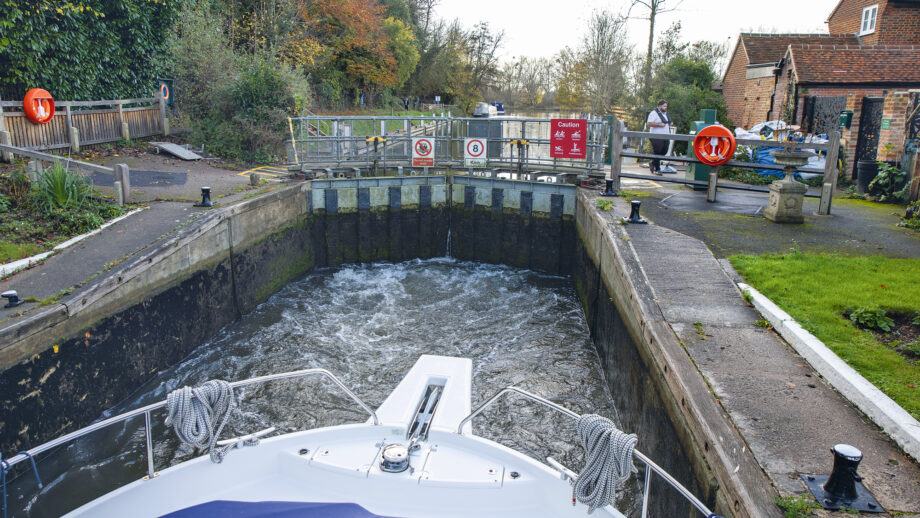
On approach, if the lock is not manned or automatic, you will need to tie up and assess whether the lock is set to your direction; i.e. is the water in the chamber at the same level as the water around your boat? If not, go to the controls and empty the lock by using the paddles so that the water drops to the same level as your boat. Once empty, you can then open the gates, manoeuvre your boat into the lock (along with other waiting craft), secure in place, then shut the gates and close the downstream paddles.
Now you need to open the paddles in the upstream gates to allow water into the chamber until it fills to the same level as the water on the other side of the upstream gate. If the paddles are manually controlled, don’t open them too fast as the sudden inrush of water can cause the boat to bounce and get damaged.
Article continues below…
How to cruise rivers and canals

How to use buoyage to navigate
Even at a slower pace the boat(s) within the chamber are likely to move fore and aft a bit as the water bounces off the bottom gates, so the lines used to secure the boat need to be monitored as the boat rises. Don’t tie the lines off, however, as you may need to bring in slack as the boat’s cleats rise to the level of the lockside rings, and then ease them off again if they carry on rising above that.
In some lock chambers you may also need to adjust the height of your fenders so that they don’t end up being lifted above the sides of the lock. Once the rise is complete, you need to tie off the boat again, go to the exit gates, close all the paddles and open the gates to allow your passage to continue.
Don’t move off until any swirling water around the exit has subsided. Once you have exited the lock, it’s good practice to moor again and close the gates behind you so that the next vessel can begin its own process.
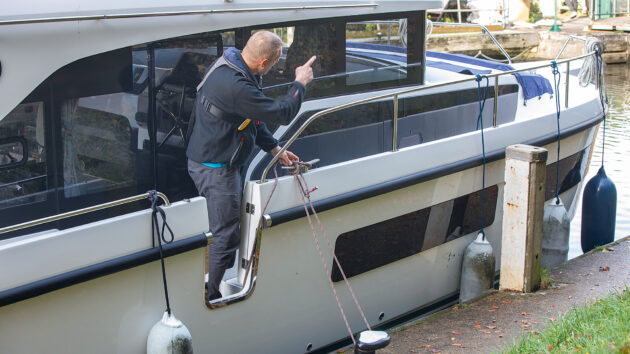
Photo: Richard Langdon
Upstream approach
Locate the waiting berth, stop and secure your boat so you can walk to the lock and see what level the water in the chamber is. If it’s set to the upstream level you’ll need to empty it first.
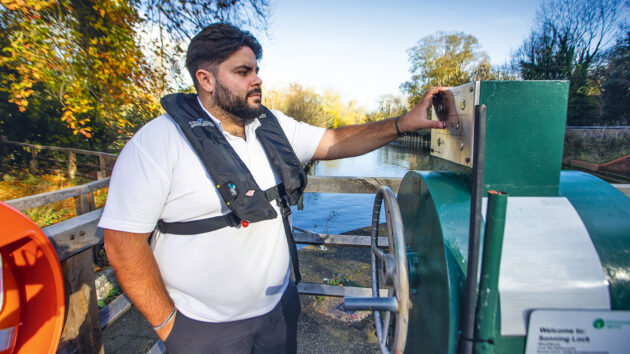
Photo: Richard Langdon
Lock controls
The gates and paddles on this lock are electrically controlled by this panel when it’s left unmanned. We need the gates shut, the upstream paddles closed and the downstream paddles open to drain the lock.
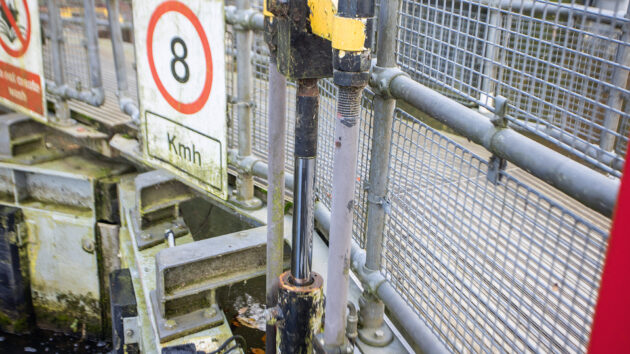
Photo: Richard Langdon
Lock paddles
The lock gate paddles on this one are controlled hydraulically. They are opened in four stages, so the water flow is controlled and doesn’t cause excessive turbulence for the boats.
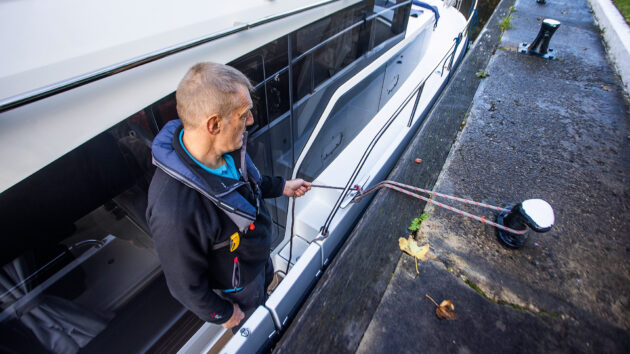
Photo: Richard Langdon
Setting lines
Once inside the lock, if your boat isn’t too large or heavy, a single centre line is a good way to stop it moving fore or aft while still allowing easy adjustment of the slack.
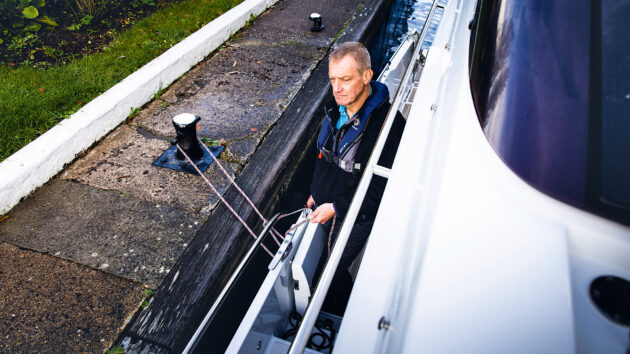
Photo: Richard Langdon
Adjusting lines
As the sluices on the upstream gate open and the water level rises, you will need to take in any slack on the line. In this photo you can see the water level has risen by about a metre.
Photo: Richard Langdon
Exiting the lock
Before opening the lock gates to exit, it’s best to wait for the swirling water to subside. If you attempt to move off too early you may find yourself being swept towards the lock wall.
 If you enjoyed this….
 If you enjoyed this….
Motor Boat & Yachting is the world’s leading magazine for Motoryacht enthusiasts. Every month we have inspirational adventures and practical features to help you realise your sailing dreams, as well as tests and news of all the latest motorboats.
Plus you’ll get our quarterly Custom Yachting supplement where we share the last on offer in the superyacht world and at the luxury end of the market.
Build your knowledge with a subscription delivered to your door. See our latest offers and save at least 30% off the cover price.
Note: We may earn a commission when you buy through links on our site, at no extra cost to you. This doesn’t affect our editorial independence.