
A new hydrogen-powered boat claims to deliver the speed and silence of an electric boat without the usual limitations of range and battery size
The problem with electric planing boats is not lack of speed or acceleration but the size of the battery; too small and the range becomes vanishingly small, too big and the weight prevents the boat from planing. But what if you could recharge the battery from an equally quiet, clean and emissions-free source?
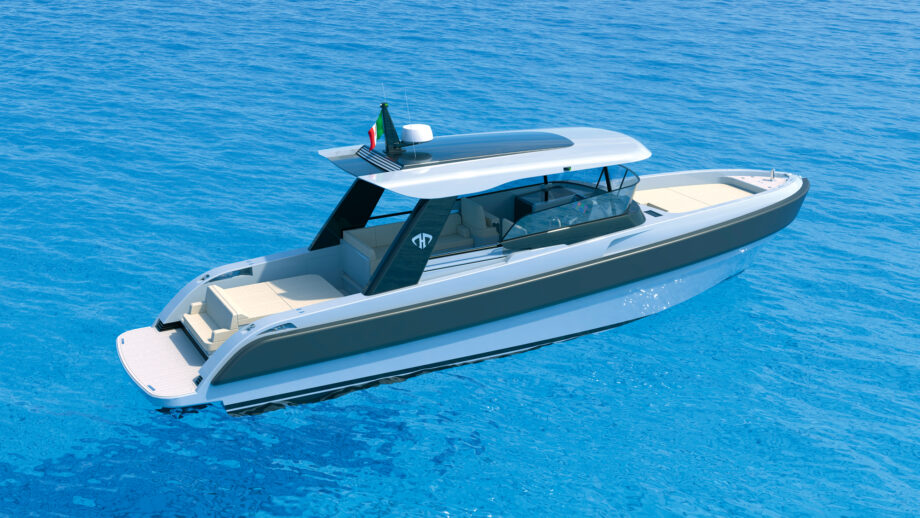
That’s the premise behind Italian yard Tykun’s hydrogen-powered H1 chase boat. By fitting it with a fuel cell that converts hydrogen gas into electricity, it gives all the benefits of an electric craft without the usual limitations. Tykun claims a top speed of over 35 knots and a range of 60nm at a cruising speed of 20 knots.
“It’s like having an electric boat with the charger always plugged in,” says Vittorio Maccone, Sales Engineer at TESYA Group, which is responsible for the H1’s drivetrain.
Fast and Functional
The idea for the project was sparked by a challenge to produce a hydrogen-powered superyacht tender that was “usable and manageable for a customer”, according to Ugo Casadio, Chief Technical Officer at Tykun’s parent company, MED Group.
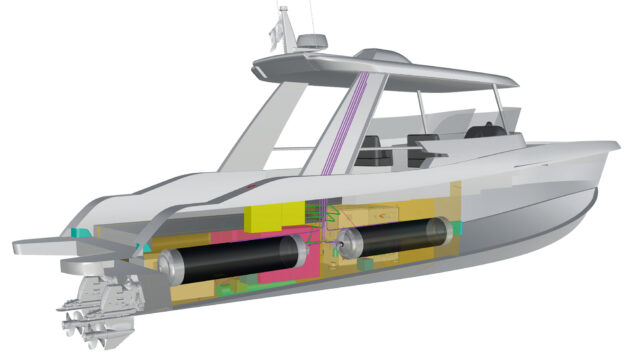
The decks have been raised by 10cm to make room for the fuel cell, batteries and four hydrogen tanks
Until now the only similar-sized hydrogen- powered vessels have been the high-tech chase boats designed and built specifically for the America’s Cup. Impressive as these carbon fibre foiling powercats are, with their 50-knot top speeds and cruising ranges of over 100nm, they are far too complex, expensive and impractical for use as a superyacht tender let alone a mainstream leisure boat.
The H1, by contrast, is based on a robust 40ft monohull design with proven military roots. Being built from aluminium, it’s still usefully lighter than standard GRP (the hull weighs around 3 tonnes) but far less brittle and expensive to build than carbon fibre. And unlike the semi-enclosed power cats that rely on complex algorithms and multiple sensors to keep them flying above the water on their adjustable foiling systems, the H1 is no harder to drive than a regular planing sportscruiser.
Article continues below…
The boat itself was designed by Tommaso Spadolini with functionality and seaworthiness as top priorities, meaning the hydrogen propulsion package had to be out of sight and out of mind. By raising the deck level 10cm higher than normal, enough space was liberated under it for four cylindrical tanks carrying 32kg of hydrogen at 350 BAR. Ventilation for the tanks was also integrated into the supports for the T-Top to minimise the aesthetic impact.
The high-pressure gas is then fed to a centrally mounted fuel cell, a marinised version of the 70kW fuel cell developed by Toyota for its Mirai car and adapted for marine use by EODev. This passes the hydrogen through a catalytic membrane which splits the molecules into protons and electrons before combining them with oxygen from the air to release heat, electricity and water.
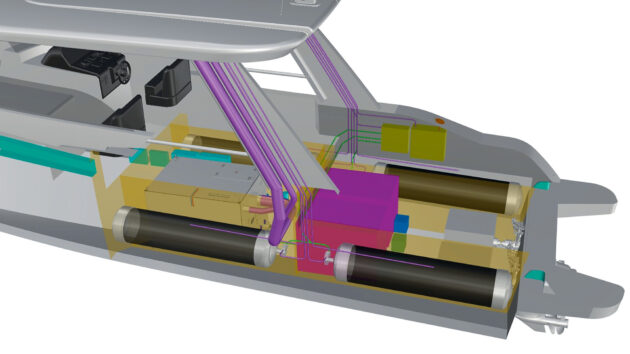
Air vents run down the T-Top supports to feed oxygen to the fuel cell and keep the bilge voids well ventilated
This alone wouldn’t generate enough power to accelerate the boat onto the plane or to reach its desired top speed, so rather than powering the twin 110kW electric motors directly, it feeds into a 240kWh battery bank that acts as both a buffer storage facility and a power booster. This can be charged by a DC fast charger in the marina before you set off as well as by the onboard fuel cell on the go. As with all planing boats, once it’s over the hump it doesn’t require nearly as much power to keep it running at an efficient speed.
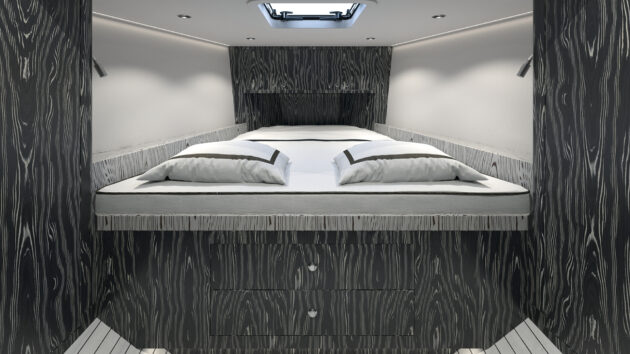
There’s a double berth tucked into the bow
Quick to Refuel
Neither the make of the battery nor the electric motors have yet been revealed but the renderings show two relatively tall battery banks set behind the fuel cell. The motors themselves are positioned well aft in a similar location to conventional petrol or diesel engines, but being smaller they don’t protrude nearly as far forward. These are linked directly to a pair of sterndrives with twin counter-rotating propellers. Again, the make and model of these has not yet been confirmed but Mercruiser
or Volvo Penta are the likely candidates.
As well as having a longer range than most electric boats (typically around 20nm at planing speeds), it’s also much quicker to refuel – the four hydrogen tanks can be refilled in just three minutes. Tykun has teamed up with hydrogen infrastructure specialist NatPowerH to provide support for this, and all the systems have been type approved to minimise legislative hurdles and maximise safety. The price of the H1 has yet to be confirmed but if a suitable customer or strategic partner can be found, the prototype could be on the water within 6-8 months.
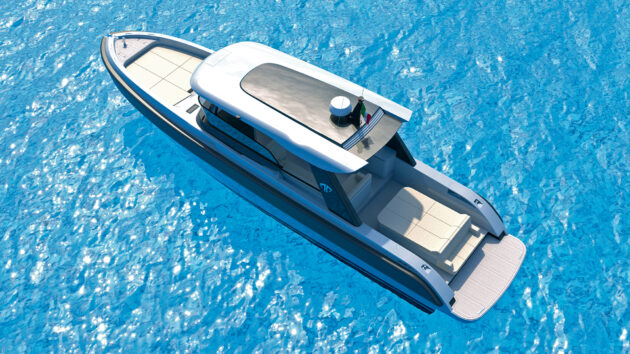
Neither the deck layouts nor the aesthetics have been compromised by the transition to hydrogen
Promising as this new concept is, its environmental credentials rely on the availability of green hydrogen and/or electricity. While most countries now generate a significant amount of electricity from renewable sources such as wind turbines and solar farms, the vast majority of commercially available hydrogen is produced from either natural gas or methane, known as blue or grey hydrogen depending on whether the carbon emitted is captured or released into the atmosphere.
Only when the hydrogen is made by splitting water into hydrogen and oxygen using wind or solar generated electricity is it considered a truly green alternative. That said any boat which offers the advantages of electric power, such as quieter running, reduced vibrations, instant torque and zero harmful emissions at the point of use, without the usual drawbacks has to be a positive development.
And as the demand for green hydrogen grows, the production capacity and infrastructure will grow with it.
 If you enjoyed this….
 If you enjoyed this….
Motor Boat & Yachting is the world’s leading magazine for Motoryacht enthusiasts. Every month we have inspirational adventures and practical features to help you realise your sailing dreams, as well as tests and news of all the latest motorboats.
Plus you’ll get our quarterly Custom Yachting supplement where we share the last on offer in the superyacht world and at the luxury end of the market.
Build your knowledge with a subscription delivered to your door. See our latest offers and save at least 30% off the cover price.
Note: We may earn a commission when you buy through links on our site, at no extra cost to you. This doesn’t affect our editorial independence.