
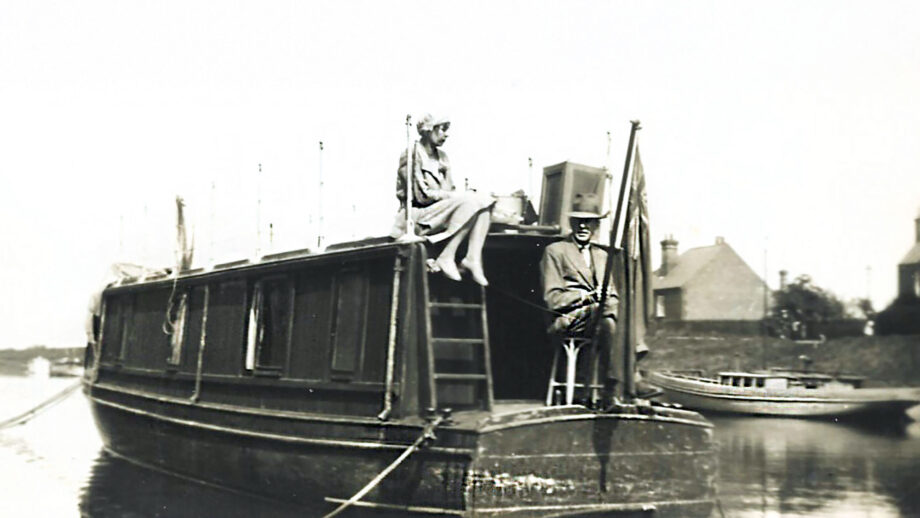
When Charles Lyne bought a 1926 narrow boat in need of restoration, little did he know the rich history tying him, the original owner and this very magazine together…
Considering my grandfather, Charles Wadham Lyne, chose to be a poor vicar, he wasn’t quite as hard up as he might have been thanks to the decisions of his forebears. Thankfully his great uncle Charles Lyne chose to be a rich merchant, which meant my grandparents could indulge in the occasional luxury, such as boating holidays on the Broads during the 1920s.
Given his interest in boating, there is every chance he spotted their holidays advertised in The Motor Boat, which by then was already a well-established periodical, having published its first issue in 1904.
Coincidentally, at about the same time, Hugh Poths of Boston, Lincolnshire, and almost certainly another reader of The Motor Boat, retired from his position as the manager of the Tai Thong Rubber Works Co., in Malaya (now Malaysia). Before leaving, Hugh had purchased and arranged for a quantity of the local teak to be shipped back to England for a special project.
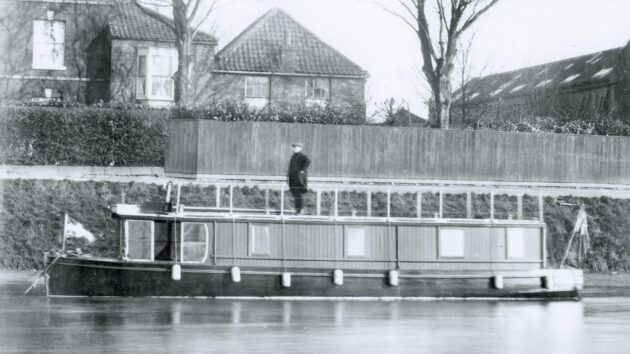
Moored on the river Witham in Boston circa 1930. Photo: Charles Lyne
Cover star
Hugh had decided to have a boat built which he and his family could enjoy cruising on the local rivers. Once resettled in Lincolnshire, he chose H C Banham Ltd as the company to build it. As well as being local, Banhams ran a holiday charter business and knew what was required of an inland waterways boat.
Making available his ample supply of quality Malayan teak, Hugh commissioned a boat that would allow him to enjoy the delights of the inland waterways, including the narrow canals.
Sometime in 1925, Banham’s designer, A. H. Comben, put pencil to paper and adapted one of his existing Broads cruiser designs to meet Hugh’s wishes. Boatbuilder John A. Hodgkinson then set about creating this rather special boat.
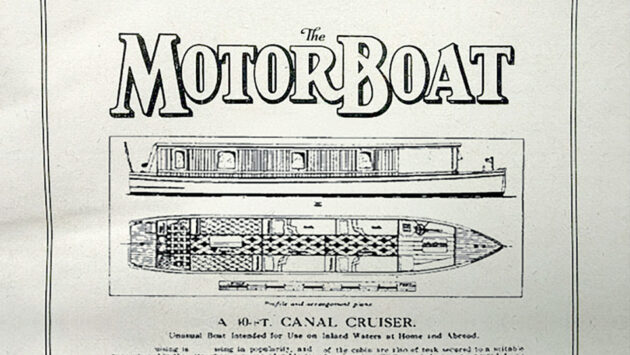
Photo: Charles Lyne
As it neared completion in the spring of 1926, someone suggested that it might be of interest to The Motor Boat magazine, and sure enough, in the April 1926 issue, it was featured over one-and-a-half pages.
Described as being a “most interesting vessel” the article continues “due to the restrictions necessitated by lock dimensions, it is by no means an easy matter to evolve a good canal cruiser, but in this case the designer appears to have achieved the desired object and the boat is of by no means unprepossessing appearance.”
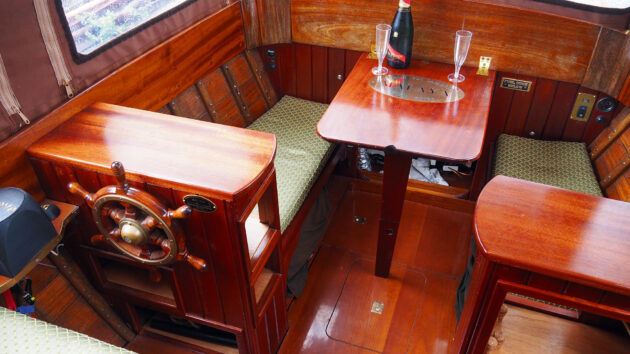
With the old diesel engine gone, the forward cockpit has been repurposed as a four-person dinette. Photo: Charles Lyne
Reading between the lines, the author was pleasantly surprised by how pretty it was, despite its unusually long, thin design – the LOA of 40ft dwarfs its narrow 6ft 11in beam.
On 10 May 1926 (amidst the turmoil of the General Strike), Hugh Poths registered this boat as ship no. 147966 with a 9.7bhp motor and a cruising speed of 5.6 mph. He named it Malaya.
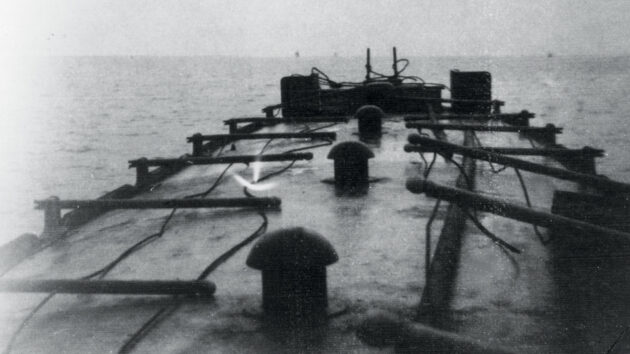
Malaya crossing The Wash in summer 1938 – quite an undertaking in a boat designed for sheltered inland waterways. Photo: Charles Lyne
Lone Survivor
Malaya may not have been the first cruiser designed specifically as a leisure craft for use on the narrow canals of England and Wales (rather than a converted barge) but as far as we know, she is the oldest surviving example.
The Poths family enjoyed their unique boat for more than three decades, undertaking several long voyages. In the summer of 1938, for instance, Hugh’s eldest son Jack took Malaya across the Wash from Boston to King’s Lynn and up the Great Ouse to Denver Sluice and beyond, to Cambridge– a 14-hour voyage across open seas in a boat designed for inland waters.
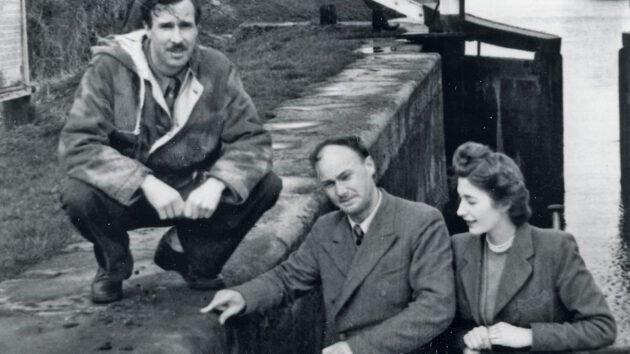
Jack Poths with Hugh Poths (jnr) and Mary. Photo: Charles Lyne
After 33 years of happy ownership, the Poths family decided to sell Malaya. Her new owner, Jack Craddock, was a garage owner and a keen supporter of the newly formed Inland Waterways Association. Her history gets a little murky after that before she appeared on the market once again in 1980.
This time she was sold to Rod Beever, who saved her from being scrapped but was possibly not well advised on the subsequent restoration, which removed all her internal bulkheads in a rather ill-fated attempt to modernise her.
The lack of bulkheads, which formed an integral part of the structure, meant that Malaya gradually developed a middle-aged spread to the point where she struggled to pass through some of the narrow canal locks she was originally designed for.
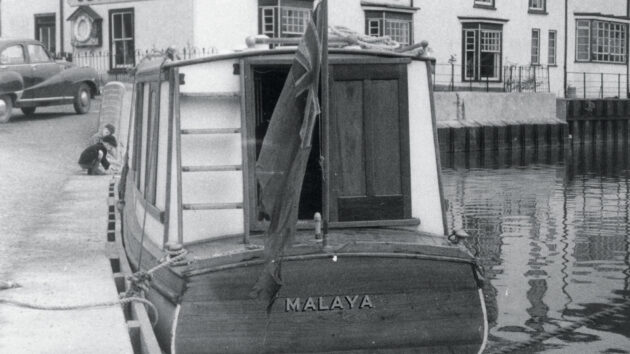
Moored outside the Cutter Inn, Ely, in 1953. Photo: Charles Lyne
Going Cheap
By the time I first spotted an advert for her in 2012, Malaya was in a very sorry state. Being newly retired with lots of time on my hands but very little money, it sounded like just the kind of project I was looking for.
I’d been into boats for years, having grown up watching my grandfather’s 9.5mm films of holidaying on the Broads, so later in life, with an adaptable wife and three sons in tow, I suggested we try exactly the same sort of holiday I’d seen my grandparents enjoying: a cruiser on The Broads. We all loved it.
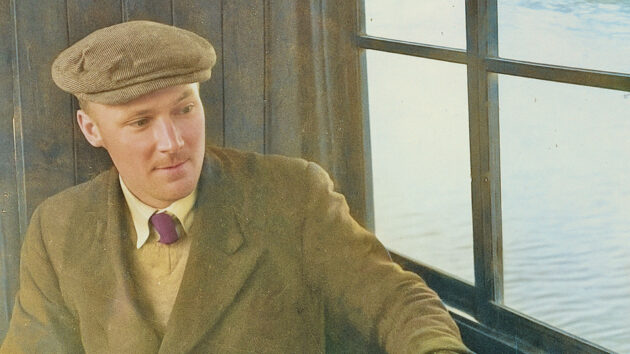
Hugh Poths (jnr) at the wheel of Malaya. Photo: Charles Lyne
One thing led to another and soon we were regularly hiring narrowboats for holidays. Then in 1998, we purchased a 1/12th share in a purpose-built narrowboat, giving us four weeks of cruising every year at a much lower cost than hiring.
We enjoyed many happy days on that ‘Ditch Crawler’, as some coastal boaters like to call it, and while its speed obviously fell some way short of an adrenalin rush, it most certainly boosted our dopamine and endorphin levels as we pottered along, taking in the fascinating sights and sounds of the rich variety of canal and river scenes.
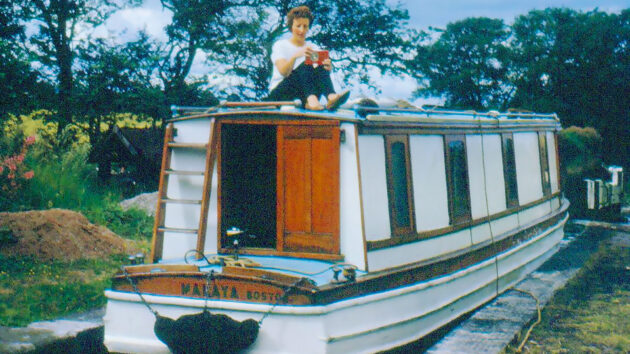
In Boggs Lock on the Staffordshire & Worcestershire canal in 1963. Photo: Charles Lyne
So, many years later, when I spotted an advert for an elderly wooden narrowboat in need of restoration, my interest was piqued. Further investigation revealed that it was being sold very cheaply (to the right buyer) as it needed a significant amount of work: £20,000 – £30,000, according to the surveyor’s report.
It came with some disadvantages – such as a rather large and extremely noisy diesel engine – and was only configured to sleep two people. But, with a bit of work from us, she could be ours to cruise whenever we fancied.
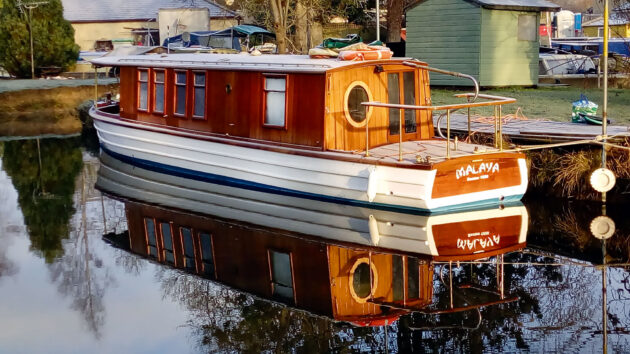
Malaya takes to the water again in 2018 after a six-year restoration. Photo: Charles Lyne
Restoring an old narrowboat: Test drive
A short demonstration cruise on the River Weaver proved to be rather interesting! At some point Malaya had been fitted with a 37.5hp Beta diesel engine. It sounded monstrous; every stroke of the pistons reverberated through the structure.
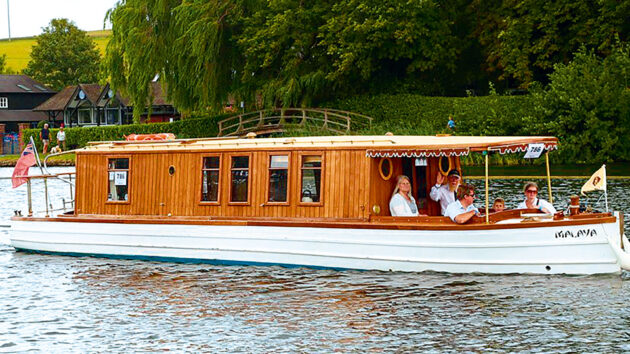
New owner Charles Lyne at the helm of his lovingly restored Malaya. Photo: Charles Lyne
We later discovered that the owners wore ear-defenders whenever they went for a cruise.
Thankfully, I already had a plan to replace it with an electric motor and knew of a spacious under-cover area where I could restore it. I also discovered that the father of one of our son’s friends was a carpenter and a bit of a wooden boat specialist.
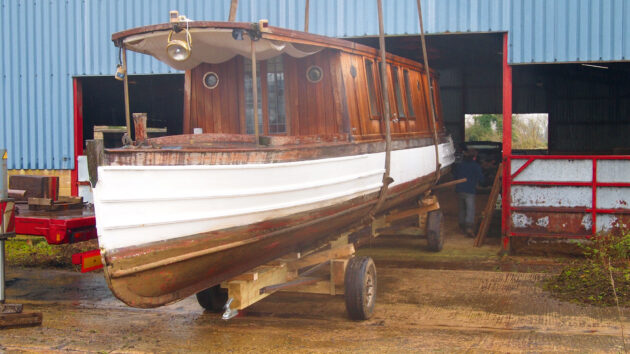
Malaya being wheeled into the cow shed in 2012. Photo: Charles Lyne
I invited Dave up to the River Weaver so he could check what work was needed. His response was largely positive but it would require considerable time and expense. He’d be able to do the skilled work as long as I could do the rest of it.
That was all the encouragement I needed. On a cold December day Dave and I drove up to the boatyard to oversee her being craned onto the back of a low-loader but first we needed to remove the heavy diesel engine. Dave set about disconnecting the engine from the diesel tank, cooling system, exhaust, battery and throttles.
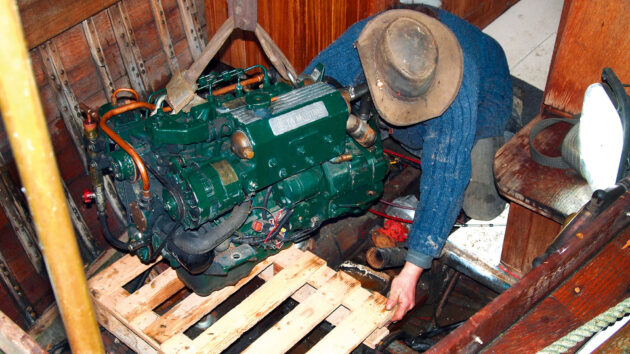
Removing the old Beta diesel engine. Photo: Charles Lyne
Even then the engine couldn’t just be lifted out due to the limited gap between the gunwales and the roof. It had to be done in stages: lifting the engine, supporting it on pallets, shortening the strops and repeating multiple times until the strops were short enough to clear it.
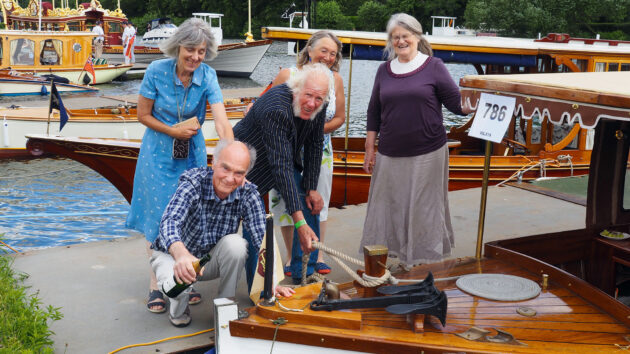
Shirley and Hugh Poths, previous owners Mac and Dave, and Barbara Lyne formally relaunch Malaya in 2019. Photo: Charles Lyne
Disaster strikes
Two days later, a huge low-loader arrived at our farmyard with what looked like a very small boat on its back. In the intervening days, Dave had been busy assembling a custom-built trolley from old lorry wheels, timber beams and steel plates, so we could wheel our new (old) boat into the cowshed/workshop.
With Malaya safely under cover, we celebrated Christmas with our traditional Boxing Day BBQ. While the BBQ was warming up, I popped over to the cowshed to check on our investment. Disaster! The rain had flooded the farmyard and the shed. Malaya was still high and dry but many of the things I’d bought to restore her, including an expensive diesel generator, were already underwater. Not a good start.
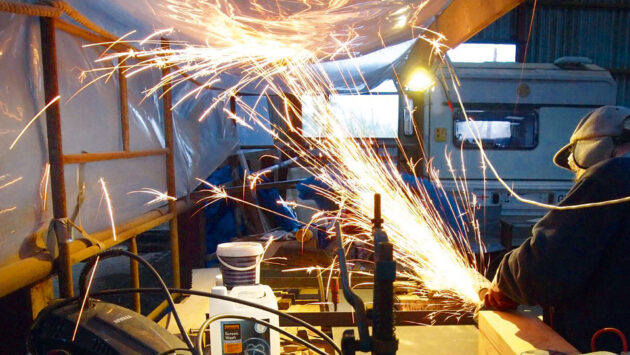
Sparks fly as the restoration begins. Photo: Charles Lyne
The weather continued to dog our efforts. By mid-January we were under several inches of snow but eventually work could begin. Dave had given me a brief: clear the inside of the boat of everything. Partitions and flooring went first, then the sea toilet, which after polishing up its brasswork and adding a smart new seat, I sold on Ebay.
With the boat empty, we now had to decide where to site the new electric motor – up at the front where the diesel had been or in the middle, closer to the centre of gravity and the batteries in order to minimise cable losses. We chose the latter. Dave set about cutting down the propshaft with a disc cutter while I stood by with a fire extinguisher in case the stream of red-hot sparks set fire to Malaya’s drying timbers.
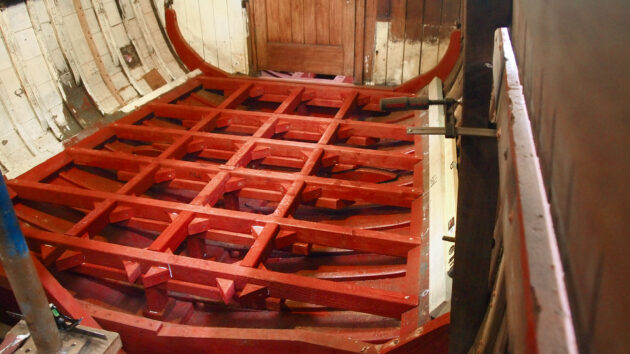
New deck beams. Photo: Charles Lyne
In order to prevent the boat from changing shape any more than it had already, I supported the roof with Acrow props and once the windows had been removed, we wrapped heavy duty ratchet straps around the hull and through the window frames to squeeze the beam back into shape.
Meanwhile, Dave taught me all about copper nails and roves, so I could assist him with the 2,000 fastenings that were required to hold all the planks securely in place.
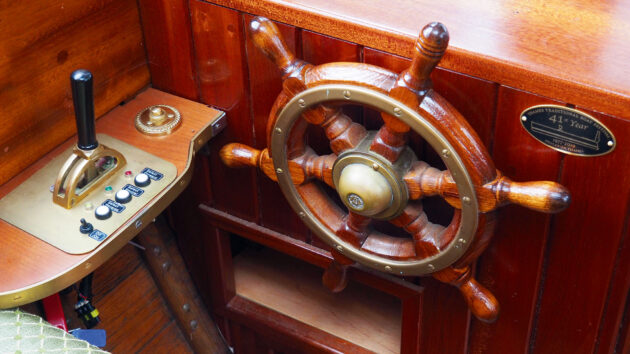
The restored helm. Photo: Charles Lyne
Article continues below…
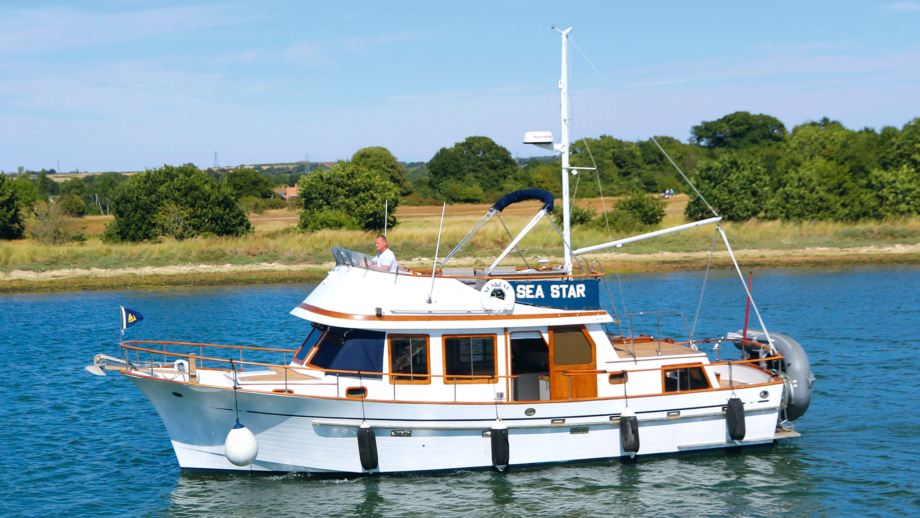
Renovating a bargain boat: I ended up with so much boat for so little money
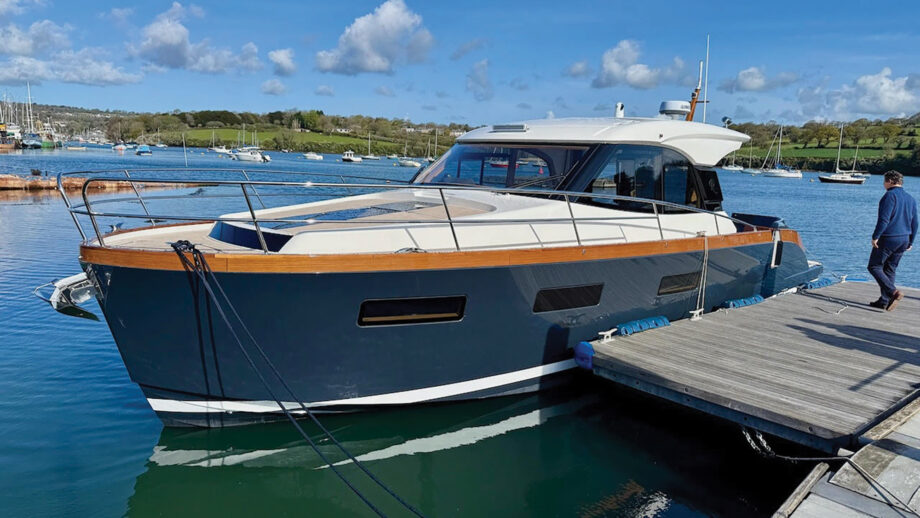
After a 13-month delay our Rustler 41 motor yacht is finally ready!
Launch day
Perhaps inevitably, the restoration proved far more time consuming and expensive than expected. I’d hoped we’d finish it in two or three years, in the end it was almost exactly six years before we gently lowered Malaya into the Thames at Lechlade.
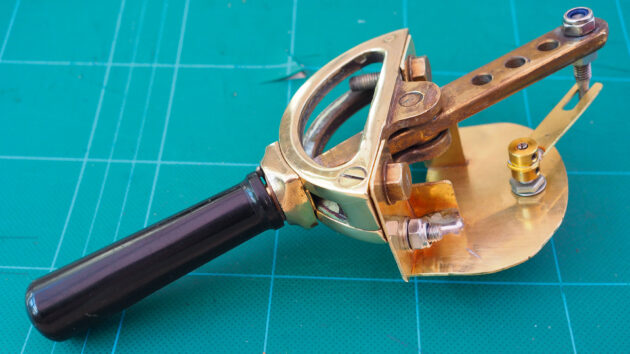
The original throttle was adapted for use on Malaya’s new electric motor. Photo: Charles Lyne
Despite having carefully caulked all the joins in the carvel-built hull prior to painting, I knew that it would be some time before the dry timbers below the waterline would swell and start to seal properly. I’d armed myself with a variety of pumps for that very reason but I still spent an anxious first night aboard, bilge-watching and pumping until the leakage rate gradually slowed.
‘Sea’ trials proved that most things worked as intended. The one disappointing aspect was the cruising range. I’d made up two coffin-sized battery boxes under the seats in the centre cabin to keep the high current cables (up to 450 amps) as short as possible. Each bank contained six 110 Ah batteries, each of which I’d hoped would be sufficient for a day’s cruising, so I could recharge alternate banks overnight.
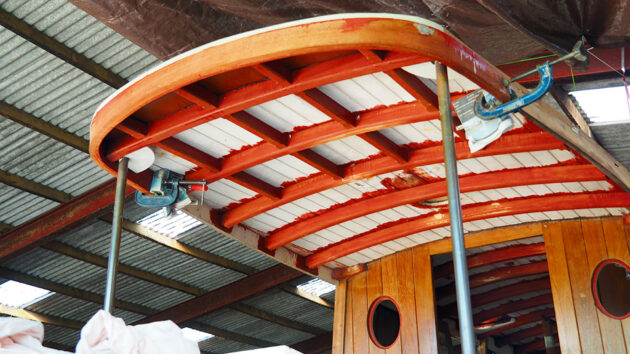
Newly rebuilt foredeck overhang. Photo: Charles Lyne
In practice, even with both banks in parallel, there wasn’t enough capacity for a day’s cruising. I tried replacing them with 130 Ah lead-carbon batteries, which were better, but still disappointing. Eventually, I bit the bullet and installed LiFePO4 (lithium-iron phosphate) batteries which offer significantly more usable capacity in the same volume.
This has proved to be been hugely beneficial, not just in terms of range but also because I can now monitor the battery charging, temperatures and tank levels by remote.
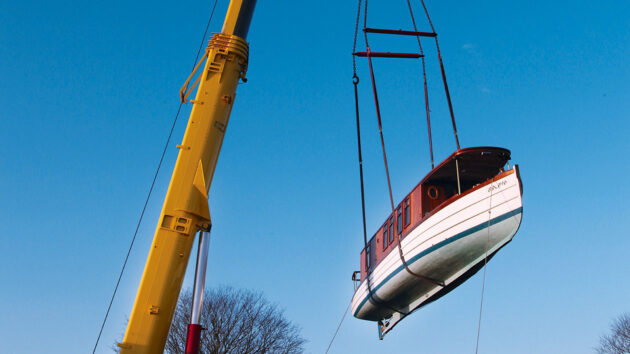
A fully restored Malaya is lifted into the Thames at Lechlade. Photo: Charles Lyne
Hooray Henley
That was all in the future, though, back in 2019 we were still learning about our ‘new’ boat. For some years during the restoration we’d been visiting the Thames Traditional Boat Festival in Henley-on-Thames and decided this would be the ideal place to show off her newly completed restoration.
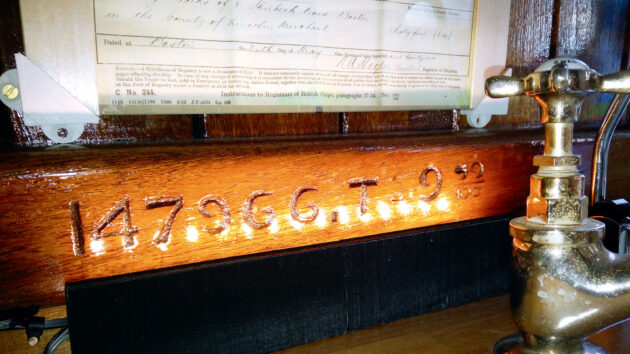
Malaya’s original registration number. Photo: Charles Lyne
Our progress downriver from Lechlade to Henley can best be described as stately. Although we could certainly go faster, doing so flattened the batteries too quickly, so we soon got used to being overtaken by almost every other river user from swans to paddle boarders!
The helm gives few clues to its new power source. Photo: Charles Lyne
We did eventually get to Henley – albeit four days later – having recharged at various locks and in at least one case, a charging point belonging to a fellow electric boat owner.
Having had the good fortune to find the descendants of Hugh Poths still residing in the Lincolnshire area, it seemed appropriate to ask the youngest Hugh Poths to officially relaunch his great grandfather’s old boat at Henley.
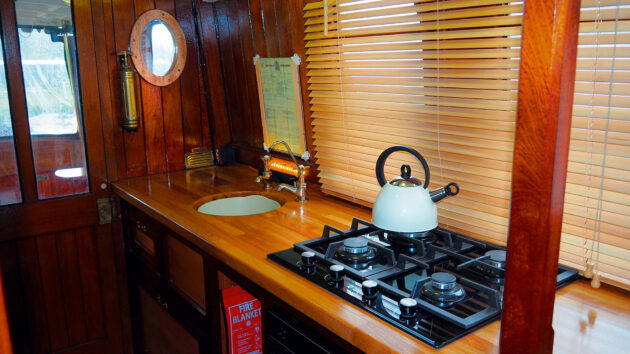
Galley mixes modern appliances with classic style. Photo: Charles Lyne
Hugh and his wife Shirley have since joined us at many of the subsequent Henley Trads and will hopefully join us again for Malaya’s 100th anniversary this year.
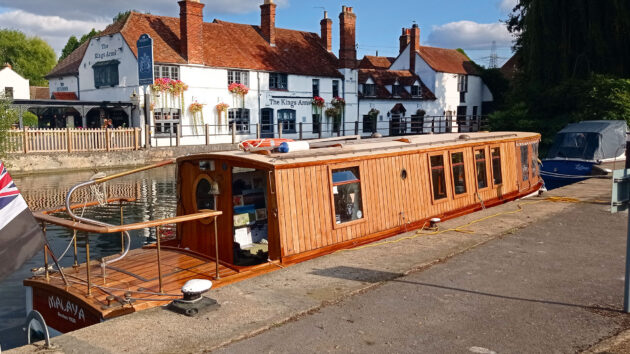
Malaya recharging her batteries outside the Kings Arms at Sandford Lock. Photo: Charles Lyne
We’re hoping that perhaps Motor Boat & Yachting would like to attend this milestone as well and complete the happy reunion that started all those years ago…
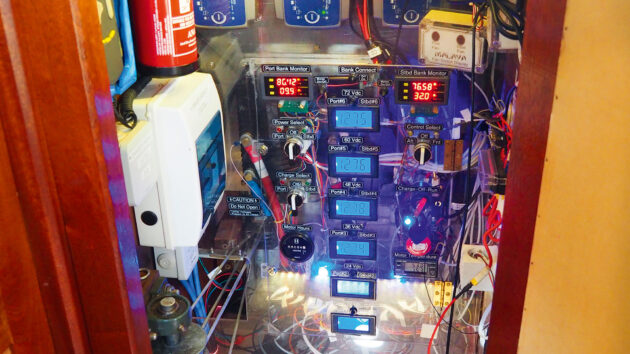
The new electrics panel. Photo: Charles Lyne
 If you enjoyed this….
 If you enjoyed this….
Motor Boat & Yachting is the world’s leading magazine for Motoryacht enthusiasts. Every month we have inspirational adventures and practical features to help you realise your sailing dreams, as well as tests and news of all the latest motorboats.
Plus you’ll get our quarterly Custom Yachting supplement where we share the last on offer in the superyacht world and at the luxury end of the market.
Build your knowledge with a subscription delivered to your door. See our latest offers and save at least 30% off the cover price.
Note: We may earn a commission when you buy through links on our site, at no extra cost to you. This doesn’t affect our editorial independence.