

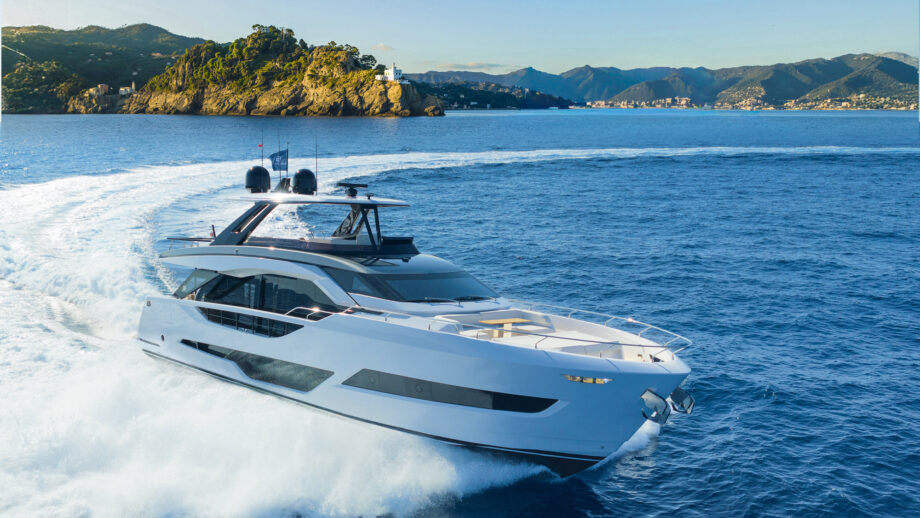
This all-new model is a much sharper looking follow-up to the original Ferretti 800 but how does it perform at sea?
The new Ferretti 800 is not the first model to carry that designation. The original one made its debut some 15 years earlier. It had a similarly elevated pilothouse, a smaller hardtop, big rectangular hull windows amidships but a lot less glazing elsewhere. Examples are still easily identified by the shark-gill detailing just below the bridge windows or their unusual metallic brown pilothouse roofs.
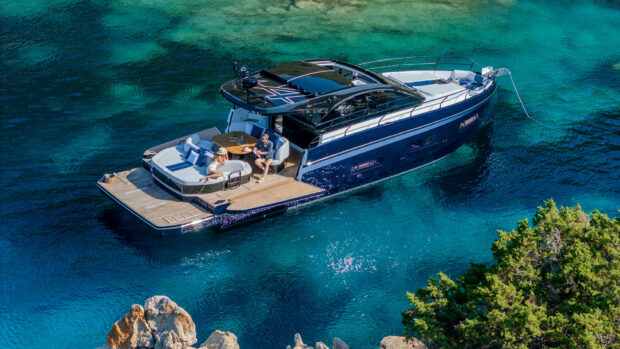
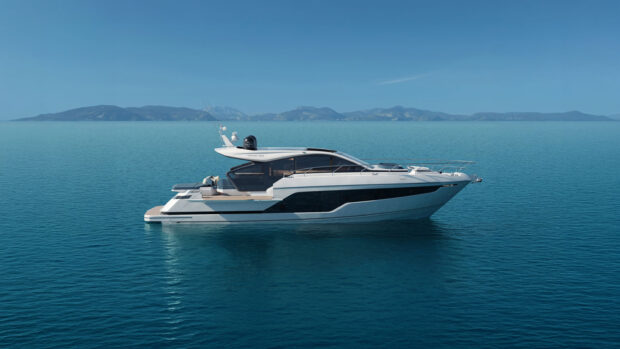
This all-new 800, designed by Filippo Salvetti’s Bergamo studio, is a considerably sharper, sportier looking beast than its predecessor. There’s no choice when it comes to colour, though – in a slight twist of the old Henry Ford adage, you can have any colour you like as long as it’s white. It’s not as uninspiring as it sounds.
Thanks to the dark hull and superstructure glazing, notches in the bulwarks to maximise views from the picture windows behind and multiple gloss black and metallic grey highlights, there’s enough contrast to keep things interesting. Overall, it’s a classy, sophisticated look that should age gracefully.
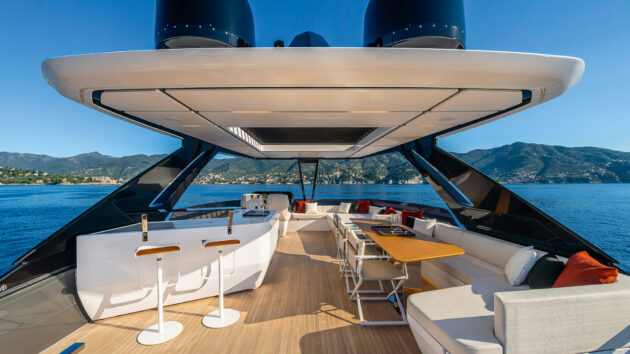
The flybridge is ideal for eating outside
Life Alfresco
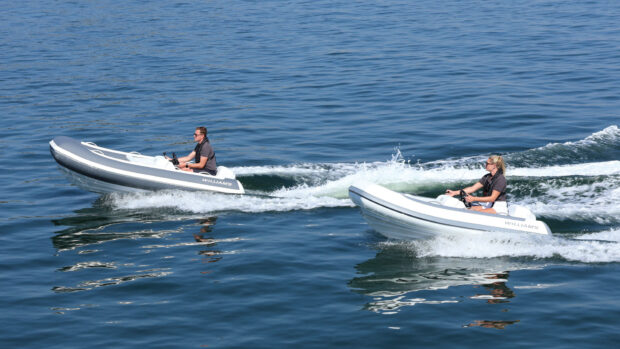
The outdoor spaces work nicely. The hydraulic bathing platform is both large and practical – it’s powerful enough to carry a six-person, 390kg Williams SportJet 395. And, once the tender has been launched, a section of the transom folds down to create an inviting ‘wet-sofa’ just above sea level.
As well as being a handy place to sit and wait for the tender, it’s an ideal spot for keeping an eye on young swimmers or enjoying an early morning coffee while looking out to sea.
The aft deck above is conventional enough. No folding platforms here (Ferretti hasn’t gone there yet) and no glass balustrade or modular freestanding furniture either. Instead, there’s just a conventional built-in bench sofa and table facing into the boat. This can be supplemented with folding director’s chairs to host the full complement of eight.
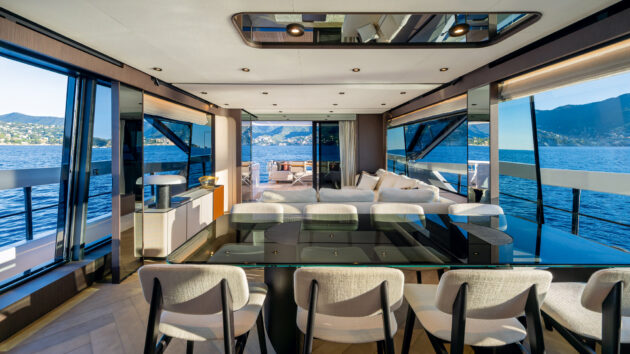
Sliding side doors make eating indoors equally special
There’s more alfresco dining potential up on the foredeck lounge. Tucked beneath the windshield, the C-shaped dinette could probably accommodate six when the table leaf is extended and the back edge of the big sunpad island is brought into play.
However, unless the weather is poor, most big meal gatherings are going to take place on the upper deck, the sociable hub of any large flybridge craft. The portside of the 800’s fly is all function. The cockpit stairs come up at the aft end, with a wet bar and a pair of bar stools amidships, and a two-seat upper-helm position forward.
The starboard side has mostly been given over to eating and relaxing. There’s a deep lounger-cum-sunpad immediately adjacent to the helm and a large dining area amidships, which should, once again, comfortably seat eight.
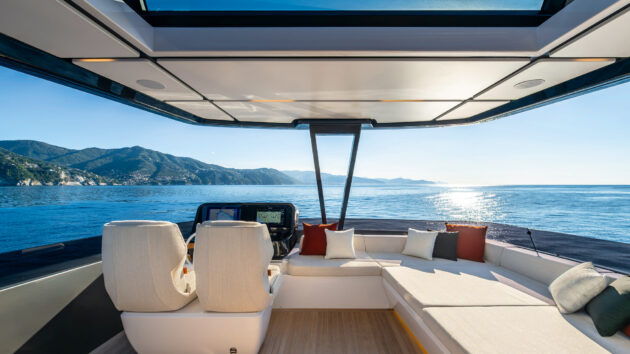
The hardtop’s central V-shaped pillar looks stylish and minimises visual obstructions from the helm
The aft third has been left open to owner interpretation. A few sun loungers would be the obvious choice – our test boat had a pair from Roda – but some owners may prefer gym equipment or opt to keep it free for stowing paddleboards or other toys.
The optional hardtop with louvred blind sunroof is supported by a stylish V-shaped central pillar forward and arch legs aft that appear to sprout up from the buttresses below. It protects roughly half of the available space up here, although there are various extra shade options for the remainder.
Inner sanctum
Benefitting from fabulous full-height picture windows along each side, the main saloon is light and bright. It is conventionally zoned with a lounge area aft and dining forward. Ferretti-regular Ideaeitalia handled the décor – a blend of stained oak veneers, soft leathers and inviting upholstery. Both ‘Contemporary’ and ‘Classic’ schemes are available, for which read lighter and darker.
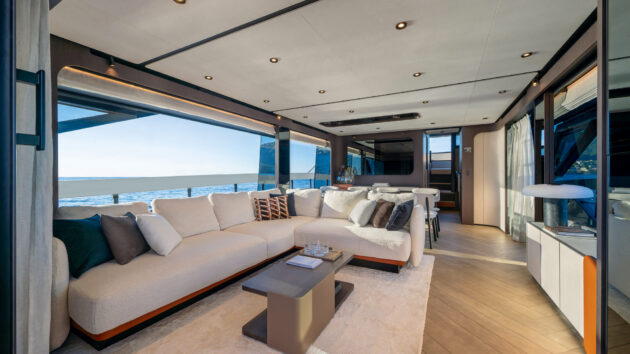
Masses of lounging space in the big, bright saloon
The lounge area aboard the 800 that we got to play with had an L-shaped sofa and coffee table to port and an optional second sofa to starboard instead of a sideboard, but there was still room for a 55in pop-up TV. Both sofas were custom-made for Ferretti but the other freestanding items are from top Italian brands. For instance, the coffee table came from Molteni, the beautiful smoked-glass-topped dining table from Minotti and the dining chairs from Alf Dafrè.
The saloon, and particularly the dining area, is made all the better by patio-style sliding doors to starboard that open out onto the side deck. There’s a full-height picture window on the other side but it doesn’t open. The former is intended to double as the principal guest route out onto the foredeck, which leaves the port side deck primarily for crew.
It’s an unapologetically old-school approach to guest and crew circulation.
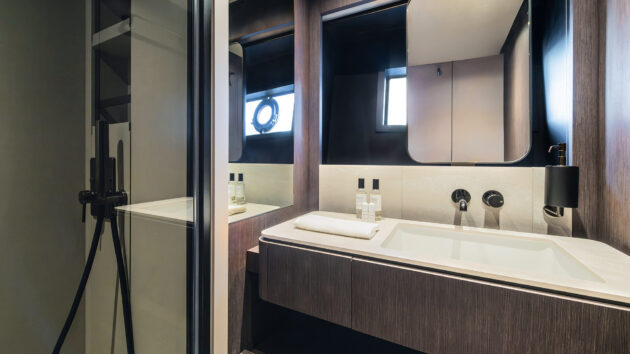
One of the three ensuite guest bathrooms
Headroom is good throughout. There’s around 6ft 10in through the main saloon and much the same in the cabins.
Beyond the dining area there are effectively three distinct areas and the crew can partition them accordingly. There is the portside galley, the forward bridge space and a starboard-side lobby with a day-head and the staircase to the lower deck.
The main saloon, galley and lobby area are on the same level but the bridge is two steps up. It could be described as semi-raised, although as with the older 800 the external profile makes it look like it has a proper RPH. To port there are two Poltrona Frau bolster-cushioned pilot seats addressing a bridge console with three 27in Simrad MFDs and a three-seat booth-cum-crew mess area to starboard. The upper helm has just two smaller MFDs.
Guests & crew
Pocket doors allow these working areas to be closed off independently. For instance, the bridge can be isolated while on passage or during the day, leaving the galley either accessible for guests or closed off when in professional catering mode.
And when the bridge and galley are shut off, the stairs and the day-head can still be accessed by the rest of the yacht without having to disturb crew and vice versa. And when the crew are tending to the lower deck or the day-head, the door between staircase and main saloon can be closed off too temporarily. The galley and bridge have their own connection to port too, a gap that can be plugged with a fold-down worksurface.
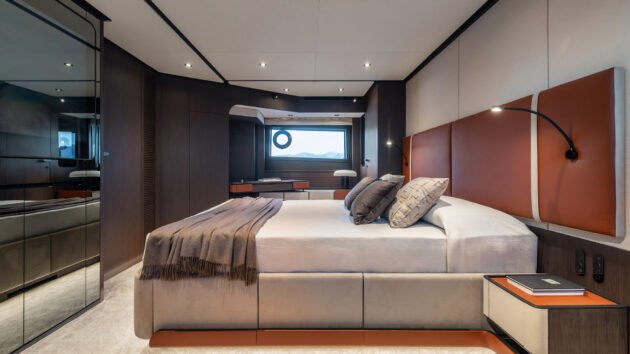
High quality but unfussy decor makes the most of the spacious full-beam owner’s suite
Standing in the galley, which is well equipped with Siemens white goods, you appreciate just how much headroom there is. It shares the same ceiling as the two-steps-higher bridge space beyond. The galley also has its own side door, which means crew can move along the port side deck without disturbing the guests.
The crew cabins are beneath the cockpit. There are three single-bunk cabins linked by a diagonal corridor. The ones on either side have longitudinal cots, while the in-betweener has a transverse bunk. There’s also a watertight door for quick and easy access into the engineroom.
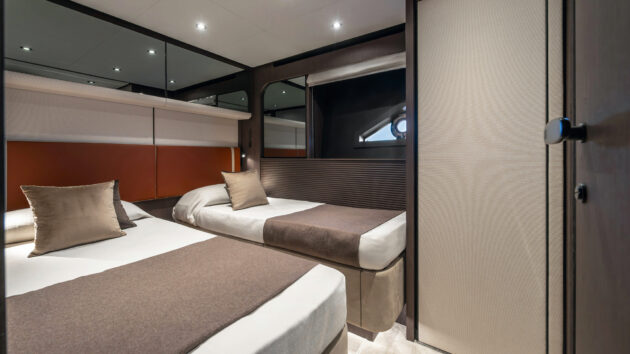
Both twin cabins have their own ensuite bathrooms
The Ferretti 800’s guest accommodation is traditionally configured – four staterooms, four bathrooms – and all where you would expect to find them. Amidships aft, the owner’s double is a full-beam affair with a forward-facing king that’s imperceptibly offset to port to make room for a diagonal vanity desk in the starboard corner. Behind the bed there’s a generous ensuite that includes both head and bidet, and a walk-in closet. Then there’s a VIP in the bow with an aft-facing bed and two convertible twins/doubles in between with forward-facing beds.
The long run of hull windows delivers plenty of light, not to mention views, to all four cabins. The owner’s cabin windows may not be quite as big as the old 800’s but the other three cabins are definitely better than before.
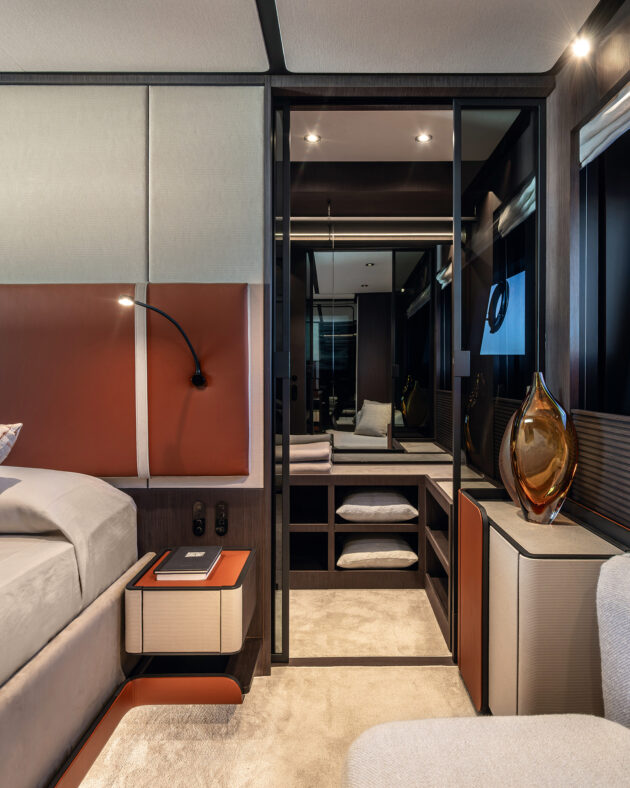
The owner’s suite includes a walk-in wardrobe
Performance
There’s a choice of either twin V12 MAN 1550s or 1800s hooked up to straight shafts. With the least powerful combo, the quoted top speed is 27 knots and the fast cruise 24 knots.
Our test boat had the more powerful set-up, which in theory should top out at 31 knots and provide a fast cruise of more like 27 knots. However, the best we could manage was just shy of 27 knots flat out, presumably because we were quite heavy! Ferretti acknowledges every tonne added over the basic specification will knock those speeds down by roughly a knot. We had no tender aboard nor any stores, but did have ten people aboard, full diesel tanks and two-thirds full freshwater tanks.
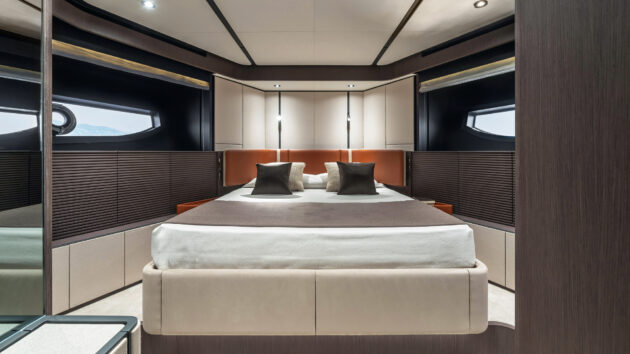
The VIP suite enjoys good floor space and headroom despite steps on either side of the bed
But what really weighed us down were the combined heft of two 27kW Cummins-Onan generators instead of the standard one, that optional hardtop and belt-and-braces stabilisation – not only a pair of Sleipner Vector fins but also two gyros, a Seakeeper 8 and Seakeeper 10. With those loadings the range at 24 knots and allowing for a 20% reserve would be something like 200nm. The fuel burn is linear, so once over the hump and on the plane there’s no obvious sweet spot. In the 18 22-knot zone the fuel burn is roughly 25 litres per mile.
Handling during our sea trial was exemplary but then the conditions were hardly challenging, with only a light breeze and little, if any, swell. We had the Humphree Interceptors active, the gyros on but the fins off. Our boat also had the optional Xenta joystick control and a full camera installation to take the stress out of the close-quarters manoeuvring.
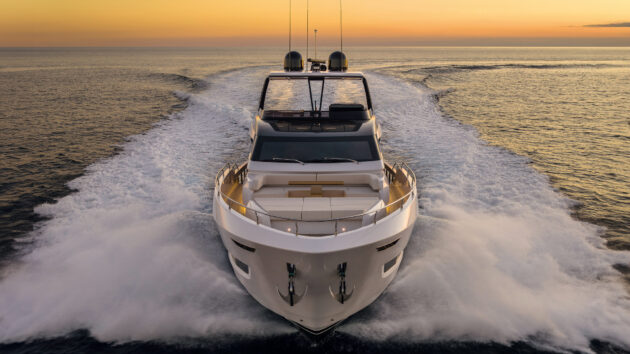
Twin anchors provide additional reassurance for owners with long-distance cruising ambitions
It also had self-centring steering, handy for those that instinctively like checking rudder indicators while helming. It was also impressively quiet. With all doors shut and cruising at 20 knots, we recorded 66 dB(A) in the owner’s cabin, 67 dB(A) in the VIP, 64dB(A) in the main saloon and just 59dB(A) at the helm. No surprise really. Ferrettis have always been well engineered and solidly built.
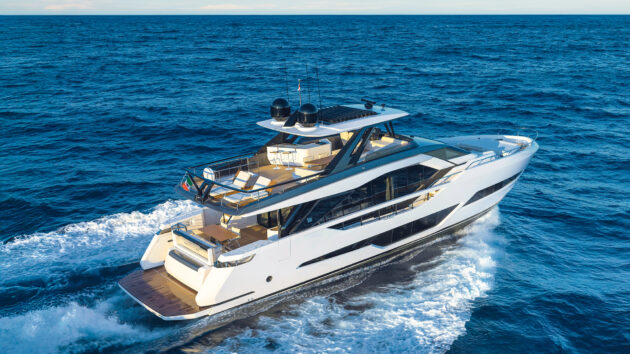
Clean lines look fresh and sporty
Ferretti 800 specifications
LOA: 80ft 3in (24.47m)
Hull Length: 77ft 2in (23.51m)
Max Beam: 19ft 5in (5.91m)
Draft: 6ft 3in (1.90m)
Height: 31ft 4in (9.56m)
Fuel Capacity: 6,400L
Water Capacity: 1,200L
Displacement: 64 tonnes
Engines: 2 x 1,500-1,800hp MAN V12
Max Speed: 27-31 knots
Fast Cruise: 24-27 knots
Certification: CE: A
 If you enjoyed this….
 If you enjoyed this….
Motor Boat & Yachting is the world’s leading magazine for Motoryacht enthusiasts. Every month we have inspirational adventures and practical features to help you realise your sailing dreams, as well as tests and news of all the latest motorboats.
Plus you’ll get our quarterly Custom Yachting supplement where we share the last on offer in the superyacht world and at the luxury end of the market.
Build your knowledge with a subscription delivered to your door. See our latest offers and save at least 30% off the cover price.
Note: We may earn a commission when you buy through links on our site, at no extra cost to you. This doesn’t affect our editorial independence.
Verdict
In any one year there are fewer than 100 customers in the world looking to buy a brand new planing 80ft motoryacht with a traditional open flybridge (rather than an enclosed tri-deck) and the vast majority of them end up buying from one of the well-known British and Italian yards. The new Ferretti 800 may not be the flashiest option out there but arguably it’s all the better for it. With its robust build quality, thoughtful layout, premium finishes and less ostentatious design, it’s a boat that looks and feels like it will stand the test of time. You only have to look at how well prices of the old Ferretti 800 have held up to justify investing in the new one today.