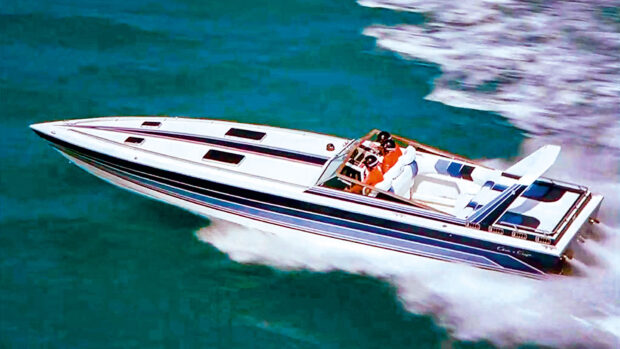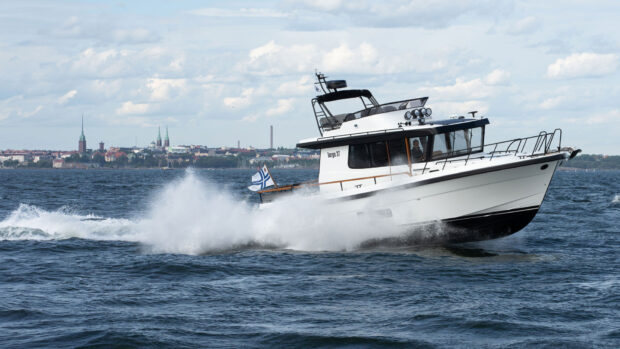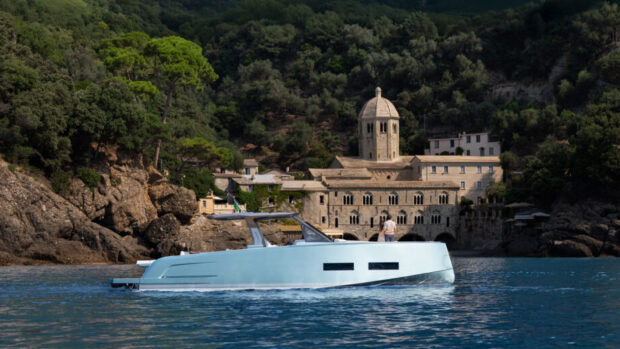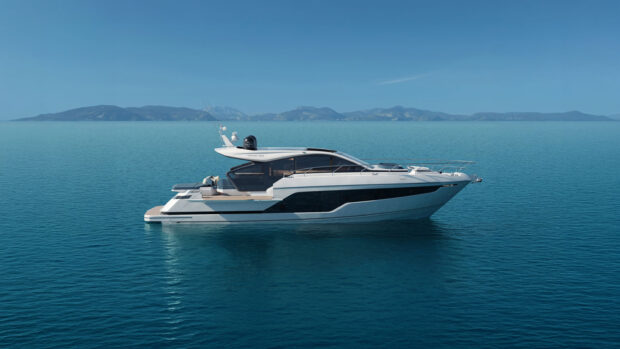


We talk to celebrated yacht designer, Bill Dixon, about life on the water and what makes a good boat great
Bill Dixon of Dixon Yacht Design is an acclaimed English yacht designer with a string of notable industry awards behind him – not least our own MBY Awards Special Judges award in 2025 for services to the industry.
While his portfolio spans four decades and a wide range of production, custom and semi-custom yachts in both the sail and power sectors, he’s probably best known for his work with Moody, Pearl and Sealine. We caught up with him at his headquarters in Swanwick Marina for a chat about what modern boat design is really all about…
How did you get involved in boats?
My family background has been all about building boats down in Exmouth. The family business goes back to the 1700s, through many generations. It was a very traditional sort of boatyard – mostly wooden boats and fishing boats and then lots of pleasure boats in the early 1900s. I was literally born next to the boatyard, so I used to walk through them and annoy the guys building the boats all the time.
Climbing in and out of them. I used to use the family launches and the little 20ft cabin sailboats that everybody used to sail in in those days. And dinghy sailing too at the local sailing clubs. So right from a young age, I knew I was going in that direction. I was much more interested in design than I was in building boats, but it was naval architecture at that stage; not necessarily yacht design.
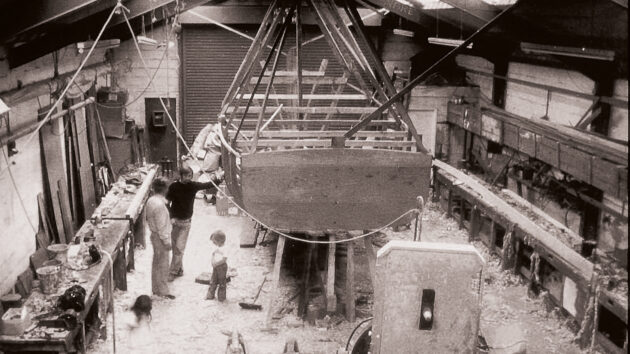
Bill’s family has been building boats in Exmouth since the 1700s
So your formative years were in sailboats?
Well I originally worked for Angus Primrose at Moody for three years before he was lost at sea, so we were lucky enough to have four Moody sailboats – a 28, an Eclipse 33, a Moody 36 and then a Moody 47. So I was obviously brought up as a sailor and I loved it. But I also enjoy powerboating. It’s a different way of boating.
The Moody 47 was a lovely boat when we had family, crew and a few of us on board, but I wanted something smaller so we could get into places more easily. So we started with a Nimbus 380 Commander and that was really good. At the time, our checklist was a pilothouse and a flybridge, and it had both those things. If you’re going long distances, perhaps to France or right the way down to the southwest, having somewhere to sit in comfort and shelter is critical.
Why did you trade that in?
Well after a time, we found that what we really wanted was a more open single-level living space. And you could say the Sealine and the Moody are somewhat connected in the way we try to flow the boat through the interior to the exterior with a covered bimini. That was actually on the Moody before it was on the Sealine, but I now own a Sealine C390. I keep it right here in Swanwick by the office, so I get out on it a fair bit.
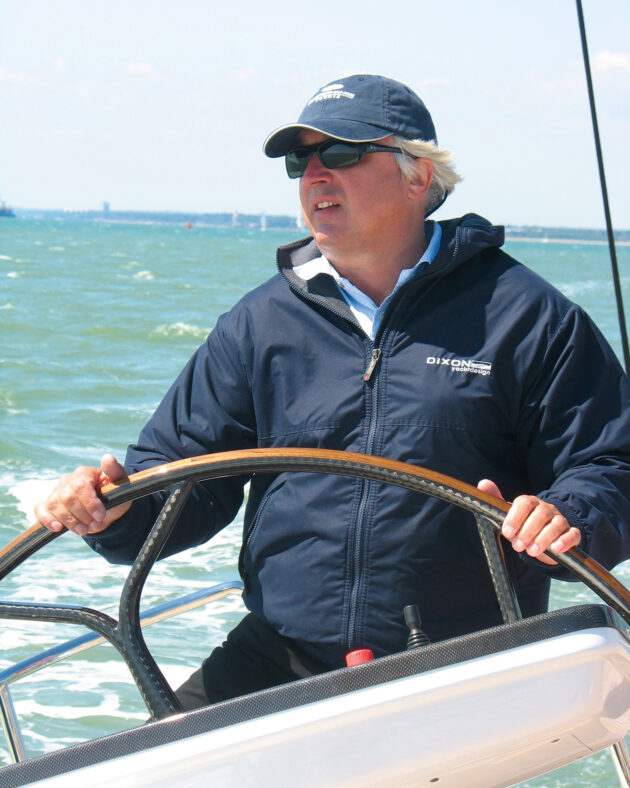
While he grew up sailing, Bill loves the go-anywhere simplicity of a powerboat. Photo: Paul Wyeth
Is there a trademark Bill Dixon design feature?
If you use a boat and you cruise and spend time on board, you come to understand what makes a good boat in terms of lifestyle. The key difference between a sailboat and a motorboat is that, with a motorboat, you don’t spend lots of time sitting around getting somewhere. You get somewhere and then you sit around. And that makes a fundamental difference to the way you organise and design your decks. So one of the things that we’ve always tried to do on our motorboats is to create a variety of different living spaces.
Can you give an example?
Yeah, on the Pearl 72, you’ve got vertical slats to suggest separation rather than a blank bulkhead to create that. So if you use a slightly staggered walkway alongside the slats, then as you move from one space to another, it creates separate zones while also opening up the whole boat visually. That’s crucial because today, it’s all about natural light. And in the old days, we didn’t have glass like we do now, so glazing enables us to create a very lifestyle-driven boat.
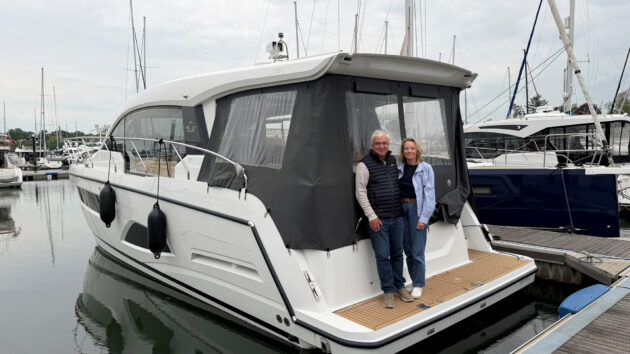
Bill and his wife Chris on board their Sealine C390. Photo: Paul Wyeth
Is it difficult to use glass well?
In the past, when you were inside a boat, you really felt inside. We all had small windows and they would often feel very constrained. In fact, we used to go mad, styling little bits of window all over the place and there wasn’t much real thought about how a design might separate you from the outside.
But now – and Sealine’s a classic example – you get big pieces of glass all-round, so when you sit inside, you wouldn’t know. You feel like you’re part of the environment and that’s really what people want. On much bigger boats, there can be a bit of a trade-off between openness and intimacy but I don’t think it’s that difficult to get it right.
You can use blinds, you can use partial bulkheads and you can also use privacy glass, where you hit a switch and nobody can see in.
Does styling tend to fight with practicality?
You know what it’s like. You go to a boat show and you immediately know whether you want to step on board a boat. Is it cool? Is it interesting? It’s a very quick response. So styling does matter a great deal. But beyond the styling is the fact that, quite often, you’re going to live on it.
A lot of the boats we design sit in marinas in the south of France and operate as people’s second homes.
You go out a few times cruising, but most of the time, it’s about using that boat as you might a home and really enjoying the relaxation, so the usability has to be spot on.
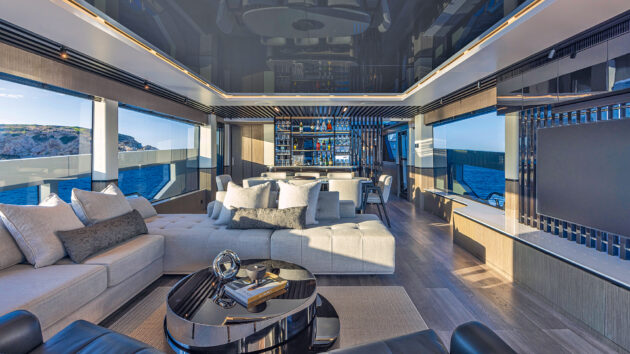
The use of implied zones and open-slat ‘bulkheads’ enables light to flow on the Pearl 82. Photo: Paul Wyeth
What’s the difference between custom and production designs?
The powerboat market has changed enormously. There’s no such thing as a pure custom yacht anymore, because everything’s semi-custom. You have the basic underpinnings and then you play with some deck furniture and modules.
At 45m, and even at 80m, you have yachts that designers then tweak with styling and interior decisions but everything’s platform-engineered, so aside from price and complexity, and the kind of experience you want to feed to the customer, the difference between production and semi-custom (which is essentially now custom) is not as enormous as people think.
So the difference is more in process than product?
Maybe, yeah. A custom boat obviously involves a one-to-one relationship with a client. With the production side, we have long relationships with our boat yards and that’s important because you understand the product line and develop it for years so the brief becomes more pared back, their faith in you increases and the communication becomes much simpler. To be an effective designer, that communication needs to be tip top – because what we try to do is figure out something special for each client.
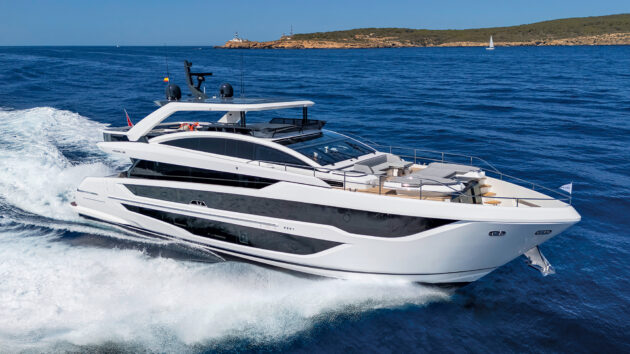
A key part of modern design is integration with (rather than separation from) the elements
Is finding that ‘thing’ the biggest challenge?
Well we don’t like to give any client something we’ve already done for somebody else, so yes, I think that is the biggest challenge – to keep reinventing boats. And it’s not just about the client. It’s about the end user. You need to create new experiences for people. Why would people buy another boat unless they can see a reason for doing it? Take the new Pearl 100 and the Pearl 95. There’s not that much difference in size but there’s a massive difference in terms of styling and lifestyle.
So you have to introduce custom flexibility into production boats?
Yes. A lot of people used to come to us and open up about what they want. We would then create a boat for them but now a lot of people can’t see the boat in their head at all, so they go to a boat show and spec it to their tastes instead. Pure custom design is disappearing and it’s being replaced with production boats that feel like they have a bit of custom flexibility.
Even on the Pearl 100, which is of course a superyacht, there’s very little customisation because we’ve figured it out better than you could customise it. And that’s an important point because people don’t have the same 3D spatial awareness in relation to how it all works and how it all fits together.
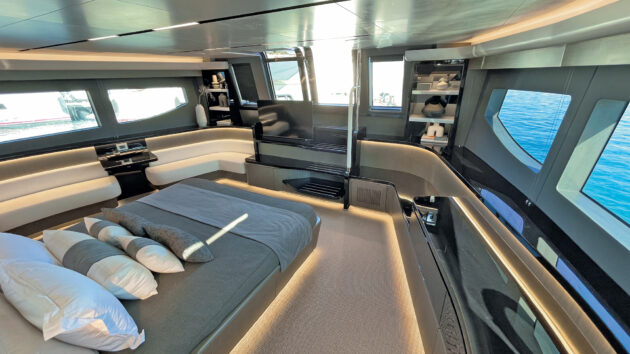
The main deck owner’s cabin on the Pearl 82 is a feature that’s filtered down from the superyacht world. Photo: Paul Wyeth
Do the greater volumes of larger yachts make that process simpler?
No, because you’re still challenging yourself in terms of what you’re trying to incorporate. You’re still optimising every space. You still play around with 25mm shifts in the bulkheads. It’s all those little things that the client isn’t aware of that make the difference between a very good boat and a great boat.
So what’s your favourite design so far?
The Pearl 82 encompasses a lot of my thoughts on private design. I’ve got a sketch that was done in the 1990s that actually has all of those things on board but it takes a long time for some of these things to have their moment. It’s quite frustrating, having your pearls of wisdom in a little notebook for two-and-a-half decades before you can actually put them into practice.
But that’s how it is. There’s always a time and a place in the market, both for boats and for features – and if you release a great idea too early, it simply doesn’t work.
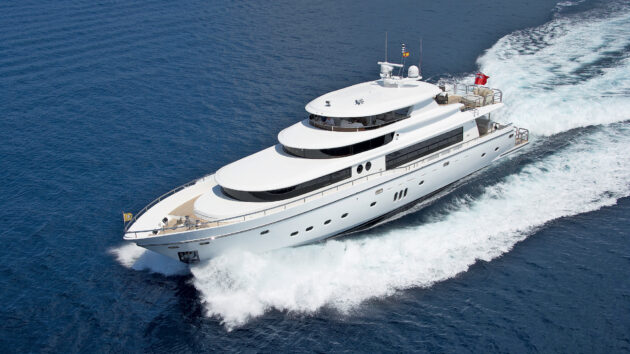
Spotting developing trends is a critical part of effective design
Can you name a good example of that?
Absolutely. The Johnson 87 – a wide-beam, high-volume, long-range cruiser with the option of a flybridge or a skylounge. It hit the market at exactly the right time. It was there for the taking and ready to grow. So all of us here at Dixon Yacht Design have to attend all of the boat shows.
We need to have a really good feeling for trends and where the market is going.
Do you get aggravated by people copying design ideas?
No, you may as well be flattered because there’s nothing to be done. We’ve invented a lot of things that we see on other boats that we don’t put our name to, but everybody tries to put a different spin on it and that’s just part of the design process.
The bow cockpit is a good example – a little bit of a recess in the bow for seating in small boats. It was somewhere else to sit and it was in a little well rather than on the deck for extra security. It was great for mooring too cos you’re standing much
deeper – and these days, everybody’s got it. We also designed a boat in Turkey.
A semi-custom 47ft day boat with a full-width bimini where the supports came down on the gunwales for extra space and extra shelter, and everybody’s using that now too.
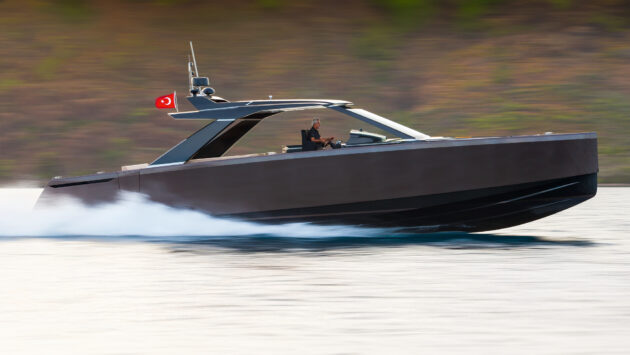
Bill introduced the fullwidth bimini on a semicustom 47-footer
Is there a boat out there by somebody else that you particularly admire?
I really like the San Lorenzo SX range. It looks like a serious piece of kit, doesn’t it?
The deck arrangement is really quite interesting in terms of the levels – a massive platform with the engines underneath and quite a deep-set owner’s space aft. Another one where I admire the innovation but not necessarily the boat itself is Wally. Their boats are right out there in terms of styling!
So what kind of boat would you design for yourself?
Maybe a power cat. It’s a really interesting and fast-evolving part of the market. I’m thinking a more pared-back style of catamaran with lower resistance than most boats, so you don’t need such big power.
A narrower beam, a boat that flies through the water; a more simple way of going boating with the cabins confined to the hulls and a raised bridge deck to keep it soft. You cannot design a proper power cat without that, because if it’s anything other than flat water, it shudders with the impacts.
Do you take it to heart when people criticise your designs?
Well you get passionately involved in the project and you believe 100% it’s fantastic, so you do get offended when you’re younger, but it’s just water off a duck’s back now. The thing is, people don’t know the process you went through to get what you’ve got and the compromises you’ve put in place that set that design that way, so it’s really an evolving process; a process of integrating ideas.
You can’t just deliver everything on day one. There’s quite a long gestation period, especially for a production boat that has to sell in good numbers.
Article continues below…

Pearl 62 yacht tour: Bill Dixon shows us around his latest design
From 50-knot speedsters to 7,000-mile explorers: The best motor boats we tested in 2025
So what is the main element of effective modern design?
Well that’s difficult because it’s always about the brief. But as far as possible within any brief, you try to design a boat where the design itself doesn’t stand in the way of your integration with the water; with the open air; with the sea. And I think there’s an important point to be made here. Because it’s easy to forget that the sea is actually a horrible environment when it’s rough.
So if I had any criticism of the modern industry, it’s that a lot of people have lost touch with some of the realities about boating in terms of respecting the sea and understanding the limitations of the boat.
 If you enjoyed this….
 If you enjoyed this….
Motor Boat & Yachting is the world’s leading magazine for Motoryacht enthusiasts. Every month we have inspirational adventures and practical features to help you realise your sailing dreams, as well as tests and news of all the latest motorboats.
Plus you’ll get our quarterly Custom Yachting supplement where we share the last on offer in the superyacht world and at the luxury end of the market.
Build your knowledge with a subscription delivered to your door. See our latest offers and save at least 30% off the cover price.
Note: We may earn a commission when you buy through links on our site, at no extra cost to you. This doesn’t affect our editorial independence.