

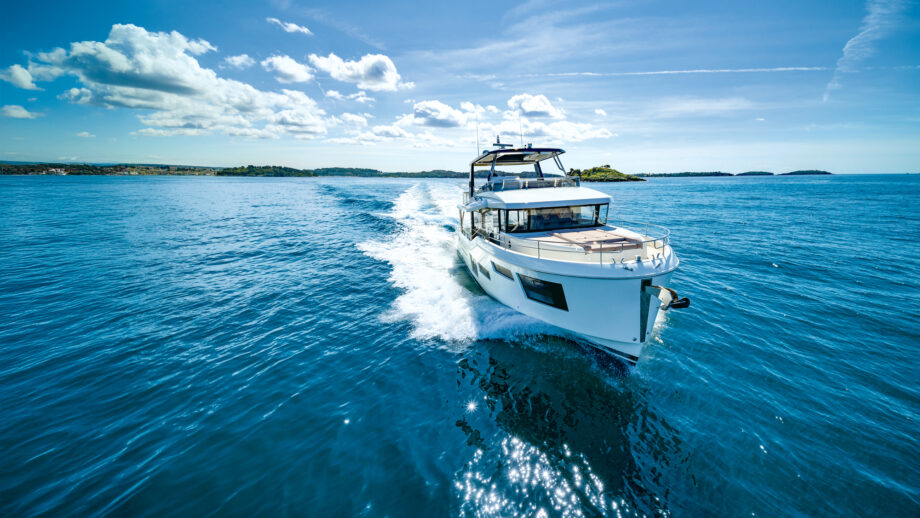
Has the flagship of Beneteau’s immensely popular trawler fleet just got even better?
Testing boats at the Cannes Boat show is always a treat. As well as enjoying a dose of September warmth I get to review craft like this Beneteau in its home waters. Well, almost. The Grand Trawler 63 is actually built in Monfalcone, Italy, but everyone knows that Beneteau represents the quintessence of French boatbuilding. Pragmatic and keenly priced, practical and well designed, French boats rule the Mediterranean.
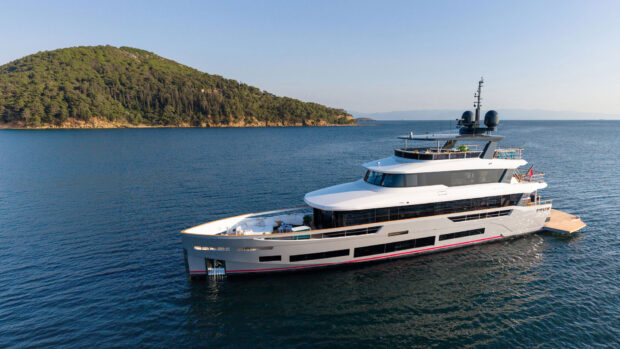
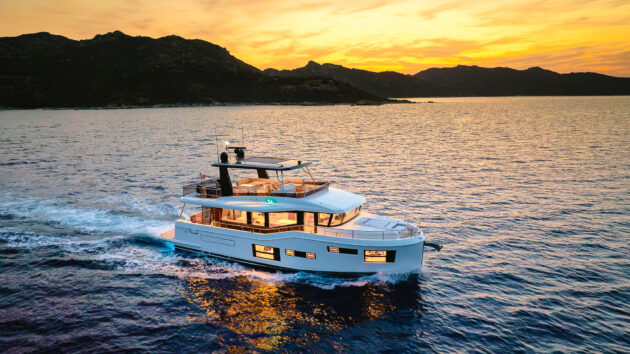
Given that the Grand Trawler 62 proved to be such a success for the shipyard – 29 were sold in four years – you might imagine that the development engineers on the GT63 trod carefully to avoid changing anything that contributed to its success. And so it proved. Some alterations are significant, but most are cosmetic. In all fundamental respects, the new model is simply an upgraded version of the old, with its businesslike profile, plumb bow, reverse-raked windscreen, and gigantic flybridge.
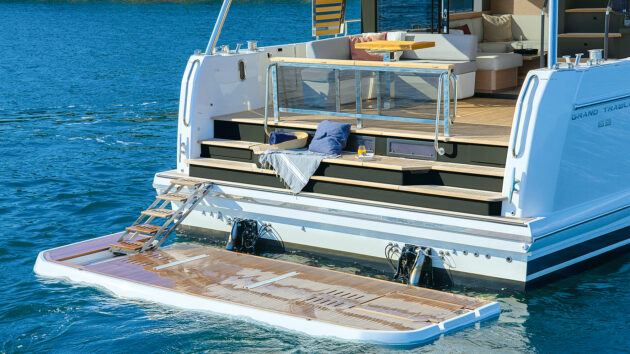
Glass transom and hydraulic bathing platform make for a very inviting cockpit
It’s not just the engineers at Beneteau who proceed with caution, but the designers too – not from fear of making ill-advised ‘improvements’ but from the corporate necessity of ensuring that every new project has at least a 40% mould commonality with its predecessor. It keeps costs down. For the same reason, there are very few curves in the interior fit-out, because curves cost money (Beneteau’s designers get very, very tired of hearing that they make ‘flat-pack’ boats).
Radii are standardised, shapes are carefully crafted to ensure they pop out of the moulds easily, and very few multiple mouldings are allowed. The production process has to be as streamlined as possible, for that is how you stay in business building boats. No one knows this better than Beneteau. Come to think of it, no one does it better either.
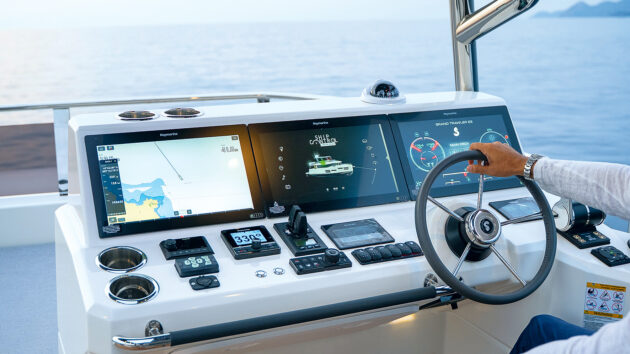
Xenta steering makes the new GT63 unusually light to helm for a big trawler yacht
GT62 VS GT63
When it comes to the differences between the GT63 and its predecessor, one of the more important improvements is the standard fitment of excellent Sleipner fin stabilisers. Another is the useful Xenta electro hydraulic steering. Beneteau’s new ‘Silent Boat’ option, a system of inverters, solar panels and 2000Ah of lithium batteries, is designed to keep all the electrics running while at anchor – including the aircon, for a while – with the genset switched off.
It was originally offered aboard the ST54, according to Beneteau, and proved popular. The system is monitored from the helm via one of the Raymarine screens.
On a cosmetic level, a lot of black paint has been applied around the cockpit and superstructure sides in an effort, successful in my view, to ‘lighten the profile’ of the boat and give it a more upmarket look. It’s not just any black paint, but quality stuff, RAL 9005, and it can also be applied to the hardtop and its supports if you so wish. Graphite vinyl cockpit headlinings replace white, LED strips replace downlighters, and the hull window framing has also been tidied up with the paint treatment. New Italian furniture options are available for the cockpit.
Inside, what used to be the ‘Luxe’ décor pack is now the standard finish, which includes slatted wood wardrobe doors, padded headboards, and sprung wood slats under the mattresses. Up on the main deck the high-level lockers in the galley are now faced with wood, and tactile checkerboard panelling features on the starboard sideboard and galley bulkhead.
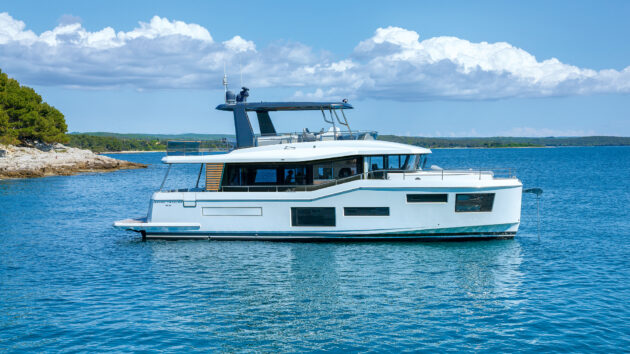
Black detailing lightens the look of the GT63’s profile
At the lower helm station the three Raymarine screens sit on new ‘floating’ brackets, imparting a subtle sense of spaciousness. Finally, the 62’s laminate saloon floor has been replaced with solid hardwood parquet, which extends into the lower deck passageway.
Fans of its predecessor, then, will breathe a sigh of relief on climbing aboard the GT63 when they discover not only that their favourite trawler yacht wasn’t broke, but its builders didn’t try to fix it. It has the same hull, and the same machinery – a pair of six-cylinder MANs of 730hp apiece. These reside in considerable comfort in a spacious and well organised engineroom, reached via a door in the port side of the transom, and through an excellent storage lazarette which, as an option, can be fitted out as a crew cabin.
For rough weather there is another engineroom hatch in the cockpit sole. On the lower deck, customers can choose between three and four-cabin layouts. The Cannes show boat had the former, which provides a spacious full-beam master stateroom amidships. This has good proportions, useful volumes of stowage space, and close on 6ft 7in (2.00m) of headroom (reducing to 6ft 1in/1.86m at the bedhead). It feels comfortable and roomy, with a dressing table to port, a chest of drawers to starboard, and a head compartment that is almost cabin-sized.
Hull windows are pleasingly huge. The bed is a generous 6ft 7in by 5ft 7in (2.00m x 1.70m). This is a suite that sets the tone aboard a confident family cruiser. Divide it into two, as on the four-cabin layout, and the boat wouldn’t seem quite the same.
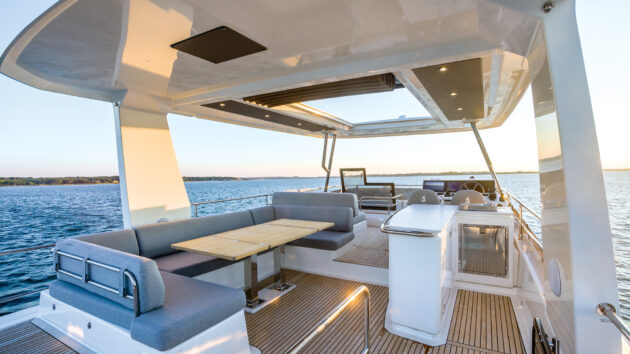
There are acres of space on the long flybridge deck
Down below
With its offset berth and forward lockers, the layout of the VIP suite up forward – which would be the master in the four-cabin version – is a smart solution to the problem of the bluff bow sections, where the topsides are almost vertical as they converge towards the stem. The bed is slightly longer and slightly narrower than the master’s, headroom is very much the same, the head is a decent size, and although it lacks the floor area of the midships cabin it is still reasonably well off for stowage.
The third cabin is a twin, on the port side, with ensuite access to the day head. It’s the smallest, but doesn’t feel particularly small, having plenty of headroom, especially between the berths, decent locker space and extra stowage under the mattresses. A big window lets in lots of light. The berths, not bad at all at 6ft 5in x 2ft 5in can slide together to make a double.
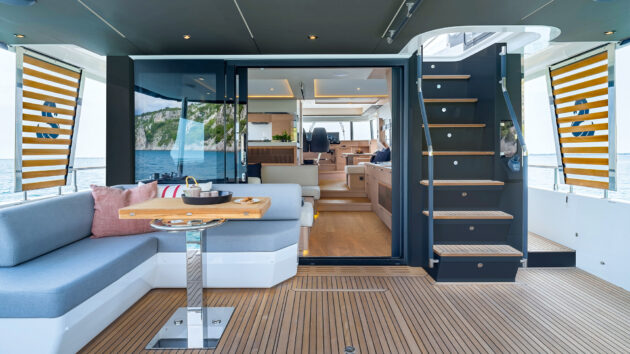
Glazed fashion plates with wooden slats look classy and help shelter the cockpit
The interior of the 63 can be finished in either oak or walnut veneers, one being slightly darker than the other. Stitched leather handles here and there lend a touch of quality, and there is a confident solidity to the numerous handrails and door hardware. The overhead handrail in the saloon is particularly pleasing. Behind the scenes, too, the pipework and cabling looks secure and reliable, even if it lacks the fetishistic orderliness and labelling that can be so reassuring on more upmarket brands.
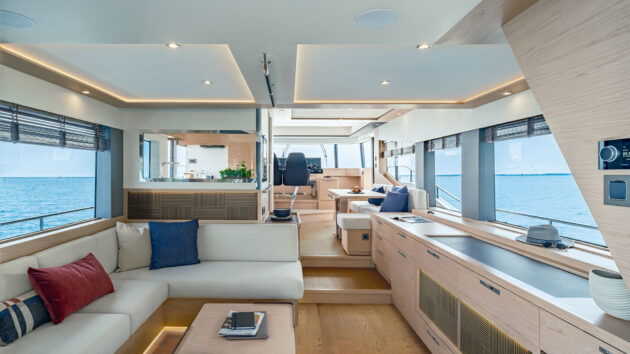
Big side windows, light finishes and a sociable layout main deck
Main deck
One of the most successful features of the GT62 was its main deck layout, and the GT63’s doesn’t stray from the true path. Its most noteworthy asset, in my opinion, is the galley. This is set high on the mid deck with a door out to the port side, windows on the interior bulkheads and its doorway opposite the dining table. It feels at once enclosed and open, and sits at the sociable centre of things. The exterior hatch for access to the rubbish bin is brilliantly practical. The sliding internal door is optional, but even without it, this is a sterling piece of design.
The helm station also gets its own side door, and sits behind its serious-looking raked windscreen with the helm seat on the centreline, and a snoozing sofa for the navigator. Also on the port side is the internal flybridge companionway, while the stairs to the lower deck are to starboard. Visibility from the lower helm is good to the sides, not great aft thanks to the elevation and the galley bulkhead, and excellent forward.
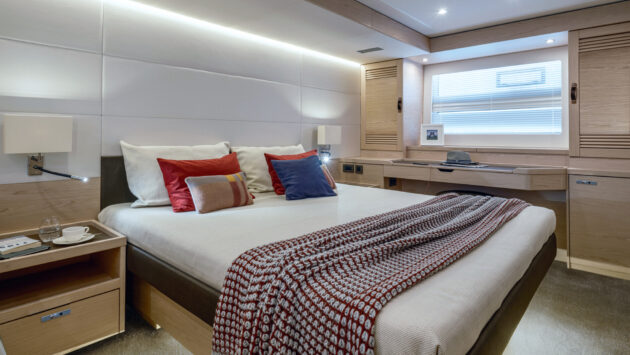
The full beam owner’s cabin is reserved for the three-cabin version
Eight can sit at the dining table with four folding chairs augmenting the bench seating, although six might be more comfortable. In the main saloon area the low-level U-shaped sofa on the port side helps accentuate the size of the windows, while over to starboard you can specify a sideboard or another small sofa. Glass doors slide open into the cockpit, over a minimal threshold.
Outside
Wide side decks and two routes up to the flybridge help make the GT63’s external areas exceptionally safe and easy to get around. The cockpit itself, complete with glass transom and sleek new furniture, and sheltered as it is by the long flybridge overhang, will prove to be a popular spot. Up on the foredeck, which is an easy stroll protected by deep bulwarks and tall guardrails, the sunbeds have not one but two adjustable backrests, the forward pair creating an excellent little bench seat over the bow. This would be a great place to sit, whether at anchor or under way.
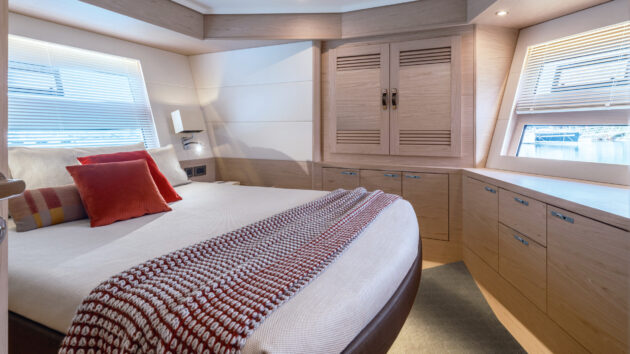
The bed in the forward VIP is angled across the beam to create more floor space
The big story, of course, is the flybridge, which is enormous. A roomy sofa and dining table sit opposite the bar and grill, augmented by forward-facing seating next to the helm and free-standing seats or loungers aft. There is another padded reclining spot just ahead of the helm console. It’s a full-beam upper deck, in effect, and is almost completely shaded by that substantial hardtop, with its massive fibreglass pillars and stainless steel supports.
If the GT63 doesn’t look much like a planing boat that’s because Beneteau doesn’t really think of it as one. Sure, it’s capable of 20 knots, but a waterline length of 53ft gives it a theoretical hull speed of around 9.7 knots, and a glance at our figures quickly shows how sensible that sort of speed is for long-distance displacement cruising, with a range of around 650 miles (allowing for a generous reserve). Bring it back to 8 knots and fuel economy just gets better, consuming a meagre 24 litres of diesel per hour for a range of over 1,000nm.
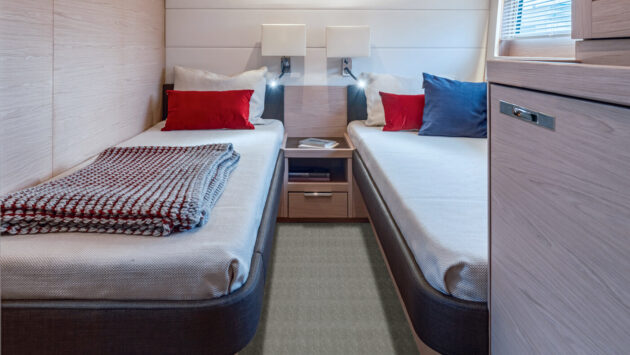
The twin enjoys plenty of headroom and light
Under way
Sleipner’s Vector fin stabilisers are now fitted as standard, and you’ll probably want to use them at all times when under way, for the weight of that hardtop is not only considerable in itself but also perched some 20ft above the waterline. These stabilisers are very effective. On our sea trial, conditions were hardly challenging for a boat of this class – a steady breeze and waves of two to three feet – but she didn’t roll, and even under hard helm inputs she went round like a billiard table.
One annoying teething problem with our particular boat, the first of the new 63s, was the proximity of the steering wheel to the upper helm console’s handrail, which produced a painful pinchpoint for the fingers. The reason, it turned out, was simple – the Xenta steering kit, standard on the GT63, is more compact than the system used on the 62, so the wheel sits closer to the dash. This will certainly have been fixed by now.
However, during our sea trial the issue was exacerbated by the fact that in following seas this is not a hull that tracks particularly true. At all speeds downwind it needed a lot of steering, which meant a lot of pinched fingers. In breezier conditions the hardtop’s sail area will also come into play when motoring downhill, and concentration will be required to guard against a broach.
Beneteau Grand Trawler 63 specifications
LOA: 62ft 2in (18.95m)
BEAM: 17ft 10in (5.45m)
DRAUGHT: 4ft 7in (1.40m)
DISPLACEMENT: 28.5 tonnes (light)
ENGINES: 2 x MAN 730hp diesel
FUEL CAPACITY: 3,870 litres
WATER CAPACITY: 840 litres
RCD CATEGORY: B for 16 people
Beneteau Grand Trawler 63 cost & options
From: €1.989 million ex yard, ex taxes
‘Essential’ trim level (includes hardtop, genset, monitoring system, inverter): €96,400
‘Comfort’ trim level (add hydraulic platform, deck wash, searchlight): €142,500
‘Lounge’ trim level (add BBQ, underwater lights, dishwasher, icemaker etc): €166,600
‘Silent boat’ pack: €114,000
Electronics pack: €26.700
Upgraded electronics pack: €62,200
Hydraulic passerelle: €43,000
Air-conditioning: €63,700
Verdict
Beneteau had limited ambitions for this new model – sales of the 62 seemed to be going well, and the requirement for a replacement was perhaps called by the marketing department rather than by the market itself. That said, there are plenty of worthwhile improvements on offer with the new GT63, which has ended up not only looking better, but with a higher-quality standard spec as well. Xenta steering is always a bonus, of course, but the most significant upgrade is undoubtedly the Vector fin stabilisers, which would appear to have the measure of that heavy hardtop. There will undoubtedly be occasions when they’ll make the difference between waiting for the weather and getting under way. And given the limited time we allow ourselves for holidays, that can be all the difference in the world.