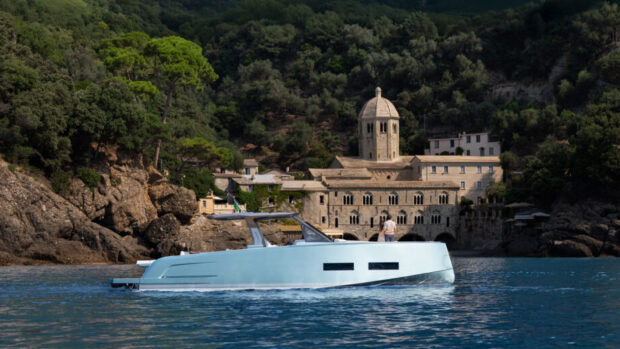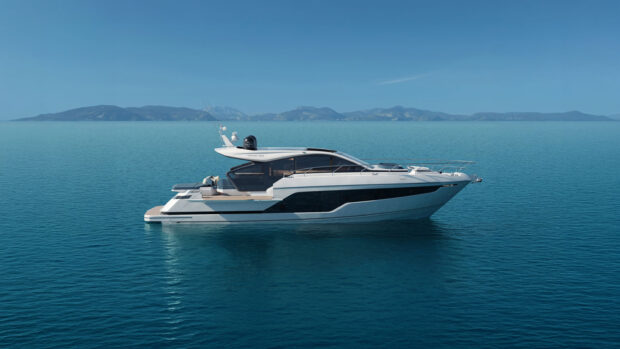


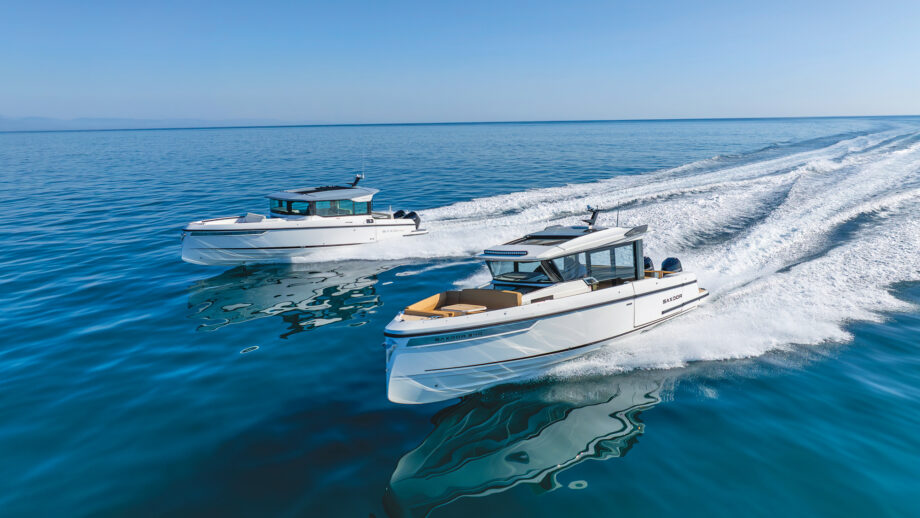
Can you pick a winner? The best-selling 320 GTC takes on the award-winning 340 GTWA. Alex Smith reports on why the 340 stole his heart
When it was introduced in 2022, the Saxdor 320 GTC became an overnight success for Saxdor and it’s easy to see why. With its full-beam pilothouse, comfortable bow cabin, sociable aft cockpit, excellent driving dynamics and realistic pricing, it’s a very tough boat not to like.
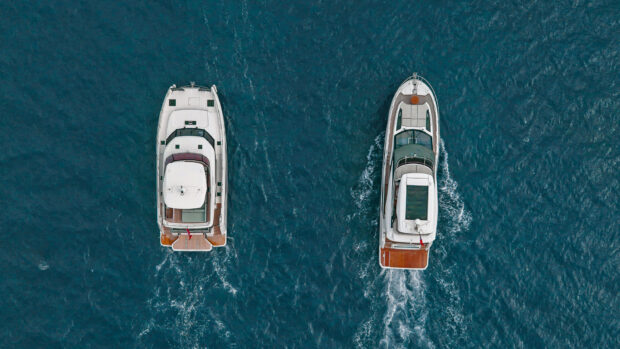
But when, just two years later, Saxdor unveiled the Saxdor 340 GTWA, it looked like the new boat would create direct competition for Saxdor’s own best-seller. After all, this was a pilothouse-equipped day cruiser with the same twin-stepped deep-V hull, comparable styling and just 1ft 7in of extra length. Even the price difference was a matter of degree rather than sector. But the new 340 was actually designed to straddle the space between the open GTO models and the full-beam GTC pilothouse platforms, so when you put them side by side, the differences quickly become clear.
Outdoor day spaces
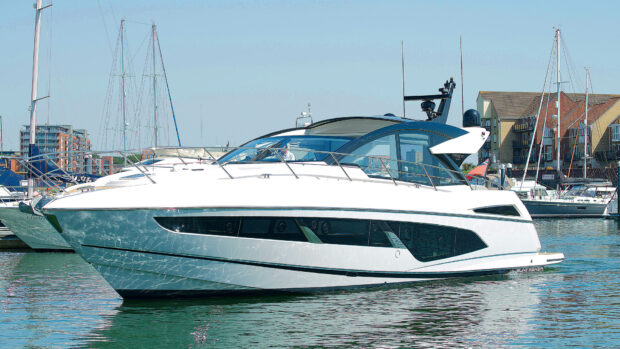
One of the key differences is, of course, the deck layout. The 320’s full-beam wheelhouse means that the bow space and aft cockpit are separated by the superstructure itself. There are narrow, raised side decks to go between one and the other (and that’s easier and more secure than you might imagine), but it’s much simpler to use the sheltered walkway, directly through the internal saloon from the aft cockpit’s sliding doors to a second hinged door in the port side of the vertical windscreen. But there’s a clear contrast in the way these two zones operate, as well as the way they’re reached…
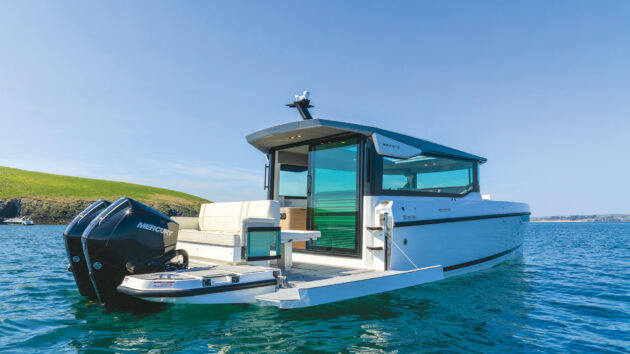
The full-beam wheelhouse expands space but restricts movement
As the 320’s primary outdoor space, the aft cockpit uses a broad transom bench with glass gates on either side. A transverse table drops down to create a sunbed and the backrests can be individually repositioned to face aft over the water. You can also expand the cockpit on both sides, thanks to a pair of 2.1m drop-down terraces as standard; and that broad open space is made to feel all the broader because the cooking facilities are located indoors on the port side of the wheelhouse, through the aft patio doors.
As for the bow space, that adopts a relatively simplistic layout, with a raised island sunbed for two, framed by practical walkaround decks for easy access to the anchor and step-through forepeak.
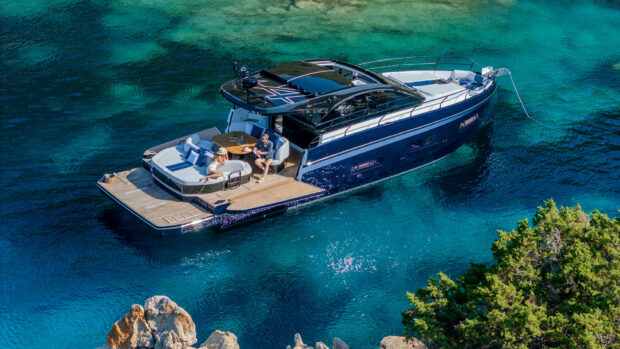
By way of contrast, the 340 GTWA uses a walkaround (WA) configuration with a narrower pilothouse orbited by a set of peripheral side decks – and in order to factor in the option of an aft cabin (something the 320 lacks) it pretty much reverses the roles of the forward and aft decks. In place of a bench seat, the aft cockpit uses a very attractive glass balustrade at the transom with opening gates on both sides.
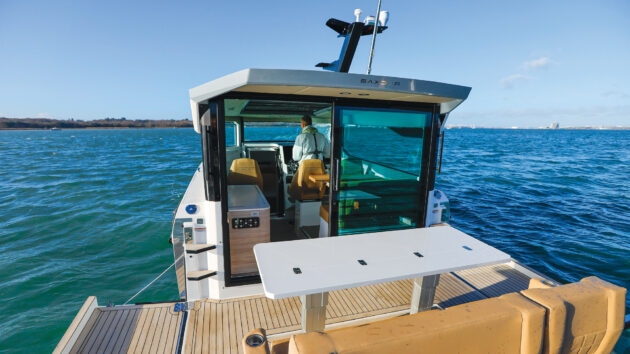
Saxdor 320: The cockpit has space for freestanding chairs
That’s bookended by thickset bulwarks containing fender storage, shore power, a transom shower and a beautifully designed wet bar with sink and optional grill. Instead of seating, the 340 features a big raised sun bed with a comfy lumbar-equipped backrest built into the aft end of the superstructure to provide the basis for that optional aft cabin.
Pilothouse access
Pilothouse access provides another interesting contrast. The 340’s cockpit layout puts the aft bulkhead out of action but our test boat does come with the optional slide-down glazing panel to open things up above the backrests. Crucially, you also get big sliding doors in the sides of the pilothouse, which can be opened up either forward or aft – and that’s particularly welcome because of the nature of the 340’s drop-down terraces.
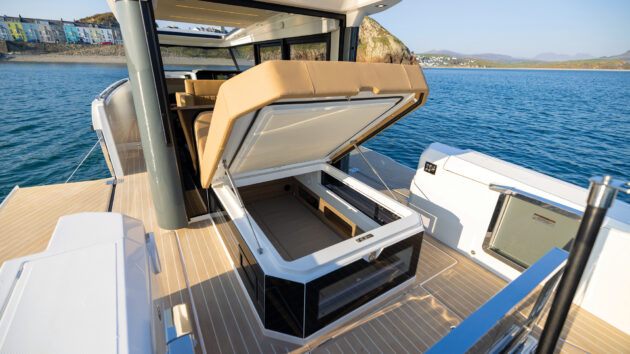
Saxdor 340: A bright, spacious aft cabin is a superb option
These terraces are slightly longer than on the 320 and located further forward, straddling the space between cockpit and pilothouse, which means they open up the internal saloon as well as the aft deck. You could of course argue that the 340’s aft cockpit lacks the sociability of the 320’s seating zone but it makes up for that with its easy-access bow lounge. Spec the 340 with the test boat’s optional C-shaped dining station and there’s space for six, plus a drop-down table so you can turn the bow deck into a large sun pad.
Wheelhouse and cabins
The 320’s full-beam pilothouse comprises three basic parts – a galley, a dining zone and a set of helm seats. Being inside, the internal portside galley is larger than the wet bar provided by the 340. It comes with a sink and either a diesel or induction hob and there’s also a fridge beneath the port co-pilot seat to help free up some handy extra storage inside the galley cabinets.
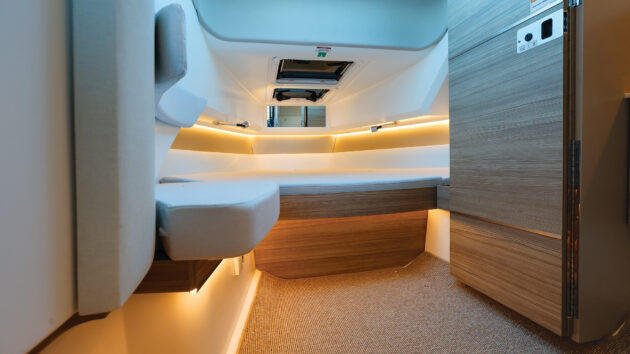
The 320’s cabin gets a little extra headroom from the bow’s island sunbed
On the opposite side is a simple two-man aft bench and a transverse table; and ahead of that are three forward seats – two helm seats to starboard and a third co-pilot seat on the port side. The two helm seats rotate to face aft so they can integrate with the starboard dinette and, in spite of its modest-looking proportions, that dinette converts into an occasional double berth to help supplement the bow cabin.
How practical it is, though, is open to question. After all, it sits across from the galley and there are obviously no side doors in the full-beam wheelhouse, so if you do have guests, then when you want to exit the bow cabin in the morning and make breakfast, you have no option but to invade the space occupied by that second bed.
As for the 340, its pilothouse is, of course, narrower but the fact that the cooking facilities are outside means all of that internal space is available for seating – and it has to be said, the seating feels significantly more sophisticated than on the 320. There’s a full-beam three-to-four-man bench seat aft, and our test boat has the optional helm bench rather than the standard individual seat pods. This means you can reverse the backrest, drop the port side bolster and expand it to seat three more people, facing aft across the expandable drop-down table, potentially increasing dining capacity to seven.
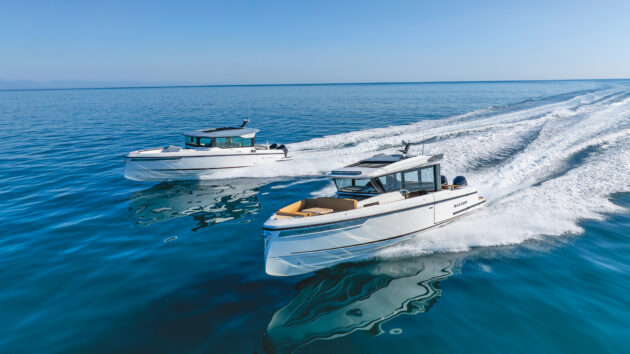
Both boats use the same twinstepped full form
Contrasting accommodation
If the 340 confounds expectations by trumping the 320’s beamier wheelhouse, the bow cabins are much more similar in terms of footprint, volume and layout. Both get a port changing seat, a forward double bed and an open-plan starboard heads that you can shut away behind hinged concertina bulkheads. But the 320 gets slightly more headroom from the raised island sunbed at the bow and the 340 gets a little extra length and a little more natural light, thanks to larger overhead skylights and a port window.
In terms of accommodation though, the really key difference is the provision of an optional aft cabin on the 340. Accessed through the port side of the pilothouse’s aft bench or through the sunbed hatch in the aft cockpit itself, it’s a really effective space. It comes with long deep windows on three sides and surprisingly good views aft through the cockpit’s glass balustrade. And remarkably, there’s even space for two people to sit up in bed with a good book.
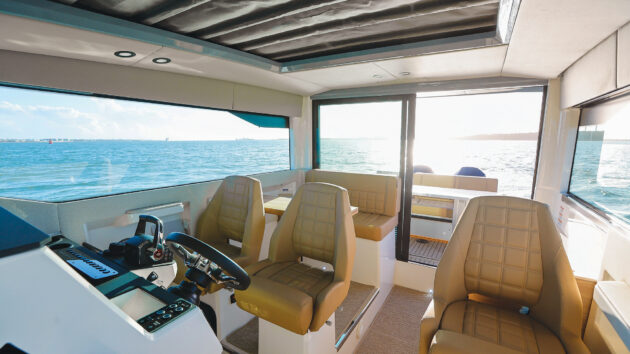
The walkway actually means less internal seating than on the 340
But it would be even better if you were to cut down the aft end of the cabin to create an integrated aft-facing bench in the cockpit’s sunbed moulding. That would of course limit headroom but only at the foot of the bed where it’s not actually needed. You would still have a window looking out across the aft deck and, if you added a table at the stern, you would then have the best of all things – an aft cabin, a raised cockpit sunbed and a transom dining zone with lovely views.
Better still, it would also buy you a dedicated outdoor seating zone capable of offering that bit more shelter from the elements than the bow lounge. In truth, it’s already an excellent layout but with an upgrade like that, the 340’s deck arrangement would be pretty much flawless.
On-water performance
We’ve known for a long while now what a good performer the 320 GTC is. Its twin-stepped hull, with its fine entry and fairly acute 21-degree deadrise, is a genuine pleasure to drive and with the uprated 225hp V6s on the transom, the figures look good too. We’re seeing a remarkably flat transition from zero to the plane in about five seconds and zero to 40 knots in 17 seconds, before pushing on to a top end of around 43 knots. We’re also seeing a very manageable fuel flow rate of around 2.3 litres per mile at everything from 20 to 30 knots for a range in the region of 150 miles.
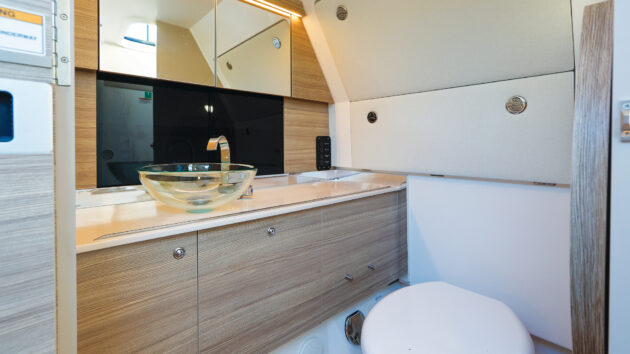
The heads uses hinged walls to keep the space open when not in use
But in spite of its extra length and weight, the larger 340, with its twin 300hp V8s, trumps that by a hefty margin. An equally flat plane is achieved in just three seconds; zero to 40 takes just ten seconds; and our top end is just a whisker shy of 50 knots. Interestingly, you feel the larger boat trying to plane from as little as ten knots and that eagerness for pace continues higher up the rev range.
From 22 to 32 knots, we’re seeing remarkably similar fuel flow figures of 2.4 litres per mile for a range of around 160 miles, but with a cruising band that is just that bit more forgiving (and a fast cruise that is markedly more efficient than the 320), you can pick any pace from 20 to 40 knots and enjoy genuinely good returns.
It is worth noting that you could equip the smaller boat with the same 300hp V8s that bring such impressive results on the 340, so if 50 knots or more is what you want, it will certainly achieve it. But as the performance discrepancy disappears, so too will most of the price differential, and 43 knots already feels like a good place for the 320 – all of which brings us very neatly to the driving experience…
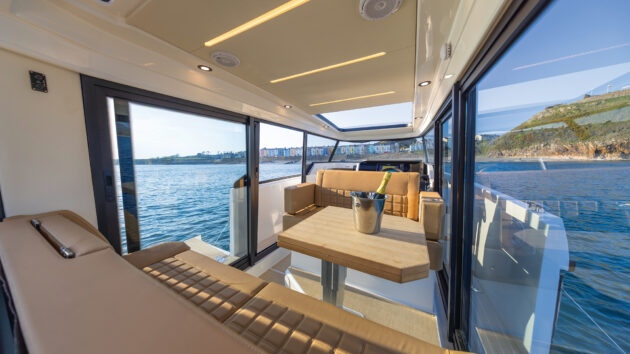
The big side doors can open up the forward or aft part of the structure
The driving experience
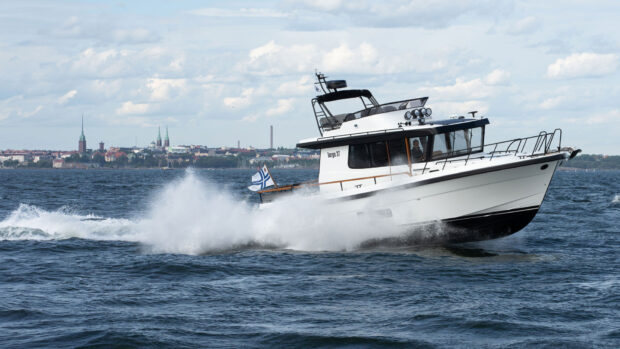
These boats use the same hull form so both enjoy good softness and reasonable dryness, which is not something you would necessarily expect from that slender, steep-sided bow shape. But there is a difference in the way the two boats feel. While the 320 behaves like a proper playtime boat, full of quick-witted agility and lively helm response, the 340 brings more in the way of maturity and composure.
The extra power and increased waterline length (as well as the subtle weight increase and windage reduction) seem to result in a drive that’s just a bit more composed and refined, as well as significantly more potent. It is, in truth, a matter of increments rather than outright nature, but it’s very discernible nonetheless.
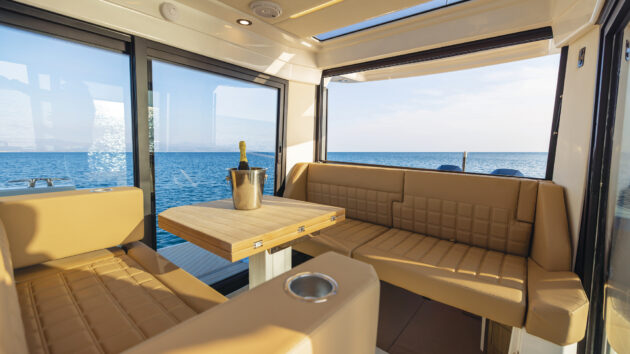
The helm bench extends to seat up to seven at the full-width dinette
These boats are both quite quiet and comfortable for relaxed passagemaking but the 340 has the edge there too, returning figures throughout the cruising band that are 1-2dB(A) lower than the V6-powered 320. Whether that’s down to the extra drag or the extra reverberation of the 320’s beamier, more voluminous pilothouse, we’re not sure but again, it is discernible – and so too is the difference in the helm station.
Given that the 320’s full-beam (side-door-free) pilothouse slightly ‘contains’ the skipper, the opening side window looks like a very worthwhile option. The fact that the driver sits on the inboard (more central) of the two starboard seats also means that the co-pilot can get a bit trapped – and the contrast there with the wide-open pilothouse of the 340 couldn’t be greater.
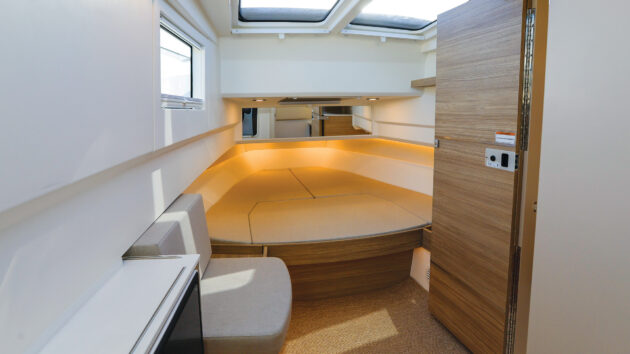
The 340 cabin gets a little extra length and some extra natural light
With its big versatile side doors, its reverse screen, its superior visibility and the helm bench’s capacity to fold out into the starboard side deck for comfortable joystick manoeuvres, the 340’s helm position is absolutely first-class. Our only concern relates to the digital tabs, which you have to access via the MFD.
That makes no sense at all if you want to do anything more than leave them on automatic, so we’d give those a miss in favour of a more natural and intuitive manual switch that enables you to access and operate them rapidly while keeping your eyes on the water.
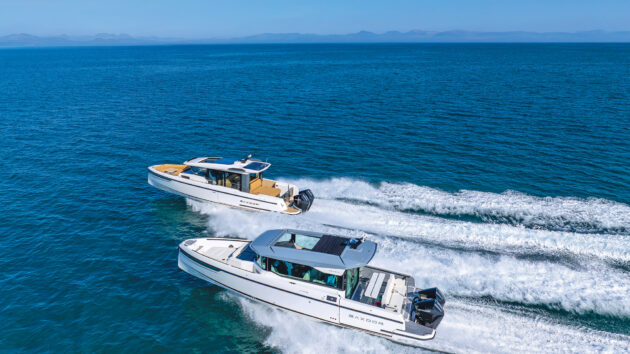
While the 320 feels very lively and engaging, the 340 feels more composed and refined, with extra pace, a faster cruise and comparable efficiency
Which boat wins?
The 340 provides easier on-board movement, an extra cabin and a very satisfying extra dose of pace and power. It also dials in an extra degree of maturity and composure in the ride and handling while all but matching the 320 in terms of cruising efficiency. With its narrower wheelhouse structure, reverse screen and extra length, the 340 is also a marginally more dynamic-looking platform than the slightly shorter, tubbier 320.
With its revised terrace positioning, it also does a better job of integrating the internal saloon with the external decks. And it does all of that at a price that only exceeds the 320 by 7% in base form and 11% in test boat form.
So is there really a case for denying the 340 outright victory? Well, arguably, yes, but realistically, no. Good though the 320 is – and it really is as good as its sales success suggests – we reckon that if you can stomach the extra cost, the 340 GTWA is the better boat.
Saxdor 320 GTC specification
LOA: 33ft 9in (10.28m)
BEAM: 10ft 2in (3.1m)
DRAFT: 1ft 10in (0.57m)
DISPLACEMENT: 2,600kg (dry)
FUEL CAPACITY: 428 litres
WATER CAPACITY: 117 litres
RCD: B6 / C9
ENGINES: Twin 200-300hp outboards
Costs and options
Price: From £180,830 inc VAT. Test boat includes the following options…
Mercury 225hp V6 upgrade: £4,192
Storm Grey Hull Colour: £3,144
Toilet & fresh water package: £4,716
Shore power system: £3,563
Trim tabs: £4,087
Bow thruster: £2,830
Saxdor 340 GTWA specification
LOA: 35ft 4in (10.78m)
BEAM: 10ft 2in (3.10m)
DRAFT: 2ft 7in (0.8m)
DISPLACEMENT: 2,650kg (light)
FUEL CAPACITY: 480L
WATER CAPACITY: 100L
RCD: B8 / C10
ENGINES: Twin 250-300hp outboards
Costs and options
Price: from £194,406 inc VAT. Test boat includes the following options…
Mercury 300hp V8 upgrade: £10,480
Joystick control: £18,865
Electric sunroof: £5,031
Shore power system: £3,563
Trim tabs: £2,830
Bow thruster: £4,087
Aft cabin package: £5,659
Aft barbecue: £2,306
Drop-down aft window: £3,039
 If you enjoyed this….
 If you enjoyed this….
Motor Boat & Yachting is the world’s leading magazine for Motoryacht enthusiasts. Every month we have inspirational adventures and practical features to help you realise your sailing dreams, as well as tests and news of all the latest motorboats.
Plus you’ll get our quarterly Custom Yachting supplement where we share the last on offer in the superyacht world and at the luxury end of the market.
Build your knowledge with a subscription delivered to your door. See our latest offers and save at least 30% off the cover price.
Note: We may earn a commission when you buy through links on our site, at no extra cost to you. This doesn’t affect our editorial independence.