

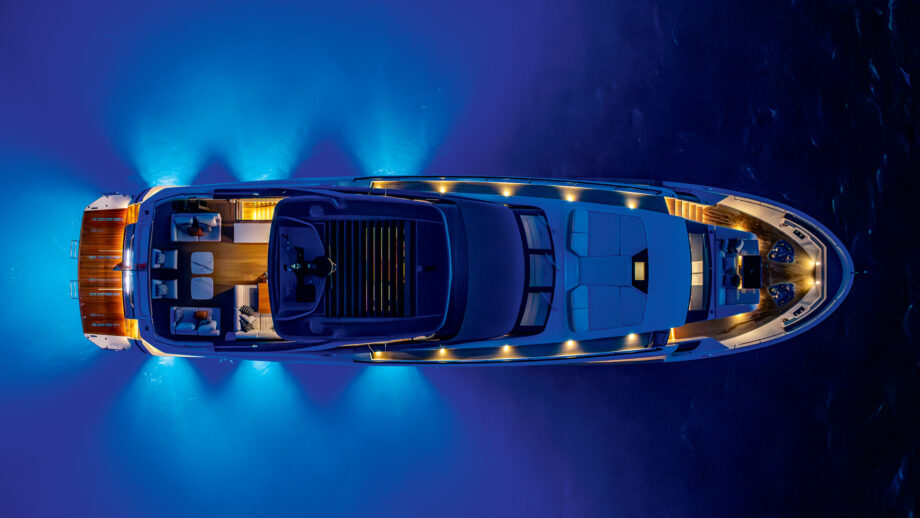
Sea trials of custom-built boats are often short-lived affairs, so when the owner of a Sanlorenzo SL96A asked editor Hugo along for blast across the Channel, he jumped at the chance
Big boats are expensive things to run. Every hour at sea costs money for the fuel, crew and engine time. So perhaps it’s no surprise that most media sea trials of 80-100ft craft tend to be fairly brief affairs lasting an hour or two at most.
There is only so much you can learn in that time, especially when there are a dozen other journalists fighting for their time at the helm. But every now and then we get the chance to do something altogether more involved, a proper sea passage that really shows you what a boat is capable of. This is one of them and it’s all thanks to MBY reader and contributor John Wolf, who kindly invited me to accompany him on a cross-Channel passage aboard his Sanlorenzo SL96A, Match.
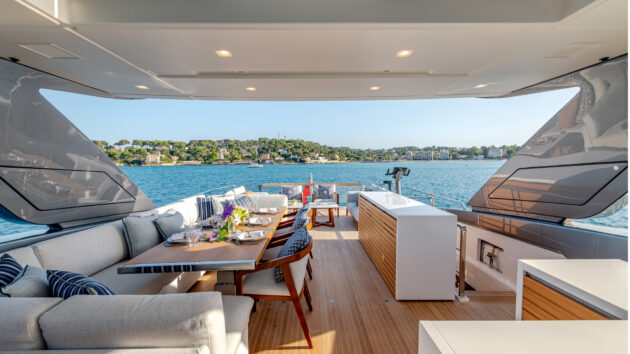
The first mate takes care of lines and fenders so John can focus on manoeuvring in or out of the berth
Captain and crew
We meet at Swanwick Marina on the Hamble where John and his crew are fueling up and preparing the boat for the 120nm passage. I say crew but in truth it’s just a solitary first mate for this trip as John captains the boat himself. He’s also the navigator, chief engineer, purser, build manager and part-time designer.
Having owned multiple boats prior to this one, he knew exactly what he wanted and spent hundreds of hours specifying every last element of Match, from the exact slab of marble used in the bathrooms to the size of the Sleipner curved fin stabilisers and the number of 22in Garmin MFDs on the bridge (five). Needless to say he is something of a perfectionist, albeit a very modest, generous and surprisingly relaxed one. Good job too, given what it costs to
top up those 10,350-litre tanks!
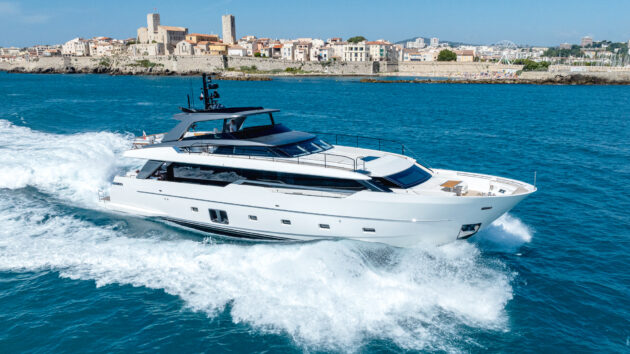
Match makes light work of any swell, pushing the waves aside
While the fuel pump is doing its stuff, I take the time to refresh my memory of the SL96A. As with all SL models it has a full planing hull and although its LOA is a whisker under 96ft it still complies with the sub 24M LLL ruling. The A in the name refers to its asymmetric layout, so instead of walkaround decks on both sides, it has a conventional side deck to starboard but to port this has been lifted to flybridge level so the main deck superstructure can be extended all the way out to the gunwales.
This creates more room inside for the saloon and the owner’s cabin at the expense of having to hang some portside fenders from the flybridge. This isn’t as onerous as it sounds, as the raised side deck also slopes down to the bow. As well as enabling crew to ferry fenders to and from the bow locker, this also allows guests to flow between the flybridge and foredeck lounge via the elevated forward sunpads.
While Sanlorenzo’s SX models have expansive beach clubs with folding balconies and multiple tiers, the SL range is more traditional. It still has a sizable hydraulic platform with a plug-in shower stand and a garage large enough to store a Williams 435 Sportjet and a couple of Seabobs, but there are no folding terraces to extend the deck space. Instead there’s a more conventional raised aft cockpit protected by a long flybridge overhang and relatively tall bulwarks.
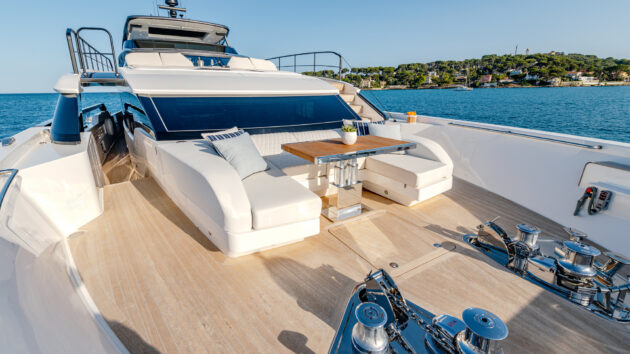
The asymmetric design only has a lower side deck to starboard. On the port side it’s at fl ybridge level
This trades some of the “connection with the sea”, which the SX and others like to boast about, for the extra shelter and security of a deep, safe, shaded cockpit. This is backed up by some of the best quality mouldings, stainless steel fittings and teak decking you will find on any boat this size. Even the two hi-lo tables look like they could support a bronze statue instead of the usual place settings.
Comfort and joy
The benefits of that asymmetric layout really make themselves felt when you step inside the sliding glass doors. Instead of the usual long thin corridor of a saloon with seating at one end and a dining area at the other, it’s noticeably wider, with room for a dining table along the port side and sofas to starboard.
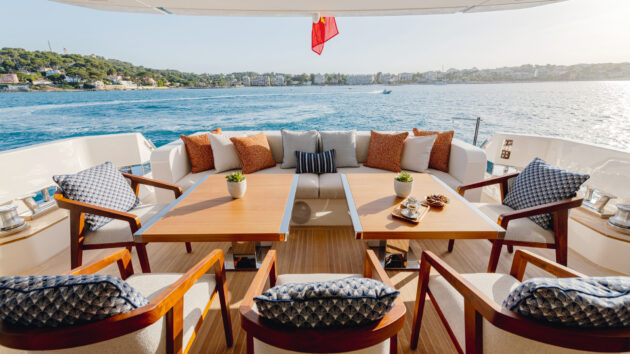
The sheltered cockpit feels very secure
To make the most of the views through the floor-to-ceiling windows here, a long section of the port bulwark lowers electronically. As there is no side deck to protect, Sanlorenzo could have simply cut down this section of the bulwark but a drop-down solution enables it to preserve the aesthetics of a continuous sheerline – respect! The other nice touch is the way the designer has encased the flybridge stairs in glass, using ‘floating’ teak steps to make a feature out of them while allowing more light into the saloon.
The combined lounge and dining area also frees up space forward for a magnificent main deck owner’s suite. This is separated from the saloon by a corridor with a day head to port and the galley to starboard. The forward bulkhead of the saloon is fitted with a custom “Mondrian” mirror that doubles as a television.
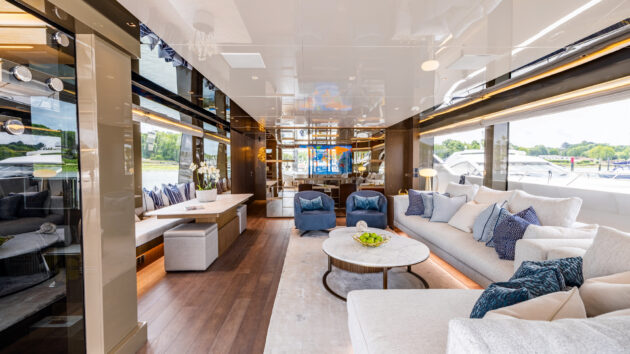
The lack of a port side deck means the saloon is wider than most with room for a lounge and dining table in the same area
As well as the enhanced space, privacy and views, this location of the owner’s cabin allows, it’s also a much quieter spot. Even at 20 knots the engines are barely audible, let alone the generators, wave slap, hull gurgles and stabiliser noises which often affect lower deck master cabins. Our only slight disappointment is that the views aren’t as good as they could be due to the height of the windows and orientation of the bed.
Personally, we’d prefer to have the bed facing forwards to enjoy the view through the sloping front windows rather than the large bulkhead television it currently enjoys. This is something you can easily request, such is the level of customisation offered by Sanlorenzo. We love the mezzanine-level dressing room/wardrobe in the forepeak – it’s a far better use of this space than a bathroom, which would involve negotiating steps in the middle of the night.
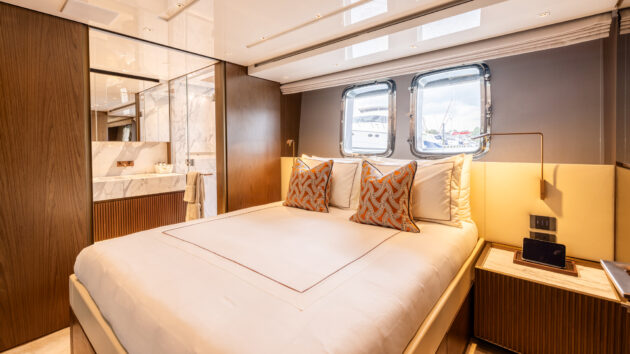
One of the four ensuite cabins on the lower deck
Moving to the lower deck, there’s not a lot to comment on other than the fact that all four of the cabins are comfortable, well proportioned and have their own stylish ensuite bathrooms. The windows aren’t huge but being a Sanlorenzo they are heavy-duty stainless steel ports rather than moulded-in hull windows. Not only is this a stronger, more robust solution but they look magnificent and can be opened for extra ventilation.
The decor is restrained but tasteful and the important stuff like bed sizes, mattress thickness, headroom, sound insulation and the quality of the artificial lighting is all a cut above the norm. The crew cabins are too. John knows that a happy crew means a happy boat so he specified Match with three separate crew cabins in the bow, all with their own bathrooms. Accessed through the galley, well away from the noise and heat of the engines, they are unusually comfortable, quiet and private for this size of boat.
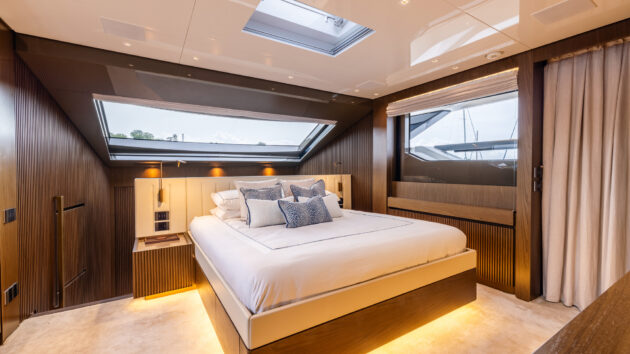
The main deck owner’s cabin enjoys exceptional space, light, quiet and privacy
Channel crossing
Tanks brimmed and loose items safely stowed, John runs through the usual departure routine. All the boat’s systems are linked to those five MFDs so at the touch of a button he can check all the ports are closed, which lights are on, what the tank levels are and the state of the batteries. A boat of this size has so many electrical systems that at least one of the two 45kVA Kohler generators has to be running whenever it’s on passage so he fires one up first before the main engines burble into life.
As standard, these are 2,200hp apiece but John has specced the most powerful 2,400hp versions. Even at idle, these kick out so much power that manoeuvring out of the marina requires a delicate touch, with short clicks on alternate throttles interspersed with plenty of neutral and occasional bursts of the hydraulic bow and stern thrusters, each of which packs more power than the diesel engine in my 22ft motor launch!
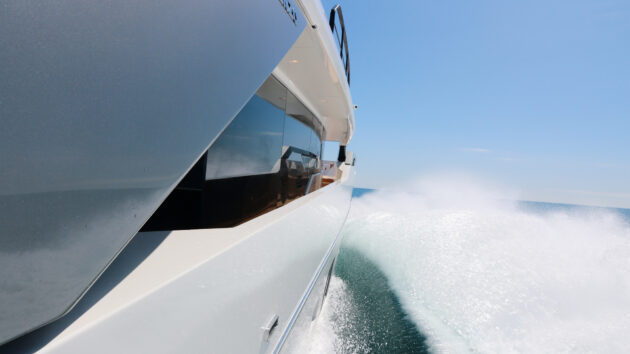
Thundering across the Channel at a steady 20 knots
Once out into the open water of the Solent, John eases open the throttles until we’re running at 22 knots. Safely ensconced in the raised pilothouse, it barely feels any different to displacement speed. Heading west towards the Needles, the wind and tide start to stir up a typically messy Solent chop. The SL96A simply brushes it aside, sending sheets of spray fanning out from the flared bow.
Strolling around the main and lower deck reveals it to be just as solid and stable as it is in the pilothouse. It’s a little noisier at the aft end of the saloon and in the rearmost cabins but not once do I lose my footing or search in vain for a handhold.
The oversized Sleipner curved fin stabilisers might be helping a bit but at this speed it’s largely the dynamic stability of the planing hull and the sheer might of its 110-tonne displacement flattening all before it. There must be a tiny amount of hull flex, there always is on a GRP boat, but other than the occasional squeak from the deckhead panels there is no evidence of it. It’s only when I step outside and feel the apparent breeze tugging at what’s left of my hair and see the boiling mass of white water being flung out from the propellers that I get a sense of the forces at work as the Needles fade into the distance behind us.
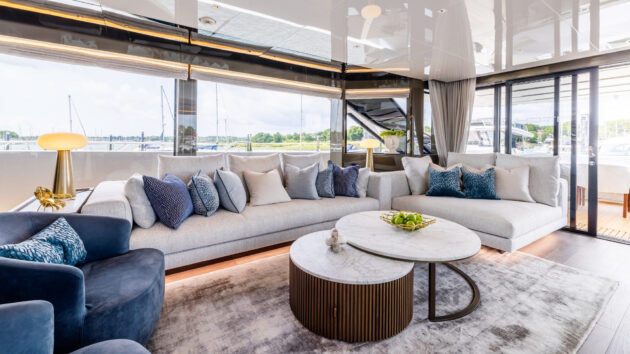
The lack of a port side deck means the saloon is wider than most with room for a lounge and dining table in the same area
Retreating back to the warm pilothouse, I sit and watch the miles roll effortlessly by. The shallow, heavily raked windscreens and chunky mullions do compromise visibility to some degree but that is largely offset by the multitude of MFDs allowing you to keep an eye on the radar, chartplotter and engine data.
Number crunching
Once we’ve crossed the shipping channels, I ask John if I can take the wheel and put Match through her paces. Switching back from autopilot to manual, we move up to the flybridge helm for a better impression of what it feels like to helm such a big beast.
With the canopy covers on and all the free-standing furniture piled into the enclosed area under the hard top, it’s a far cry from the glorious photographs of Match in her usual Mediterranean setting but it demonstrates how versatile this space can be.
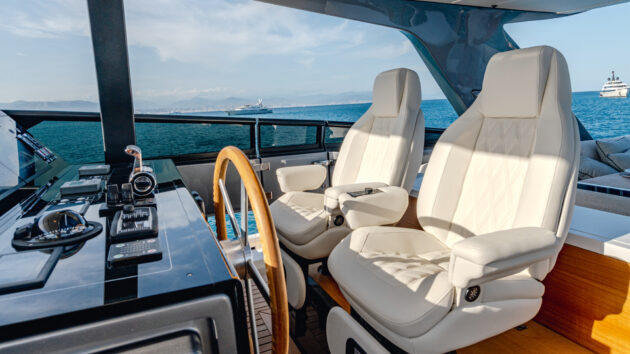
Hard top louvres rotate to vary light and shade over the fl ybridge helm
Settled into one of the two multi-adjustable Besenzoni captain’s chairs, I ease the throttle forwards to see how those mighty MTUs respond. It takes a second for them to overcome the inertia of 110 tonnes lying dead in the water but once the big props bite the hull slips along very cleanly.
Adding more throttle sees the bow lift ever so slightly as the turbos kick in, but the transition from displacement to planing is so subtle as to be almost indistinguishable. The fuel burn backs up this impression with no obvious hump and an almost linear progression between speed and consumption; at 15 knots it’s returning 24lpm, at 20 knots that rises to 28lpm and flat out at 28 knots it’s 34lpm. You pays your money and takes your choice.
More surprising is how it responds to steering inputs. The ship’s wheel is devoid of feedback, spinning from lock to lock without resistance. That’s because the steering is electric, with the wheel turning a rotary encoder that sends canbus signals to the rudder actuators. Despite this, the rudders and hull are responsive.
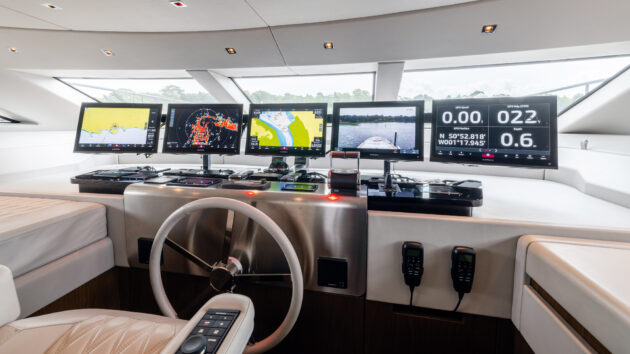
The view forward is better than it looks although the raked screens and thick mullions do limit it
Assisted by those curved fin stabilisers, it heels into the turn naturally and completes a 180-degree turn in short order. You’re never going to chuck it about for fun but it’s reassuring to know you can make a full speed turn without any misbehaviour.
Sanlorenzo SL96A specifications
LOA: 95ft 4in (29.06m)
BEAM: 22ft 2in (6.76m)
DRAFT: 6ft 3in (1.9m)
DISPLACEMENT: 110 tonnes
FUEL CAPACITY: 10,350 litres
WATER CAPACITY: 1,500 litres
STARTING PRICE: €10.1m ex VAT
 If you enjoyed this….
 If you enjoyed this….
Motor Boat & Yachting is the world’s leading magazine for Motoryacht enthusiasts. Every month we have inspirational adventures and practical features to help you realise your sailing dreams, as well as tests and news of all the latest motorboats.
Plus you’ll get our quarterly Custom Yachting supplement where we share the last on offer in the superyacht world and at the luxury end of the market.
Build your knowledge with a subscription delivered to your door. See our latest offers and save at least 30% off the cover price.
Note: We may earn a commission when you buy through links on our site, at no extra cost to you. This doesn’t affect our editorial independence.
Verdict
Point proved, we ease the speed back to a 20-knot canter and head for Jersey. Less than an hour later we’re easing into St Helier harbour. Fenders out, lines at the ready, John drops down to the aft cockpit for the final part of the docking manoeuvre. Instead of a third fixed set of throttles and thruster controls, he’s opted for a plug-in remote control so he can move around and keep an eye on things. In almost six hours we have covered just over 120nm, despatching a wide range of different sea conditions without having to adjust our speed or heading one iota. Sure, we have burnt some fuel doing so but with a flight to catch later that afternoon time was not on our side. On another day we could have taken things slower and revelled in the amenities she has to offer but that’s the beauty of owning a big planing motoryacht, it gives you the option to take it fast or slow as your mood or conditions dictate. And in the case of the SL96A that barely seems to incur any compromises. No wonder John is already eyeing up another larger SL model!