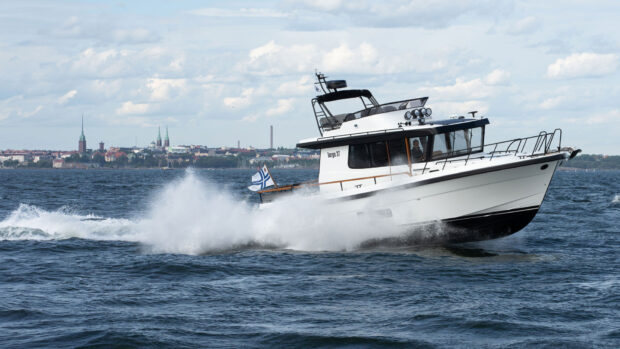


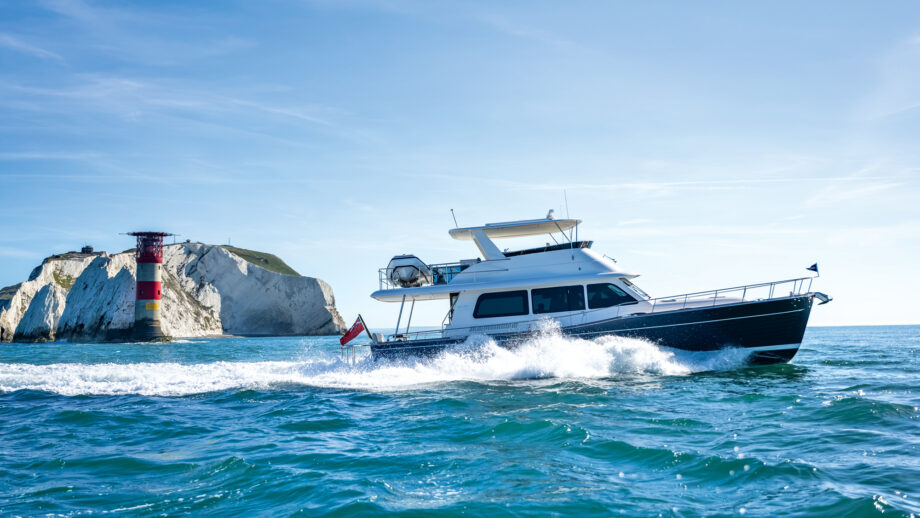
The entry-level Grand Banks flybridge may look quite traditional but its high-tech hull design and construction means it behaves very differently, as we found out on its first UK test
Few motor boats carry the weight of expectation that a Grand Banks does. While no one company can claim to have invented the trawler yacht, Grand Banks certainly helped define it, selling over 1,100 examples of its original GB36 and building a peerless reputation over the ensuing years for solid, seaworthy, liveaboard cruising yachts.
Its early models were all slow displacement craft. With the advent of powerful diesel engines, Grand Banks switched to heavily built semi-displacement hulls that could push through lumpy seas more quickly, albeit at the cost of a hefty fuel bill.
That all changed in 2014 when former ocean racer Mark Richards took the helm at Grand Banks.
Rather than relying on weight and power to deliver the famous Grand Banks cruising experience, he opted for a more high-tech approach. Out went the heavy semi-planing hulls and in came a new generation of lighter, nimbler designs using Grand Banks’ new V-Warp technology.
More a design philosophy than an innovation, this combines a slippery variable vee hull design with a light but stiff carbon reinforced construction process and careful weight distribution to deliver an unusually fast, efficient, well-balanced craft. First introduced on the Grand Banks 60 in 2017 and subsequently rolled out across the range, it now features on everything from the flagship Grand Banks 85 to this boat, the entry-level 54.
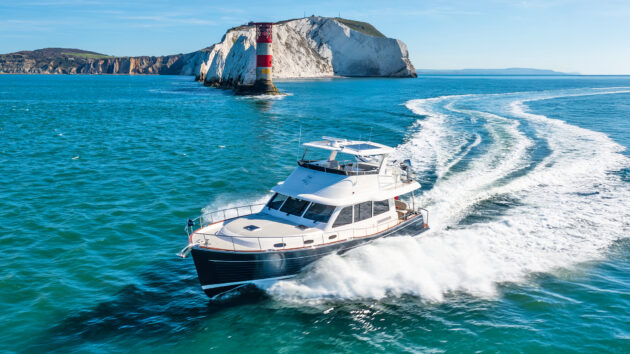
New V-Warp hull design and carbon fibre reinforced build make for a surprisingly fast, agile and fuel efficient ride
Launched at the Cannes boat show in 2021, the 54 is available in both Sedan and Flybridge guises and finally arrived on these shores at last year’s Southampton boat show. We took advantage of its presence to carry out the first full sea trial of a new generation Grand Banks in UK waters. The question we wanted to answer was whether in the quest for speed and fuel efficiency, it had lost any of the magic that made its predecessors so special.
Quality street
Stepping aboard for the first time, it certainly looks and feels like a traditional Grand Banks. That long swooping sheerline (its 58ft from stem to stern) may be a little lower and leaner than the previous Grand Banks 53 Aleutian, and the pronounced tumblehome stern adds a dash of Downeast glamour but all the usual styling cues from the ‘plank-effect’ topsides to the lacquered teak transom are present and correct.
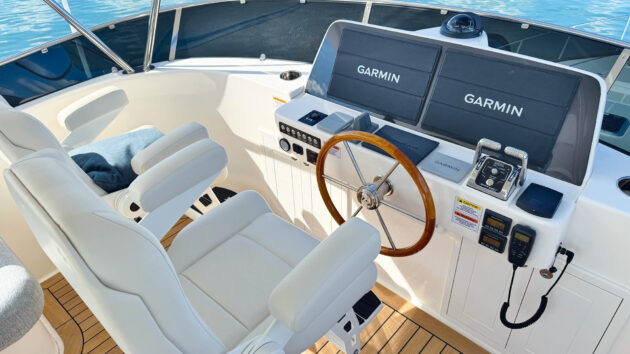
Multi-adjustable Stidd seats are just as comfortable and supportive as they look
However, not everything is quite as it seems; clearly the topsides haven’t been made of wood since the mid 1970s but who knew that the transom and cap rails are also composite mouldings painted to resemble high gloss teak, complete with hyper-realistic graining and artificial joins? It looks utterly convincing and costs a small fortune but unlike the real deal requires no maintenance other than the occasional polish.
It’s certainly not a supply issue as the rest of the boat is awash with real teak, all of which looks as solid and beautifully finished as any we’ve seen on a modern production boat. You only have to look at the size and thickness of the steps up to the flybridge or the depth of lacquering and intricate GB inlays on the table tops to appreciate that no expense has been spared in either the sourcing of materials or workmanship.
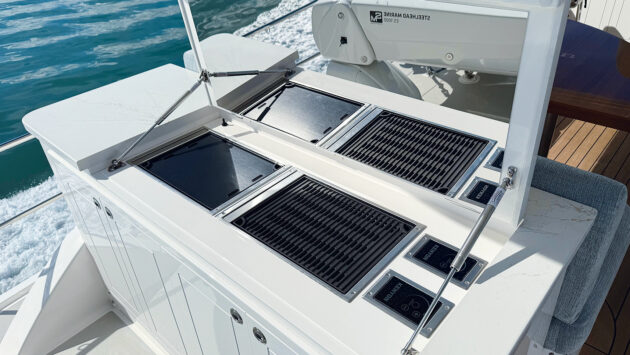
Flybridge catering duties are split between this cooking unit and a drinks wetbar further forward
It’s the same story with the stainless-steel work; the guardrails are thicker and sturdier than most rivals’, the cleats and fairleads wouldn’t look out of place on a 100-footer, and every weld has been ground out and polished to perfection. Even the GRP mouldings seem uncommonly chunky, while every hinge, latch, handle and gas strut has been deliberately over-specified to ensure they open and close with a reassuring thunk.
Article continues below…
Absolute Navetta 62 review: Trawler functionality meets modern Italian flybridge style
Best Flybridge Motor Yachts 2025: Tested
Weighing in
The Grand Banks 54 may be 30 per cent lighter than the old Grand Banks 53 but you’d never know it from the way it looks and feels at rest. It’s a clever trick because much as we appreciate the performance and fuel efficiency benefits of a lighter build, we still like that hewn-from-granite feel Grand Banks is famous for.
We’re also pleased to see that Grand Banks hasn’t sacrificed any of its usual seamanlike qualities. The side decks are wide and well protected with opening gates and guardrails on both sides, the foredeck is long, safe and blessed with a large, compartmentalised anchor locker.
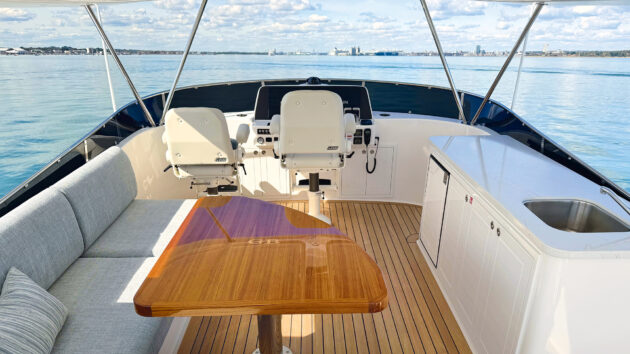
Not the largest of flybridges but the quality of the helm seats, GRP mouldings, stainless steel and woodwork is outstanding
Both the above come at the expense of a slightly narrower saloon and fewer on-deck amenities than you’d find on a typical 58-footer, but we suspect that’s a sacrifice most Grand Banks owners are willing to make. Who needs folding platforms, convertible foredeck lounges and waterside beach clubs if it risks compromising its core cruising credentials? Even the lack of a hydraulic bathing platform – the tender has to be lifted and stored on the flybridge – will be seen as a blessing in disguise by anyone who’s battled with a faulty closing mechanism.
In practice, the deck spaces more than hold their own. The aft cockpit is a wonderfully secure space sheltered by a full length cockpit overhang and served by a pair of wetbars on either side of the central door. Unlike most flybridge yachts of this size, it’s a single side-hinged teak-framed door rather than the usual stackable sliding glass option, so although it doesn’t create as large an opening, it’s quicker and easier to open and shut. Besides, the two teak framed windows on either side of it drop down in unison at the touch of a button when you want to open things up.
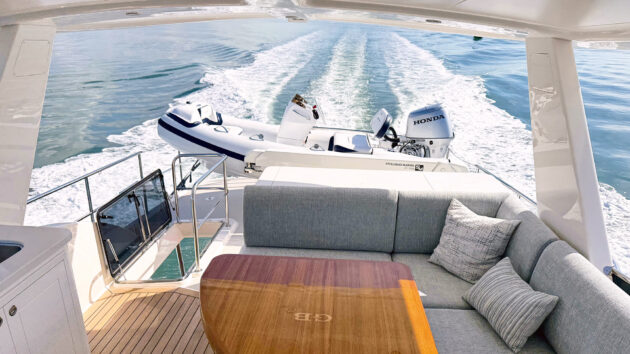
The tender has to be lifted on and off the flybridge using a crane but arguably that’s a more reliable solution than a hydraulic platform
The flybridge isn’t as expansive as some, largely due to the space given over to tender storage, but the lack of sunloungers and relatively compact dining area are more than made up for by the quality of fixtures and fittings. Twin fully adjustable
Stidd helm seats, two marble-topped wetbars, a stunning GB-inlaid teak table and a typically robust optional hard top put the emphasis on comfort and quality rather than size.
Warm welcome
The same philosophy applies to the interior. While not as voluminous as some trawler yachts, the main deck saloon is a lovely place to spend time. That’s partly down to the welcoming embrace of all that golden teak and partly to the sociable, step-free layout. With the helm, galley, dining and lounging areas all on one level, it’s easy for people of all ages to move around and socialise underway and at rest.
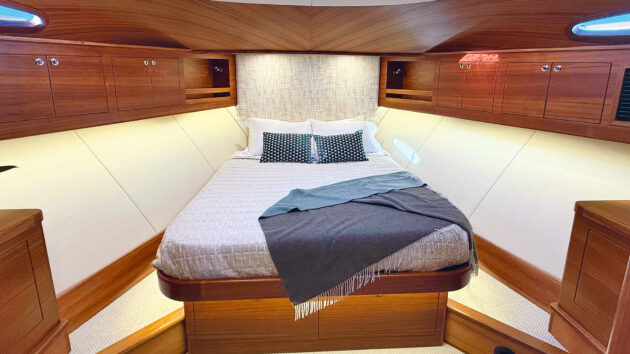
The forward owner’s cabin lacks the volume and views of a full beam midships master but is no less comfortable or stylish for it
There’s even a beautifully crafted handrail running the length of the ceiling. Two other features we liked are the skipper’s door next to the helm and the big electric windows amidships. With everything opened up, this area is as bright and breezy in summer as it is warm and cosy in winter.
There is an option to move the galley downstairs in exchange for slightly larger dining and lounging areas but this will likely be decided by your preferred cabin layout. With the galley down, there is only room for two large ensuite cabins, whereas with it up you gain a third small double. Even then, it’s not a straightforward choice as the three-cabin layout puts the owner’s suite in the bow with the two guest cabins amidships, whereas the two-cabin version sees the owner’s suite shift amidships with a slightly smaller VIP in the bow.
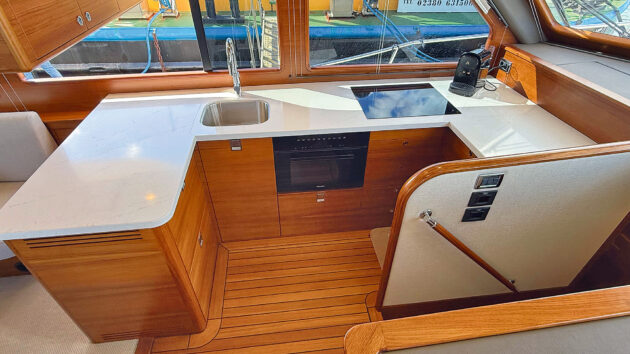
The galley up layout enables the chef to feel part of the action
Whichever option you choose, you still won’t get a full-beam owner’s mid-cabin. That’s down to Grand Banks’ insistence on locating the engines well forward to achieve that vital flat running angle. There isn’t enough room ahead of them to factor in a full-beam ensuite mid-cabin plus a bow cabin and stairwell. Whether that bothers you is a matter of personal taste; our test boat had the three-cabin layout and while the forward owner’s cabin lacks the floorspace and big windows of a full beam owner’s suite, it’s no less smart or comfortable.
The midships twin is also unexpectedly generous with full-width single beds, plenty of headroom and a very spacious ensuite bathroom. The third cabin is definitely the short straw with a rather slim double bed, limited headroom and, in our test boat, a large washer dryer tucked next to it. You also have to tramp through one of the other cabins to use the heads as neither of the ensuites has a second door into the corridor.
The fit and finish is exemplary, as is storage, with under-floor bilge lockers in the corridor, drawers under the stairs and a walk-in wardrobe in the owner’s cabin. There’s also a huge lazarette under the cockpit in addition to an immaculate engineroom.
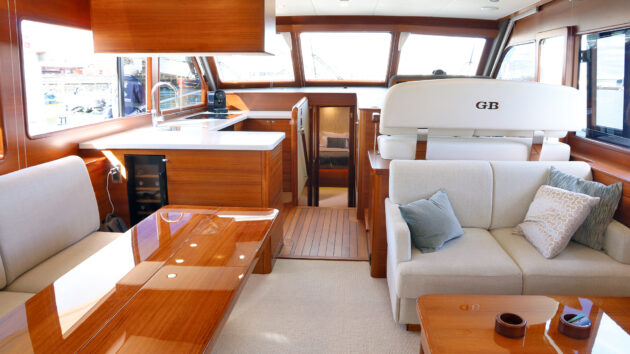
Electric drop-down side and aft windows allow plenty of light and fresh air into the saloon. The eye level locker above the galley does create a blind spot to port
Performance underway
Most planing boats now feature a modified or ‘warped’ vee hull with a sharp deadrise angle at the bow that flattens off to a medium vee at the stern but Grand Banks’ V-Warp hull is more extreme. Featuring a very fine entry with a pronounced flare amidships and an unusually flat stern (just 6 degrees at the transom), it’s designed to part the waves then disperse the water sideways without dragging a deep trench behind it.
To maintain this running angle and maximise fuel efficiency, it not only needs to be kept light but the centre of gravity also needs to be as low and central as possible – hence the positioning of the engines. To achieve the weight target the hull is moulded using vacuum infusion of a foam-cored e-glass sandwich, while the decks, superstructure and hard top are full carbon composite.
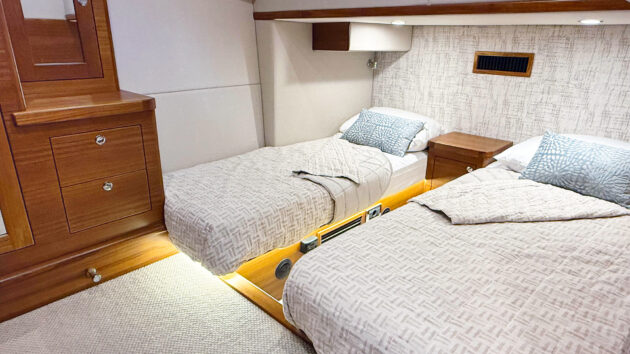
A generous twin with plenty of space and headroom
All the bulkheads and major furniture mouldings are also fused directly to the hull rather than bonded with tabs. The result is an immensely rigid structure that even when fitted with all that chunky wood, steel and marble weighs a spritely 25.5 tonnes – almost 8 tonnes less than the Grand Banks 53 and nearly 7 tonnes less than a Princess F58.
Combined with that slippery hull, the results are transformational. The semi-displacement 53 used to run out of steam at 22 knots; our test boat topped out at 31.4 knots. Admittedly it was fitted with 900hp Volvo D13s rather than the standard 725hp D11s (the 53 had 715hp Cummins) but the difference is night and day.
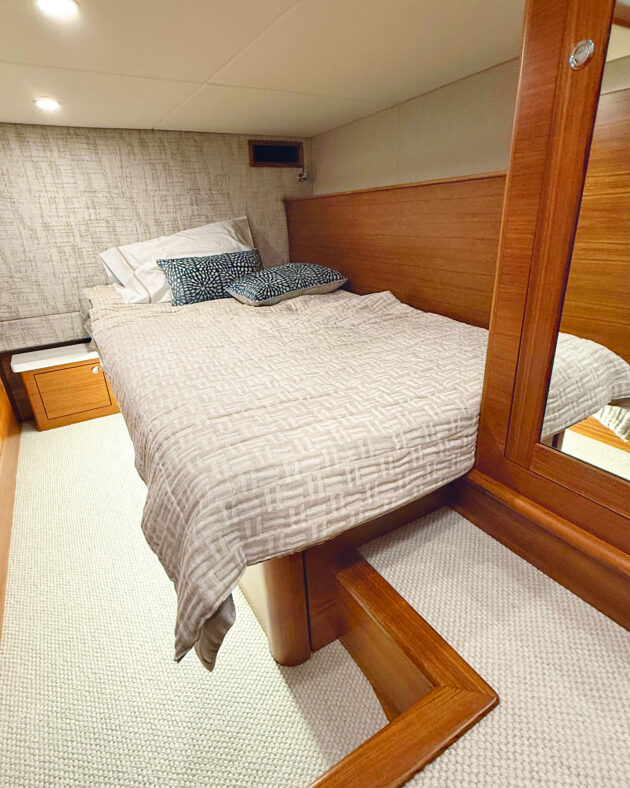
This small double is less spacious
The Princess F58 with its big 1,200hp MANs does eventually outrun it but at a price – at 25 knots the Princess is burning around 350 litres per hour whereas the Grand Banks is consuming 241lph.
If the figures tell part of the story, the driving experience tells the rest. Even at a 650rpm idle, it slips through the sea so easily they’ve fitted it with a trolling valve to slow it down when manoeuvring around the marina. But the magic really starts to happen when you put the throttle down; instead of the stern squatting and the bow pointing skywards while it struggles to climb onto the plane, the GB54 accelerates with the poise and grace of a dolphin.
There is no obvious transition from displacement to planing, the bow lifts a couple of degrees and stays there while the speed keeps on rising. The joy of this is that you can pick whatever speed you like, knowing that the boat will remain utterly poised and the fuel curve will rise predictably.
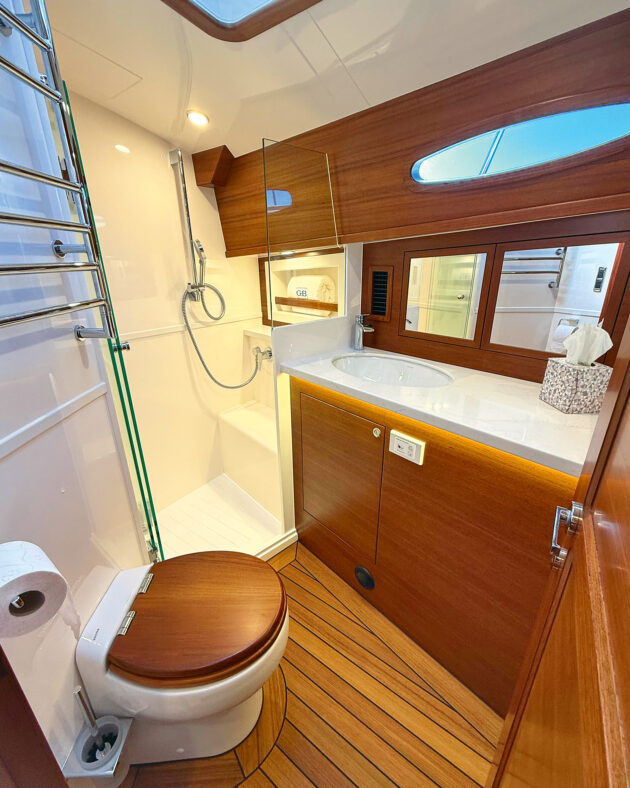
Both bathrooms are large, stylish and fitted with heated towel rails and full size electric toilets
It’s also surprisingly agile. Half a turn of the wheel is enough to send it pirouetting into a bend with the agility of something half its size. At 25 knots it can pull a 360° spin in less than a couple of boat lengths. The automatic Humphree fins and stabilisers help, but the hull and rudders are doing the bulk of the work. It makes other trawlers feel cumbersome and would embarrass the majority of modern flybridge boats too.
Remarkably, this doesn’t come at the cost of an overly firm ride. The conditions for our test weren’t that challenging but even when charging over our own wake or piling through the tidal race off Hurst Point we couldn’t provoke a slam or shudder. You’d need a big sea to find out whether it can match the surefootedness of the old GB53, but it feels just as solid and squeak-free as the Grand Banks of old.
Grand Banks 54 specifications
LOA: 58ft 0in (17.68m)
BEAM: 17ft 7in (5.4m)
DRAFT: 4ft 3in (1.3m)
DISPLACEMENT: 25.5 tonnes
FUEL CAPACITY: 3,500 litres
WATER CAPACITY: 1,000 litres
HOLDING TANK: 250 litres
ENGINES: 2 x Volvo Penta 725-900p or IPS800
Grand Banks 54 costs and options
Base price: $3.92m ex taxes
Upgrade to 900hp Volvo D13: $53,500
Faux teak transom: $7,500
Humphree fin stabilisers: $95,700
Garmin electronics package: $79,400
Central heating system: $52,000
Northern Lights generator: Std
Walker Bay tender and engine: Std
 If you enjoyed this….
 If you enjoyed this….
Motor Boat & Yachting is the world’s leading magazine for Motoryacht enthusiasts. Every month we have inspirational adventures and practical features to help you realise your sailing dreams, as well as tests and news of all the latest motorboats.
Plus you’ll get our quarterly Custom Yachting supplement where we share the last on offer in the superyacht world and at the luxury end of the market.
Build your knowledge with a subscription delivered to your door. See our latest offers and save at least 30% off the cover price.
Note: We may earn a commission when you buy through links on our site, at no extra cost to you. This doesn’t affect our editorial independence.
Verdict
Any concerns we had that in embracing the new Grand Banks may have lost a little too much of the old have been quashed. All the things we admired about Grand Banks, such as the solid build quality, sea-kindly ride, secure decks and practical layout are as good as ever but now they come with an added dose of performance, a more engaging drive and remarkably frugal fuel consumption. It still won’t be to everyone’s taste, due to Grand Banks’ prioritisation of seakeeping over cabin size and numbers, nor can we overlook its premium pricing, however justifiable it may be. But for those who want to go places in speed, comfort and style, few boats can match the GB54’s depth of talent.